60-Day Follow-Up Talks Become the Real Battle: Tough Road Ahead for Iran's Nuclear Issue and Frozen Funds [U.S.-Iran Ceasefire]
- Input
- 2026-06-15 18:26:45
- Updated
- 2026-06-15 18:26:45
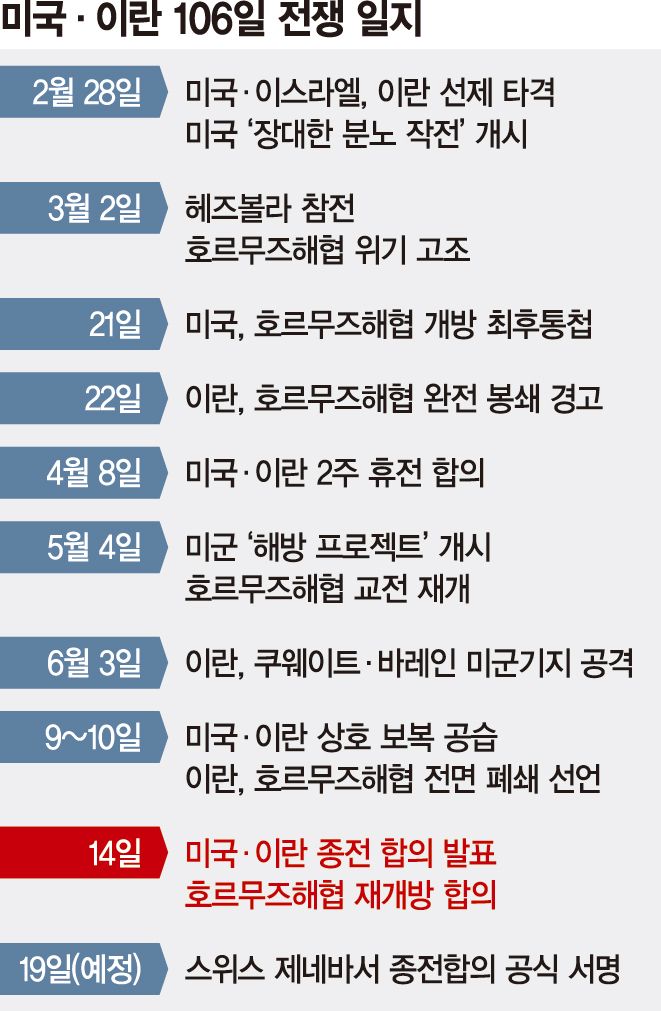
During this period, the two sides will enter detailed negotiations on a final nuclear agreement and the lifting of U.S. sanctions on Iran. The deal also includes talks on a plan for Iran to recover half of its $24 billion in frozen assets first, and the remaining half during the 60-day negotiations. The agenda includes a halt to uranium enrichment, disposal of highly enriched uranium stockpiles, easing of sanctions on Iran, and an economic reconstruction program for Iran. Iran's missile program is also expected to be left out of the talks.
■ The handling of the nuclear program is the biggest challenge
The fiercest front will undoubtedly be the issue of Iran's nuclear program. The United States says it wants to block any possibility of Iran becoming a nuclear-armed state at the source. Its demands are clear. It wants the immediate removal from the country, or permanent destruction, of all nuclear material Iran has enriched so far, including highly enriched uranium. It also wants a strict post-deal control mechanism that would permanently ban any future nuclear material enrichment inside Iranian territory. On highly enriched uranium, Washington has already softened its stance by agreeing to destruction inside Iran. But it remains uncompromising on post-deal controls, including a ban on any further nuclear material enrichment.
Iran, by contrast, says keeping enriched uranium at home and maintaining a nuclear program for peaceful purposes are sovereign rights it can never give up.
Another major hurdle is the release of Iran's funds, estimated at at least $100 billion, that remain frozen overseas. For Iran, which is suffering from economic hardship, the immediate inflow of money and the lifting of economic sanctions are the main reasons it agreed to the ceasefire talks. It is therefore hoping for a swift release of funds.
The U.S., however, is insisting on a 'step-by-step for step-by-step' principle, under which frozen funds would be released gradually depending on Iran's compliance, such as denuclearization measures. The tug-of-war between Iran, which wants to quickly recover the frozen money to revive its battered economy, and the U.S., which wants to keep it as a sanctions lever, will be a key point to watch.
Iran has presented the release of 'frozen Iranian funds' as a precondition for negotiations. In response, a U.S. government official told CNN on the 15th that Iran's claim was false. The official said, "This is an agreement to disburse frozen funds based on performance. If the Iranian side does not fulfill its obligations, the frozen funds will not be released."
■ The release of Iran's frozen funds is also a key issue
The English-language edition of Iran's semi-official Mehr News Agency on the 14th published an explanation of the draft memorandum of understanding conveyed by Mohammadi, the chief strategic adviser to the head of Iran's negotiation team. Mohammadi outlined a draft agreement consisting of 14 items.
He said Iran is currently providing various services in the Strait of Hormuz, including safety, navigation, and security, and collecting fees for them. "The right to collect such fees belongs solely to Iran and Oman, and no other party has the authority to make decisions on this matter," he stressed. The first clause of the draft is a current ceasefire provision on all fronts, including Iran and Lebanon. It also includes the lifting of the U.S. blockade of the Strait of Hormuz.
He also referred to a proposed development and reconstruction fund worth $300 billion. The document used the term "reconstruction." The Iranian side emphasized restoring damage.
Mohammadi stressed that the other side's demands regarding Iran's nuclear program are currently limited to highly enriched nuclear material, and that no discussion is taking place on other aspects of Iran's nuclear activities. He also said the issue of Iran's missiles and proxy forces has been excluded from the negotiation agenda.
■ Attention turns to the main negotiations after the MOU signing
He added that even if the two sides reach a final agreement, Iran's obligations would be limited to a pledge not to build nuclear weapons and to resolving the issue of its 60 percent enriched uranium stockpile through a formula proposed by Tehran.
In that context, Mohammadi said the 'dilution' of nuclear material is being discussed. "Even if the material is diluted, it will remain inside the country, and if necessary, it can be restored to a higher enrichment level within a short time," he said. He explained that under this MOU, Iran has no immediate nuclear-related measures to take.
"Everything has been pushed into the future. First, we need to see whether the other side lifts the blockade, releases frozen assets, suspends oil sanctions, and ends the war in Lebanon. If those things happen, then we can think about the next step," he said.
[email protected] Reporter