Middle East Orders Down 90% So Far This Year; Expectations Rise for Benefits From Reconstruction Boom and Resumed Projects [U.S.-Iran End of War]
- Input
- 2026-06-15 18:23:00
- Updated
- 2026-06-15 18:23:00
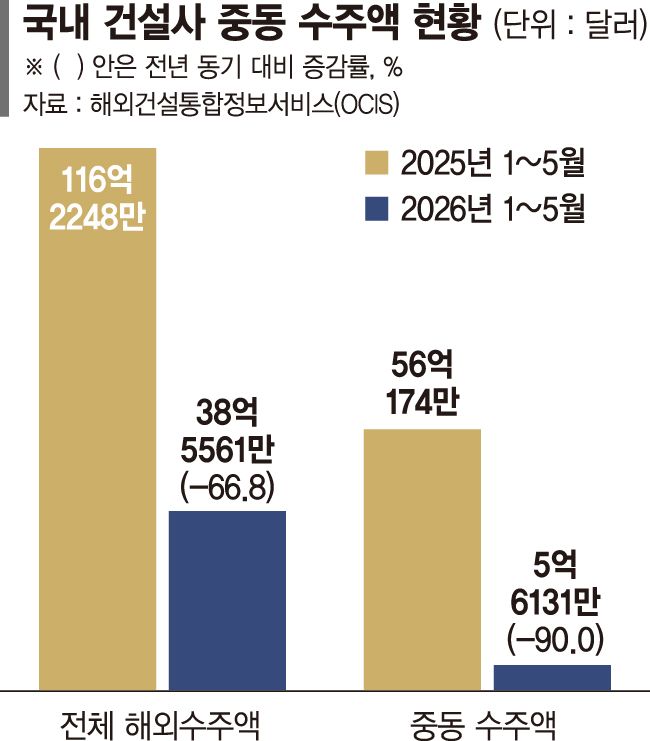
According to the Overseas Construction Integrated Information Service (OCIS) on the 15th, overseas orders won by South Korean construction companies from January to May this year totaled $3.85561 billion. That was down 66.8% from $11.62248 billion in the same period last year.
The contraction in the Middle East market was especially pronounced. Orders from the region came to $561.31 million this year, down 90.0% from $5.60174 billion in the same period last year. Its share of total overseas orders also fell sharply, from 48.5% to 14.6%. Because the Middle East accounted for nearly half of all overseas orders last year, the industry feels the slowdown even more acutely.
By country, the declines in Saudi Arabia and the United Arab Emirates (UAE) were steep. Orders from Saudi Arabia fell from $2.67959 billion last year to $55.88 million this year, while those from the UAE dropped from $2.39218 billion to $455.52 million. Qatar also saw a decline, from $385.17 million to $28.07 million.
The industry attributes the slump to a combination of geopolitical uncertainty and investment adjustments by major client countries. Still, there is hope that if the end of the war becomes a reality, delayed projects could move forward again. Planned plant and infrastructure projects may resume, and future demand for reconstruction and recovery could also emerge.
An official at the International Contractors Association of Korea (ICAK) said, "Delayed projects may be pushed ahead again, and reconstruction demand could also emerge." The official added, "For facilities that Korean companies have already built, they may have a relative advantage in recovery work."
Others, however, said it is difficult to directly link the end of the war with a recovery in Middle East orders. An industry official said, "It is true that the war had a major impact, but even before that, major client countries were already adjusting project plans and cutting investment." The official added, "It is too early to be optimistic about an immediate recovery in the order market just because the war has ended."
Lee Eun-hyung, a Research Fellow at the Korea Research Institute for Construction Policy (RICON), said, "Even if the war ends, reconstruction projects will not be ordered right away." He added, "It will take considerable time before actual construction orders are placed and won."
He also noted, "If uncertainty in the Middle East eases and conditions for raw materials and logistics stabilize, that could be a positive factor for the construction industry."
[email protected] Jang In-seo Reporter