High oil prices expected to persist even after the war ends, keeping inflation elevated for now [U.S.-Iran ceasefire]
- Input
- 2026-06-15 18:20:25
- Updated
- 2026-06-15 18:20:25
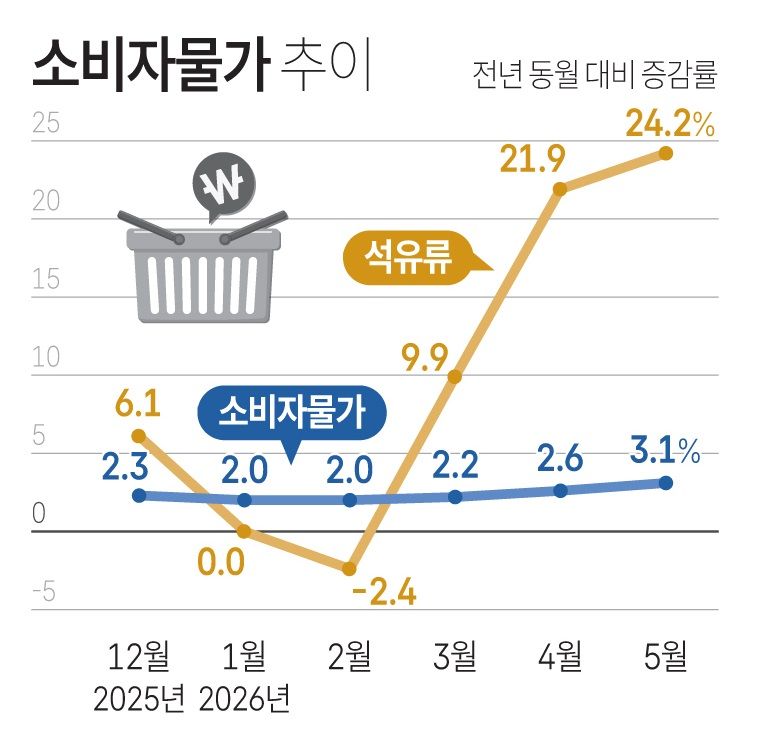
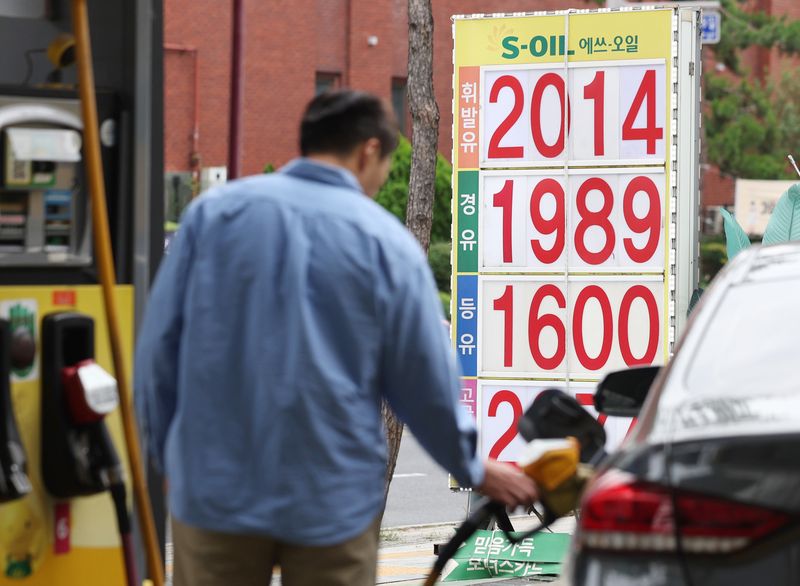
Attention is focused on whether domestic consumer prices, which surged into the 3% range, can return to stability following the U.S.-Iran ceasefire agreement. The 3% inflation rate is the result of a policy that artificially suppressed petroleum product prices, which had jumped more than 20% because of the Middle East war, through government spending. If international oil prices stabilize in the $60 to $70 per barrel range after the war ends, domestic inflation could fall to the low 2% range, in line with earlier forecasts, as early as the fourth quarter.
However, because price indicators tend to lag, it will take at least several months to rebuild oil production facilities and export terminals in the Middle East and to normalize logistics networks. Continued weakness in the won-dollar exchange rate and persistently high import prices, along with stronger consumption as domestic demand recovers, are likely to keep inflation in the 3% range for now.
The oil price cap, which helped cut consumer inflation by as much as 0.8 percentage point, is likely to end as early as July, given the growing fiscal burden.
According to the government and others on the 15th, consumer inflation this year is expected to average in the upper 2% range, supported by international oil prices that remain above last year’s levels and an economic recovery driven by the semiconductor boom. Core inflation, excluding food and energy, is also projected to be around 2.5% this year.
The latest data that directly reflected the Middle East war showed consumer prices rising 3.1% in May from a year earlier. That was the sharpest increase since March 2024, when inflation also stood at 3.1%.
If the Middle East war, a direct driver of high inflation, comes to an end and the Strait of Hormuz reopens, domestic prices are expected to stabilize quickly as international oil prices fall.
Still, with about 70% of crude oil imports dependent on the Middle East, the pace of restoring oil transport through the Strait of Hormuz and rebuilding supply chains and production facilities in Iran and elsewhere will be crucial.
A review of expert analysis suggests that it will take at least two to three months for Middle Eastern oil supply and logistics to normalize, and it will not be easy for crude volumes passing through the Strait of Hormuz to fully recover to the prewar daily average of 20 million barrels. Dubai crude, which traded between $63 and $72 per barrel from March to May last year, is widely expected to remain above $90 for a considerable period even after the ceasefire.
Ma Chang-seok, a researcher at KDI, said that based on a scenario in which international oil prices, measured by Dubai crude, stabilize quickly from $95 to $80 per barrel between the second and fourth quarters, "relief from inflation pressure caused by oil prices will begin in earnest next year."
Because prices lag behind production and imports, the 3% rise is expected to continue for some time. In addition, several domestic factors are waiting in the wings, including increased travel during the summer vacation season, a surge in energy use for cooling, and greater volatility in agricultural, livestock and fishery product prices due to the rainy season and heat waves. Strong consumer sentiment, fueled by the semiconductor boom, record stock market gains and expectations of economic growth in the 2% range, is also adding to price pressures.
The biggest wildcard replacing international oil prices is the strong won. The won’s continued weakness in the 1,500 range is pushing up import prices for energy and raw materials, and those costs are spreading to overall consumer prices. On top of that, nearly 5 trillion won in high-oil-price support funds will be distributed through September, and strong spending sentiment among some groups, driven by the semiconductor and stock market booms, is expected to make inflation harder to bring down.
[email protected] Jung Sang-gyun Reporter