"Sidecars Are Part of Daily Life"... KOSPI Volatility Has Surpassed the GFC
- Input
- 2026-06-15 16:18:41
- Updated
- 2026-06-15 16:18:41
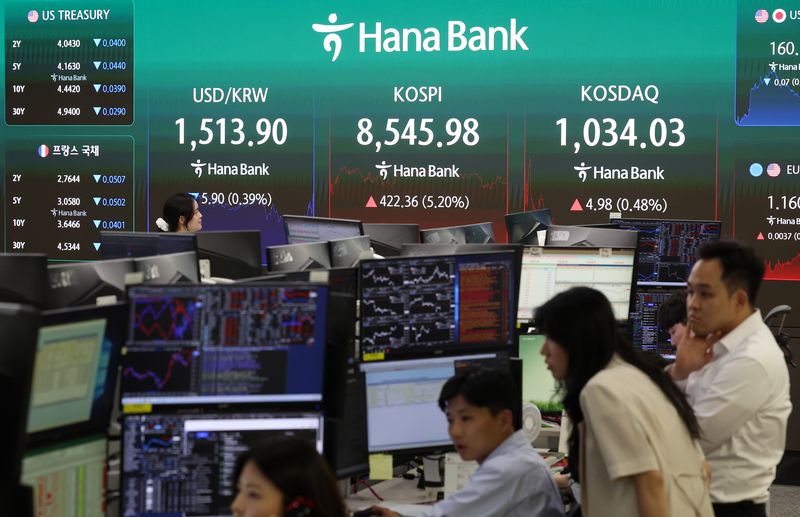
[Financial News] The South Korean stock market has recently been experiencing even sharper volatility than during the Global Financial Crisis (GFC). Analysts say the market is being shaken by large semiconductor stocks that account for nearly half of KOSPI's market capitalization, along with leveraged trading flows.
■ Fear in the stock market hits an all-time high According to the Korea Exchange (KRX) on the 15th, the KOSPI 200 Volatility Index (KOSPI 200 Volatility Index) closed at 87.73. During the session, it even hit an all-time high of 94.25. The index, often called Korea's fear gauge, measures expected market volatility reflected in options prices. In the securities industry, a reading in the 50 to 60 range is seen as a warning sign of systemic risk, when investors lose rational judgment and rush to sell. A reading in the 70 to 80 range is viewed as an uncontrollable panic phase in which even government stimulus measures fail to work.
From the 9th through the 15th, however, the KOSPI 200 Volatility Index stayed above 87 for five straight trading days. On the 9th, it reached 91.23. Breaking above 90 on a closing basis was the first time since the index began official calculation. It had previously reached 83.58 shortly after the outbreak of the United States–Iran War on March 5 this year, while the peak during the 2008 GFC was 89.30.
Sidecars triggered by sharp market swings have also become routine. Early in the session that day, a temporary suspension of program buy orders, or a buy sidecar, was activated on KOSPI. Sidecars have been triggered for seven consecutive trading days in the South Korean stock market, surpassing the previous longest streak of six trading days set during the outbreak of the United States–Iran War from March 3 to 10. In the KOSPI market, a sell sidecar was triggered on June 5, followed by a sell sidecar and a circuit breaker mechanism on the 8th, a buy sidecar on the 9th, a sell sidecar on the 10th, a buy sidecar on the 12th, and another buy sidecar on the 15th. In the KOSDAQ market, a sell sidecar and circuit breaker mechanism were triggered on June 8, followed by buy sidecars on the 9th and 11th. So far this year, KOSPI sidecars have been triggered 26 times in total, matching the record set during the 2008 financial crisis, while KOSDAQ sidecars have been triggered 14 times.
■ "The volatile market is not over yet" The recent rise in volatility is being attributed to an extreme concentration in large-cap stocks and single-stock leverage. As of that day, Samsung Electronics and SK hynix together accounted for 53.97% of KOSPI's market capitalization, well over half. With half of the index tied to the movements of just two stocks, the entire market has become vulnerable to even small shifts in the global tech cycle.
Volatility has increased further as a large number of single-stock leveraged exchange-traded funds (ETFs) tracking Samsung Electronics and SK hynix have been listed. Because leveraged ETFs track multiples of daily returns, rebalancing takes place each day near the time net asset value (NAV) is calculated before the market close. As the size of the funds grows and the daily price swings of the underlying assets widen, the scale of trading tied to rebalancing also increases. In fact, the 3rd through 6th most traded products by turnover this month were single-stock leveraged ETFs tied to Samsung Electronics and SK hynix. The only products with higher trading value were KODEX Leverage, a leveraged ETF tracking the entire KOSPI, and KODEX 200, which follows the KOSPI 200 Index.
Experts warned that the volatile market could continue for some time. Lee Jae-won, a researcher at Yuanta Securities Korea Co., Ltd., said, "The current volatility has not been fully resolved," adding that major monetary policy meetings, including those of the Federal Reserve System (Fed) and the Bank of Japan (BOJ), could act as volatility triggers.
Lee Sang-hyun, a researcher at Meritz Securities Co., Ltd., said, "The higher the KOSPI 200 Volatility Index, the wider the daily return swings can be, so a single decision can have a much bigger impact than before." He added, "If you invest through leveraged or leveraged inverse ETFs, volatility can be twice as large, so even greater caution is needed."
[email protected] Han Young-joon Reporter