"The Minimum Wage Should Be 12,000 Won an Hour": Labor Unions Submit Their Demand for Next Year
- Input
- 2026-06-15 15:06:07
- Updated
- 2026-06-15 15:06:07
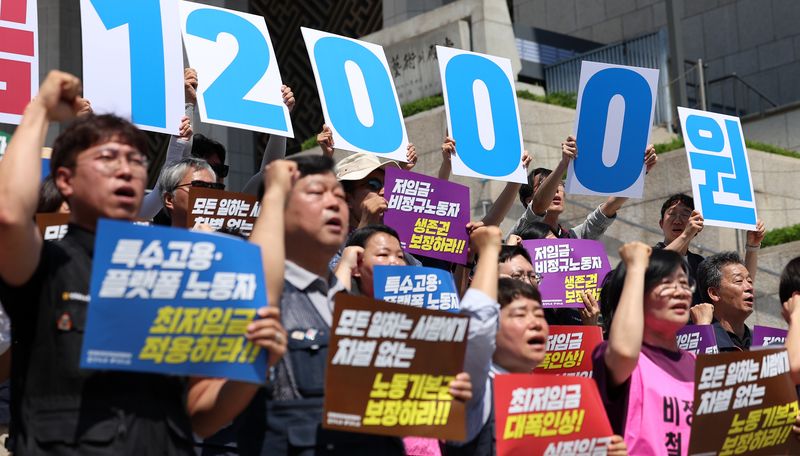
The labor sector plans to pressure the government and lawmakers to revise laws and institutions, including abolishing the reduced minimum wage applied to trainees and workers with disabilities, and extending minimum wage coverage to special-type workers, platform workers and freelancers.
The Federation of Korean Trade Unions (FKTU) and the Korean Confederation of Trade Unions (KCTU) held a press conference at the Sejong Center for the Performing Arts in Seoul's Jongno-gu on the 15th and unveiled their labor and civic groups' demand for the 2027 minimum wage.
The unions' initial demand for the 2027 minimum wage is 12,000 won. Based on 209 working hours a month, that comes to 2,508,000 won.
The labor sector argues that over the past three to four years, minimum wage increases have fallen short even of the rise in real inflation indicators, meaning the combined rate of economic growth and inflation. It also cited the recent tilt toward capital-driven asset accumulation in the stock market and disputes over performance bonuses as evidence that the value of labor is being undermined, using that as a basis for a sharp increase.
Ryu Gi-seop, secretary general of the FKTU, argued that "a sharp increase in the minimum wage is a practical measure to address polarization, even just to ease this polarized structure in which wage gaps are hard to close with labor income alone." Lee Mi-seon, vice chair of the KCTU, also stressed that "this amount, 12,000 won, is the minimum cost of survival for low-wage workers to make it through an era of high prices."
They also called on the government and lawmakers to improve laws and institutions. Their position is that the Minimum Wage Act should be revised to abolish industry-specific application and the review provisions related to reduced or excluded minimum wages for trainees and workers with disabilities. On extending minimum wage coverage to subcontracted workers such as special-type workers, platform workers and freelancers, which failed to be implemented next year, they said the government and lawmakers must prepare countermeasures and amend the Labor Standards Act.
They rejected the business community's argument that higher minimum wages are passed on as hardship for small business owners and the self-employed. The labor sector says the issue of raising the minimum wage and easing difficulties for the self-employed should be treated separately, and that support measures for the self-employed should be pursued alongside minimum wage talks.
As solutions to the difficulties faced by the self-employed, the labor sector proposed reintroducing the Employment Stabilization Subsidy, cutting various fees including platform commissions, and revising the Act on the Fair Transactions in Subcontracting and the Act on the Promotion of Mutually Beneficial Cooperation between Large Enterprises and Small and Medium Enterprises.
The Minimum Wage Commission is scheduled to hold its sixth plenary session on the 16th and review whether to apply different minimum wages by industry next year. Inside and outside the business community, expectations are that full-scale discussions on next year's minimum wage increase will begin in late June.
[email protected] Kim Jun-hyeok Reporter