'After Iran, North Korea'... Trump’s post-war diplomacy with North Korea could be back on the table
- Input
- 2026-06-15 14:37:45
- Updated
- 2026-06-15 14:37:45
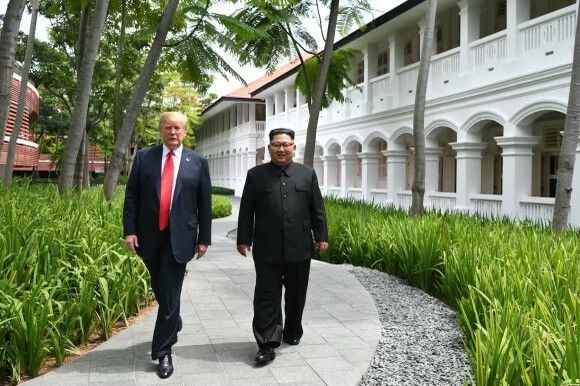
On the 13th, Trump posted a photo on Truth Social showing him walking side by side with Kim at the site of their Singapore summit eight years ago, without any explanation. That immediately fueled expectations that Trump may move to wrap up the Iran war before pursuing another U.S.-North Korea summit.
Earlier, the Peaceful Unification Advisory Council (PUAC), which is affiliated with the presidency, had predicted the possibility of dialogue between the United States and North Korea around the time of the U.S. midterm elections on Nov. 3.
At a press briefing on the 10th, Kang Chang-il, Senior Vice Chairperson of the Presidential Council on Peace and Unification, said, "When President Trump visited China last month, he had no room to spare because of the Iran war," and predicted that he would turn to North Korea issues after the war ends. Trump has continued to send friendly messages to Kim even after the launch of his second administration.
A Ministry of Unification (MOU) official said, "There are various views on the outlook for U.S.-North Korea dialogue, but we will refrain from making assumptions and continue to watch closely."
However, North Korea has continued advancing its nuclear capabilities while drawing closer to China and Russia.
After Trump visited Beijing last month and held a summit with Xi Jinping, President of China, the White House released a fact sheet saying the two sides had "confirmed the shared goal of denuclearizing North Korea." Pyongyang rejected that claim. Instead, North Korea has been focusing on solidarity with China since Xi’s visit to Pyongyang, the first in seven years. Xi held a North Korea-China summit with Kim in Pyongyang on the 8th and 9th, but made no mention of denuclearization, leading some to interpret the move as China effectively recognizing North Korea as a nuclear-armed state.
Meanwhile, the Trump administration has shown a sense of déjà vu by attending a G7 Summit before major talks with both North Korea and Iran.
Trump will attend the three-day G7 Summit in Evian-les-Bains, France, starting on the 15th. A ceasefire agreement between the United States and Iran is then expected to be signed in Geneva on the 19th.
Eight years ago, before his summit with Kim in Singapore, Trump also attended the G7 Summit in Quebec first. After finishing the G7 schedule in Canada, he flew directly to Paya Lebar Air Base in Singapore.
The 2018 Singapore summit was the first meeting between the leaders of the United States and North Korea in 65 years, following the 1953 Korean Armistice Agreement. After the talks, the two sides abruptly agreed on four points: complete denuclearization of the Korean Peninsula, guarantees for a peace regime, efforts to normalize U.S.-North Korea relations, and the repatriation of war dead remains.
However, the second U.S.-North Korea summit, held in Hanoi, Vietnam, in February 2019 to discuss detailed implementation measures for the Singapore agreement, ended without results. After Trump lost the 2020 United States presidential election, the agreement between the two sides effectively lost force.
[email protected] Kim Kyung-soo Reporter