Labor groups demand a minimum wage of 12,000 won next year, or 2.508 million won a month
- Input
- 2026-06-15 13:03:34
- Updated
- 2026-06-15 13:03:34
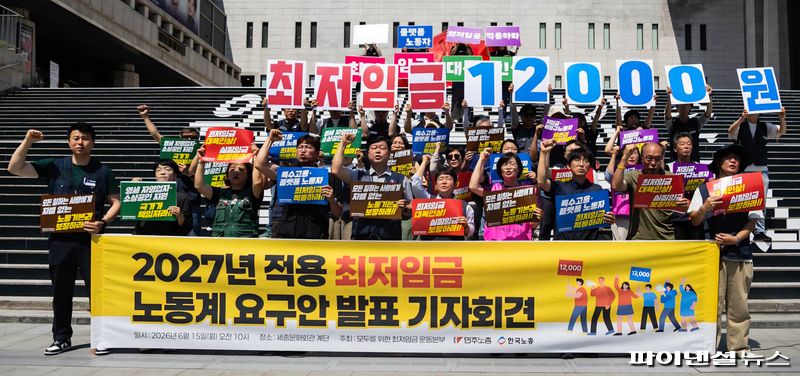
On the morning of the 15th, the Federation of Korean Trade Unions (FKTU), the Korean Confederation of Trade Unions (KCTU), and the Solidarity Headquarters for the Minimum Wage for All held a press conference titled "The labor sector's first demand proposal for the minimum wage to be applied in 2027" on the steps of the Sejong Center for the Performing Arts in Jongno District, Seoul.
Labor groups said recent minimum wage increases have failed to keep pace with inflation, deepening the burden on low-wage workers. According to the campaign headquarters, the average minimum wage increase over the past three years from 2023 to 2025 was 2.37%, lower than the average inflation rate of 2.66% during the same period. In particular, last year’s minimum living cost, as calculated by the Minimum Wage Commission, was 2.754 million won a month, while the monthly minimum wage converted to a monthly basis was around 2.15 million won, leaving the coverage rate at just 78.3%. They also stressed that the hourly equivalent of the appropriate actual living cost for next year is 13,737 won, meaning their proposed 12,000 won is only 87.4% of that amount.
Ryu Gi-seop, secretary-general of the FKTU, said, "This is the minimum social demand based on common sense: how can the minimum hourly wage be lower than the price of one lunch?" He added, "In an atmosphere where more attention is being paid to investment returns than to income earned through labor, the value of work is being undervalued. In a situation where wage gaps are hard to close through labor income alone, a sharp increase in the minimum wage is a practical measure to ease polarization."
Lee Mi-seon, vice chair of the KCTU, also said, "An hourly wage of 12,000 won is the minimum cost of survival for low-wage workers in an era of high prices and high fuel costs." She added, "When workers have less money in their pockets, consumption falls. So raising the minimum wage is not just a workers' issue; it is a way to revive the local economy."
The labor sector also argued that workers in the minimum wage blind spot should be brought into the system. The point is that special employment, platform, and freelance workers such as delivery riders, designated drivers, parcel couriers, and private tutors are effectively dependent on employers, yet still do not receive minimum wage protection. The Minimum Wage Commission previously rejected a proposal to expand minimum wage coverage to contract-based workers.
Lee Nam-shin, co-representative of the Korean Non-Regular Workers' Center, said, "Now is the time for the government and the National Assembly to fulfill their responsibilities so that the millions of special employment and platform workers who sometimes lose their lives on the job and are not properly paid for their work can work with pride." He added, "Relevant laws should be revised quickly so that expanded minimum wage coverage for special employment and platform workers can definitely take effect next year."
They also proposed removing discriminatory elements from the minimum wage system, including abolishing industry-specific wage differentiation, improving wage cuts and exemptions for trainees and workers with disabilities, and strengthening measures to prevent and punish unpaid wages.
There were also calls for support measures for small business owners and the self-employed. Labor groups proposed reintroducing the Employment Stabilization Subsidy, lowering platform and franchise fees, and revising the Act on the Fair Transactions in Subcontracting and the Act on the Promotion of Mutually Beneficial Cooperation between Large Enterprises and Small and Medium Enterprises to address management difficulties faced by small business owners and the self-employed. Kim Eun-jung, executive secretary at People's Solidarity for Participatory Democracy, said, "Raising the minimum wage and protecting the self-employed are not conflicting goals." She added, "The minimum wage must hold up so that consumption can recover and the self-employed can also survive. What is needed is not to divide workers and the self-employed, but to correct unfair market structures and ease the burden on small business owners."
[email protected] Park Seong-hyeon Reporter