Foreign investors who sold 74 trillion won worth of stocks turn to a 2 trillion won buying spree... Can the KOSPI break through its all-time high on hopes for an end to the war?
- Input
- 2026-06-15 06:25:44
- Updated
- 2026-06-15 06:25:44
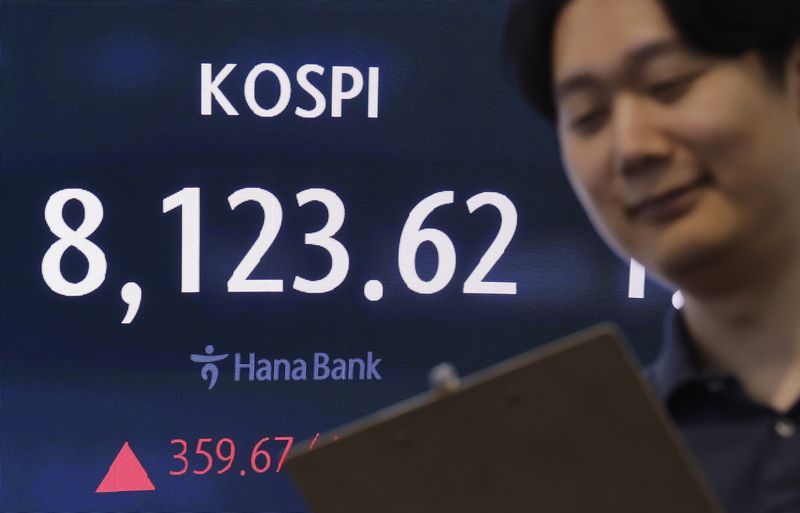
[Financial News] Hopes that geopolitical risks in the Middle East will ease, combined with signs of improving foreign investor flows, have put the domestic stock market to a crucial test as it seeks to break through its previous peak.
According to the securities industry on the 15th, the KOSPI experienced extreme roller-coaster trading throughout last week. On the 8th, it plunged as low as the 7,400 level intraday, triggering a circuit breaker. Then, on the very next day, the 9th, it surged more than 8%, triggering a buy-side sidecar. Volatility reached a peak. In the end, the KOSPI finished last week at 8,123.62, slightly lower than the previous week.
What stands out most is the return of foreign investors, the key force behind market flows. Foreign investors had weighed on the market by selling a net 74 trillion won worth of stocks for 24 straight trading days starting on the 7th of last month. But on the 12th alone, they switched to net buying of more than 2.2 trillion won. The market is interpreting this as a sign that the won-dollar exchange rate is stabilizing and risk appetite is recovering on hopes of an end to the war between the United States and Iran.
The first major variable that will determine the direction of the domestic market this week is clearly the 'United States-Iran ceasefire negotiations.' If the talks are settled smoothly, international oil prices, bond yields and the US dollar are expected to stabilize at lower levels, providing a powerful tailwind for global equities. On the other hand, if friction emerges during the negotiations, there is also a risk that profit-taking will hit recently surging semiconductor and growth stock names.
The second key factor is the Federal Open Market Committee (FOMC) meeting scheduled for the 18th local time. The market already assumes that the benchmark interest rate will be left unchanged, but investors are closely watching changes in the dot plot, which shows Fed officials' future rate outlook, as well as the tone of the first press conference by newly appointed Fed Chair Kevin Warsh.
Experts say it is unlikely that Warsh, who took office after being nominated by President Donald Trump, will deliver an extreme hawkish message that shocks the market in his first appearance. Still, they warn that if he takes a conservative stance emphasizing price stability, short-term volatility will be unavoidable. Another factor that could affect domestic flows is the movement of global short-term funds following SpaceX's Nasdaq listing.
"Short-term swings are a buying opportunity... Expectations for the second-quarter earnings season remain intact"
Brokerages are warning about short-term volatility driven by major external events, but they still expect the KOSPI's medium- to long-term uptrend to remain intact. Daishin Securities set this week's KOSPI trading range broadly at 7,000 to 8,800, describing recent fluctuations as a process of cooling overheated leading stocks and absorbing supply.
In particular, the prevailing view is that the pre-earnings season for the second quarter, which will begin in earnest with Samsung Electronics' earnings guidance in the first week of July, will provide positive momentum. Kyung-min Lee, a researcher at Daishin Securities, stressed that the KOSPI's valuation remains in undervalued territory and said upward revisions to earnings forecasts will increase pressure for the index to rise.
Na Jeong-hwan, a researcher at NH Investment & Securities, also advised that "even if strong volatility emerges due to comments from Chair Warsh or noise surrounding the ceasefire talks, investors should use it as an opportunity to accumulate leading stocks such as semiconductors at lower prices."
[email protected] Moon Young-jin Reporter