"Jensen Huang Skips Japan": Nikkei Report Sparks Pessimism, with Some Saying, "Pathetic, Another Lost 30 Years"
- Input
- 2026-06-15 07:27:26
- Updated
- 2026-06-15 07:27:26
[Financial News] Concerns are growing in Japan that the country is losing competitiveness in the age of artificial intelligence (AI), after NVIDIA CEO Jensen Huang visited South Korea and Taiwan but left Japan off his itinerary.
Japan closely covers Jensen Huang's visits to South Korea and Taiwan
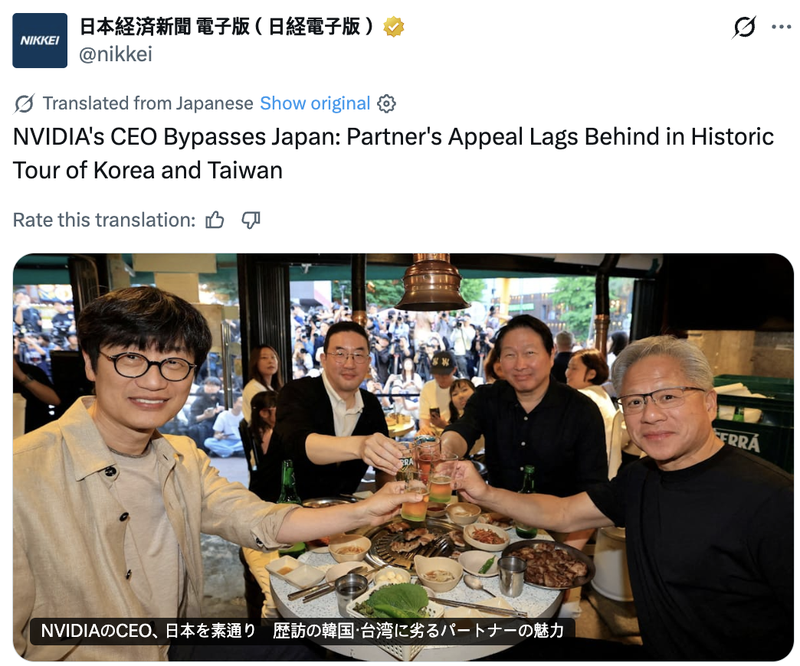
On the 14th, the Japanese business daily The Nikkei analyzed Huang's recent Asia tour and concluded that it "shows not only Japan's declining competitiveness in the semiconductor industry, but also the risk that Japan could fall behind in the AI revolution."
The article used a photo of Huang meeting with major business leaders in Hongdae on the evening of the 5th, his first day in South Korea, including Chey Tae-won, chairman of SK Group, Koo Kwang-mo, chairman of LG Group, and Lee Hae-jin, chairman of NAVER's board.
Huang visited his home country, Taiwan, late last month and stayed for about two weeks, meeting in succession with executives from major companies such as TSMC and Foxconn. He also announced plans to invest $150 billion annually, or about 227 trillion won, in Taiwan. He then visited South Korea, where he met with the heads of major groups such as SK and LG and took part in a television program shoot, keeping a packed schedule for three nights and four days. Japan, by contrast, was excluded from this Asia trip.
The Nikkei said Huang viewed South Korea and Taiwan as "key partners" and showed special interest in both countries. It pointed to the fact that NVIDIA, a fabless company without its own factories, relies on TSMC for most of its production and receives high-bandwidth memory (HBM), a core component for AI semiconductors, from SK hynix and Samsung Electronics. The paper described South Korea and Taiwan as "indispensable regions in NVIDIA's supply chain."
"Japan Is Losing Its Appeal as an AI Partner"
The report also said Japan's standing has weakened by comparison. The Nikkei noted that "Japan is less attractive as a partner than South Korea and Taiwan," adding that while Japan has strengths in semiconductor manufacturing equipment and materials such as wafers, there are not many companies directly connected to NVIDIA.
The lack of global companies in Japan capable of leading the AI industry was also cited as a limitation. The Nikkei said big tech firms such as Google and Microsoft are pouring huge sums into building data centers and buying NVIDIA chips in large quantities, but Japanese companies struggle to compete at that scale of investment.
The paper also said that while Japan continues to cooperate with NVIDIA, it still falls short of South Korea and Taiwan in terms of scale and influence.
It added, "Japan should ask itself how many companies are attractive enough for Huang to personally make time to visit," and stressed that "whether Japan can become a partner to leading companies like NVIDIA in the era of the AI revolution will determine the country's competitiveness and national wealth."
Japan's digital trade balance is in fact worsening. In April, METI projected that Japan's digital deficit, driven by rising imports of U.S. information technology (IT) services, would widen to 18 trillion yen, or about 170.7 trillion won, by 2035.
Japanese netizens say they were overtaken because of lazy education and egalitarianism
Local reaction in Japan to the news was also pessimistic.
Comments included, "It's only natural they would pass us by, since Japanese companies are far inferior to those in South Korea or Taiwan," and "It's so pathetic. We created a situation like another lost 30 years."
One Japanese netizen pointed out that while Japan has fallen into lazy education and egalitarian education that suppresses talent, China, South Korea, and Taiwan have actively promoted elite education in mathematics, science, and engineering as a "national strategy" and transformed their systems into technology-focused education.
[email protected] Seo Yoon-kyung Reporter