Industry Hit by High Exchange-Rate Shock... Cement Raw Material Prices Jump 37% [The New Normal Era of a 1,500 Won Exchange Rate]
- Input
- 2026-06-14 19:01:09
- Updated
- 2026-06-14 19:01:09
According to the Seoul foreign exchange market on the 14th, the won-dollar exchange rate has been fluctuating above the 1,500 won level this month. After reaching 1,532.0 won on the 4th, it climbed as high as 1,561.5 won during night trading on the 6th, showing no sign of easing.
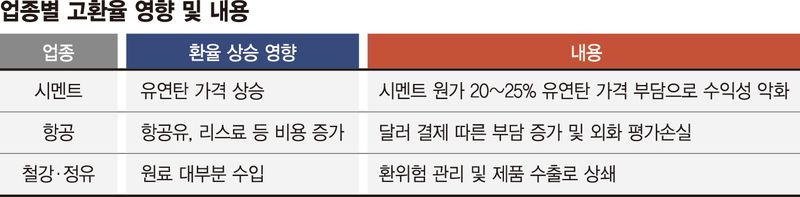
The cement industry is especially struggling with the strong won-dollar rate because import prices for thermal coal, the main raw material for cement, are also rising. Cement production requires limestone, clay and silica to be heated to 1,500 degrees Celsius, and thermal coal is essential in that process. Thermal coal is said to account for 20% to 25% of cement production costs, but because it depends entirely on imports, prices inevitably fluctuate with external risks. According to raw material price data from the Ministry of Trade, Industry and Energy, the average price of Australian Newcastle thermal coal for power generation rose 36.43% from $109.15 per ton in January to $146.7 per ton as of the 5th of this month.
The airline industry, which has already entered emergency management mode because of high oil prices, is now facing a high exchange-rate shock as well, leaving it worried about survival. Since airlines pay for jet fuel, aircraft lease fees and maintenance costs in dollars, higher oil prices and a stronger dollar directly increase expenses. In its latest annual report, the International Air Transport Association (IATA) projected that global airlines' net profit this year will be only about half of the roughly $45 billion expected in 2025.
In its latest quarterly report, Korean Air said that a 10-won change in the exchange rate would result in foreign-exchange valuation gains or losses worth 55 billion won. Large full-service carriers have relatively low aircraft lease exposure and stronger in-house maintenance capabilities, allowing them to absorb some of the cost increase.
The steel industry is also concerned that, given the nature of the business, where most raw materials are imported, sharp exchange-rate volatility could weigh on management and operations.
A steel industry official said, "Our basic principle is a Natural hedge, in which foreign-currency inflows are first used to cover foreign-currency outflows." The official added, "We manage exchange-rate risk by matching the size of assets and liabilities by currency, and when necessary, we use derivatives such as forward exchange contracts and currency swaps."
In the refining industry, crude oil is imported 100%, so a stronger won immediately creates cost pressure. However, the impact is partly offset by product exports.
Still, if the rise in the exchange rate and financial market uncertainty deepen and persist, leading to a broader global economic downturn, negative effects on the entire industry, including domestic refiners, will be unavoidable.
A government official said, "We are closely monitoring market conditions so that we can minimize damage to companies caused by a stronger exchange rate and sharp fluctuations."
Park Shin-young, Kim Dong-ho, Kim Hyun-chul