Jeonse Loans for Non-Resident One-Homeowners in Regulated Areas Reach 5 Trillion Won... Maturity Extensions Could Be Blocked if Deemed Speculative
- Input
- 2026-06-14 19:01:05
- Updated
- 2026-06-14 19:01:05
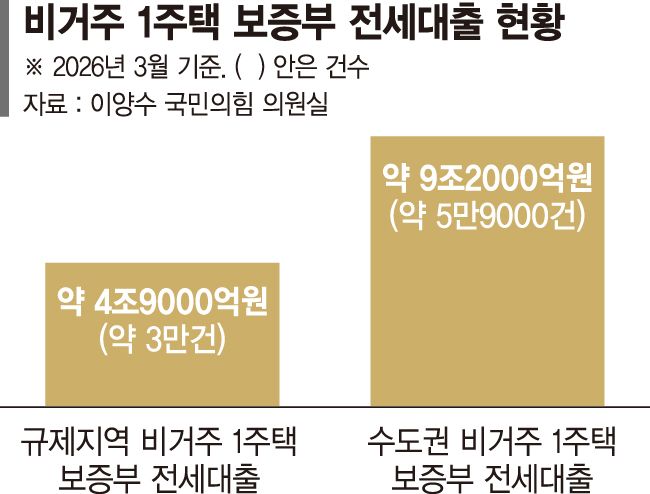
On the 14th, the Financial Supervisory Service (FSS) submitted data to the office of Lee Yang-su of the People Power Party, a member of the National Policy Committee, showing that the outstanding balance of guaranteed jeonse loans for non-resident one-homeowners who own apartments in regulated areas totaled about 4.9 trillion won as of the end of March. Regulated areas refer to all 25 districts of Seoul and 12 cities and counties in Gyeonggi Province, including Gwacheon and Yongin. These areas were designated when the government announced the October 15 Real Estate Measures last year.
The outstanding balance of guaranteed jeonse loans for non-resident one-homeowners who own apartments in the Seoul metropolitan area reached about 9.2 trillion won, across 59,000 cases. By region, the figures were 3.2 trillion won in Seoul, 1 trillion won in Incheon, and 5 trillion won in Gyeonggi Province.
The financial sector expects the roughly 4.9 trillion won in jeonse loans for non-resident one-homeowners in regulated areas to become the main target of the new restrictions. Because these owners hold apartments in areas designated as regulated due to rapid home price increases while not living in them, they are seen as having a relatively strong speculative element. Even in non-regulated parts of the Seoul metropolitan area, non-resident one-homeowners in places where home prices have recently surged, such as Dongtan in Gyeonggi Province, could also fall within the scope of the measures.
The financial authorities are expected to define criteria for speculative non-resident one-homeowners and then consider measures such as refusing to extend maturity loans, banning new jeonse loans, or tightening limits by lowering the guarantee ratio from the current 80% set by the guarantee institution. The authorities are struggling to establish a standard for speculative non-resident one-homeowners. Many non-resident one-homeowners are genuine end users who are not speculating, such as those who need housing for their children's education, work assignments in other regions, or parental care. As the line between end users and speculators is unclear, designing exceptions may prove far more difficult than setting the speculative-use standard. If exceptions are made too broadly, end users will be protected but the effectiveness of the regulations could weaken. If exceptions are applied too strictly, however, innocent end users could be harmed. A financial authorities official said, "Several options have already been prepared."
As President Lee Jae Myung recently pointed to jeonse loans as one of the causes of rising home prices, attention is turning to whether next month's measures will include broader restrictions on jeonse loans along with rules for non-resident one-homeowners.
One option under discussion first is to further reduce the guarantee ratio for jeonse loans in the Seoul metropolitan area and regulated areas from the current 80% to around 70%.
[email protected] Park So-hyun Reporter