Permanent Tariff Quotas on Imports Seen as Unavoidable... Government to Examine Effects by Food Item
- Input
- 2026-06-14 19:01:01
- Updated
- 2026-06-14 19:01:01
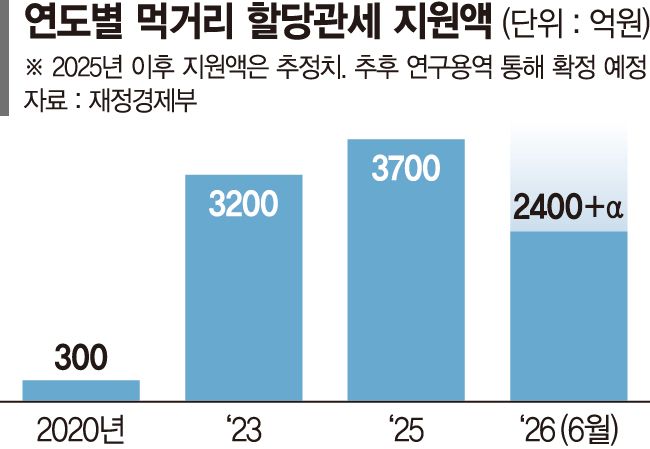
Tariff quotas are a kind of "price control lever." They are a flexible tariff system that temporarily lowers or raises the duty rate on certain imported goods by up to 40 percentage points from the base rate in order to stabilize prices. Among them, emergency tariff quotas are introduced immediately after a Cabinet meeting when there is a sharp rise in prices or supply instability.
According to the Ministry of Agriculture, Food and Rural Affairs (MAFRA) on the 14th, MAFRA is conducting a policy study with the Korea Rural Economic Institute (KREI) on the impact of import tariffs on the agricultural sector. The study is intended to analyze the price-stabilizing effects of low-tariff quotas (TRQ) and tariff quotas. It also aims to examine the impact on domestic producers. Funded by the government, the study began in March and will run for six months, with results due in the second half of this year. This is the second such study this year, following the first one last year.
A KREI official said, "This study will examine the price-stabilizing effects, by item, of agricultural and livestock products that were subject to tariff quotas last year." The official added, "Pork imported last year was subject to tariff quotas, so it has been included as a new research item." The official also noted, "We plan to look at the effects of tariff quotas on urea for fertilizer as well."
The reason MAFRA is carrying out the study again is that tariff quota policy has become a key measure for stabilizing prices. By temporarily lowering tariffs, it can reduce import costs and respond flexibly to rising exchange rates and oil prices. At the same time, it also carries the risk of hurting domestic farmers. The study will be used as basic data to review supply and price impacts on domestically produced items and to secure budget support. In addition, the Public-Private Consultative Body for Imported Agricultural Products Management, which is set to launch this month under the Prime Minister's Office, plans to begin talks with farmers' groups.
[email protected] Choi Yong-jun Kim Chan-mi Reporter