"Mars-bound" Musk lands on Nasdaq... the whole world is betting on him [Global Report]
- Input
- 2026-06-14 18:42:20
- Updated
- 2026-06-14 18:42:20
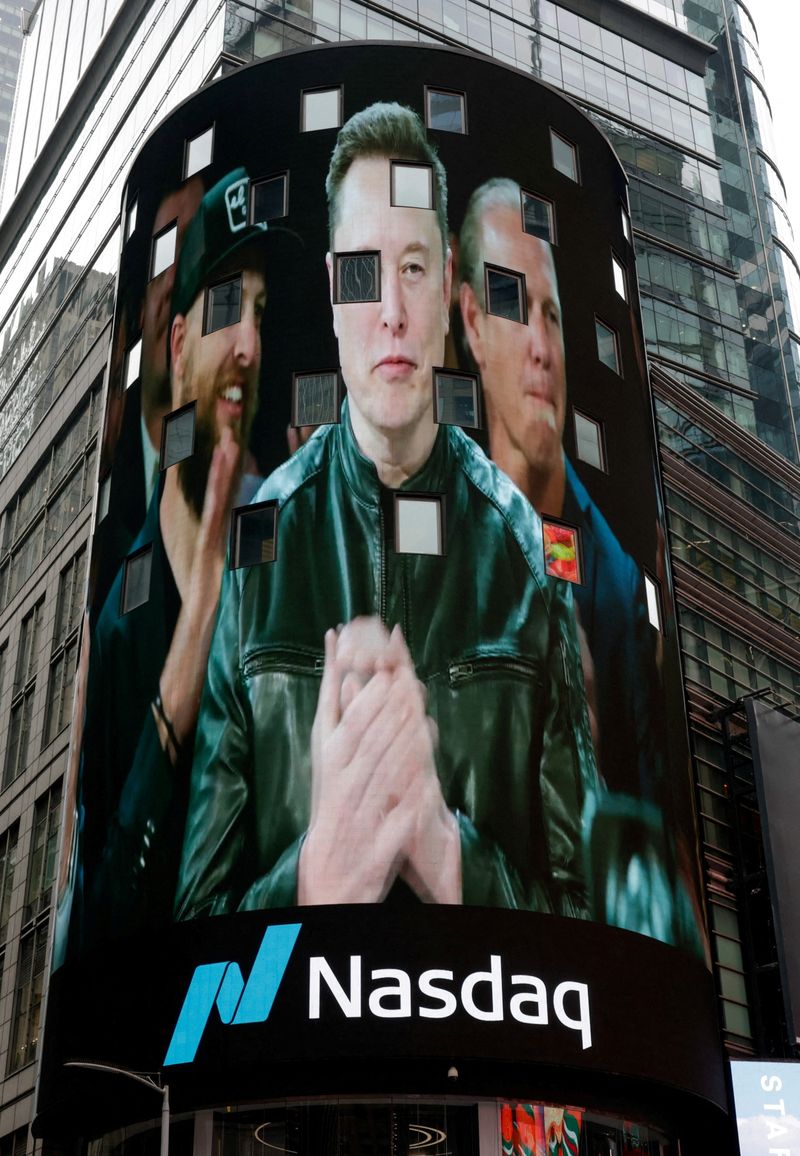
For Musk, who has become the first trillionaire in human history, this listing is more than a simple expansion of wealth. It is significant because it secured the funding needed to turn his 24-year dream of lunar exploration, Mars settlement, and making humanity a "multiplanetary species" into reality. Wall Street is also viewing the move as an investment not in a rocket maker, but in "the next 100 years of humanity."
■135→160.95→166.75
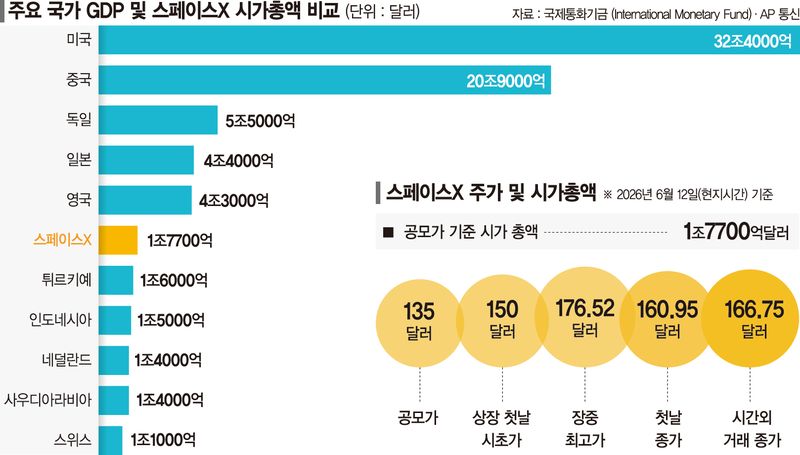
When the stock code "SPCX" first appeared on Nasdaq on June 12, 2026, local time, the share price opened at $150, well above the $135 offering price. At one point during the session, it surged to $176.52, pushing gains above 30%, and it closed at $160.95. That marked a 19% rise in a single day. The excitement did not fade in after-hours trading, where the stock climbed to $166.75. Trading volume was also record-breaking. By 2 p.m. on the first day alone, more than 360 million shares had already changed hands, about 10 times the first-day total volume of Cerebras, this year’s second-largest IPO. By the end of the day, total volume had exceeded 500 million shares. Trading value reached about $80 billion, making it one of the hottest IPOs in U.S. stock market history. The roughly 570 million shares traded on Facebook’s debut in 2012 still stand as the largest first-day volume in U.S. IPO history. SpaceX came close to that mark and set a new milestone on Wall Street.
■$1.77 trillion→$2.104 trillion
It entered the "Big 6" club in just one day. Based on the $135 offering price, SpaceX’s market capitalization was $1.77 trillion. But with the closing price fixed at $160.95, its valuation swelled to $2.104 trillion. NVIDIA leads the market with $4.96 trillion, followed by Alphabet Inc. at $4.38 trillion, Apple at $4.27 trillion, Microsoft (MS) at $2.87 trillion, and Amazon.com, Inc. at $2.54 trillion. Musk’s Tesla, Inc. ranks eighth with a market cap of $1.5 trillion. A private space company that began in a garage just over 20 years ago is now standing shoulder to shoulder with the world’s largest corporations.
■$75 billion, three times Saudi Aramco
The IPO raised $75 billion. That is nearly three times the roughly $26 billion raised by Saudi Aramco in 2019, the largest IPO on record. SpaceX secured the massive funding by selling a total of 5,555,555,555 shares at $135 each. The number may look accidental, but it was calculated. Multiply it by $135 per share, and the proceeds come out to exactly $75 billion. Some interpreted that as a symbolic flourish typical of Musk. The funds are expected to go toward developing the next-generation Starship, expanding Starlink infrastructure, supporting NASA’s lunar exploration program, and advancing Musk’s lifelong goal of "making life multiplanetary." At an event held at the company’s Starbase headquarters in Texas, Musk said, "Whoever is watching this video, I hope SpaceX can take you to the Moon, to Mars, and ultimately beyond." He then recalled the company’s early days and said, "I thought SpaceX had less than a 10% chance of succeeding."
■$794.6 billion→$1 trillion
The most dramatic number that day was not the stock price. Before the IPO, Musk’s net worth was about $794.6 billion, according to Forbes. As SpaceX’s listing revalued his stake in the company, his net worth crossed the $1 trillion mark. It was the first time in human history that a trillionaire had emerged. If $1 trillion were converted into physical $1 bills, it would require 1 trillion notes. A U.S. $1 bill is about 6.14 inches, or 15.6 cm, long. Laid end to end, those bills would stretch about 97 million miles, or 156 million kilometers. That is enough to make more than 200 round trips between Earth and the Moon, whose average distance is 238,855 miles, or 384,400 kilometers. According to NASA, the distance between Earth and the Sun is about 93 million miles, or 150 million kilometers, meaning the line of $1 trillion in bills would exceed it. Divided among all people on Earth, the picture changes again. Based on estimates from the U.S. Census Bureau and the UN, the world’s population is about 8.2 billion. If $1 trillion were distributed equally, each person would receive about $122. Musk’s fortune stands out even more when compared with other billionaires. According to Forbes, the next richest person after Musk is Google co-founder Larry Page, whose net worth is about $294 billion. Compared with the $1 trillion threshold for a trillionaire, there is still a gap of $706 billion.
■82.4%... the unshaken "Musk empire"
The 82.4% figure is the share of voting power Elon Musk will continue to exercise even after SpaceX goes public. SpaceX uses a dual-class voting structure. Musk holds more than 90% of Class B shares, which carry 10 votes per share, and he also owns 12.3% of Class A shares, which carry one vote each. As a result, even after raising massive capital through the IPO, he will retain effective control of the company. That is another defining feature of this listing. In most cases, a founder’s ownership and influence gradually weaken after a company goes public. Musk, however, chose a structure that opens only part of the company to the market while firmly preserving control. In fact, only about 4% of the company’s total value was floated in the IPO. In the end, investors were funding Musk’s vision, not gaining the power to check him. From rocket launch schedules and Starship development to Starlink expansion, AI investments, and even Mars settlement plans, the final authority over SpaceX’s future remains concentrated in Musk’s hands.
■4,400 millionaires
According to The New York Times (NYT), about 4,400 current and former SpaceX employees are expected to become millionaires through the listing. Chief Operating Officer Gwynne Shotwell and Chief Financial Officer Bret Johnsen are each said to hold equity worth more than $1 billion. But the most attention-grabbing figure is not an executive. Juan Hernandez, a Mexican welder who joined the company in 2015 at an hourly wage of $28, is reportedly holding about $880,000 worth of stock based on the $135 offering price.
■$18 billion in revenue, but a $4.9 billion loss
The financial results hidden behind the flashy IPO are more complicated. SpaceX’s annual revenue for 2025 reached $18 billion, up 33% from a year earlier. However, net loss for the same year came to $4.9 billion, while EBITDA stood at $6.58 billion. The main engine of profit is clearly Starlink. Starlink generated $11.4 billion in revenue in 2025, accounting for 61% of total sales, and posted operating profit of $4.4 billion. Its subscriber base surpassed 10.3 million across 155 countries, doubling for the second consecutive year. The problem is xAI. The xAI division, which SpaceX acquired in February 2026, posted an operating loss of $6.35 billion in 2025 alone. In effect, the cash flow generated by Starlink is being used to finance AI investment. Revenue from the space industry is being turned into ammunition for the artificial intelligence race.
■Questions beyond the numbers
A $2 trillion company, a $1 trillion human, and 4,400 millionaires. Those are the numbers created in a single day, June 12. SpaceX is no longer just a rocket company. Its empire, as envisioned by Musk, stretches beyond Earth, into satellite internet, artificial intelligence, space data centers, and even the Moon and Mars. June 12 was the day Wall Street put a price on that vast vision for the first time. The problem is that, as the $4.9 billion loss and a PSR of 109 show, all of this is still a promise. Even so, Nasdaq investors bet $75 billion on that promise. What they bought was not just shares in a rocket company, but Musk’s dream of making humanity a multiplanetary species.
[email protected] Reporter Lee Byung-chul Reporter