The 'roller-coaster KOSPI' is frightening investors, who are trying to ride out the storm
- Input
- 2026-06-14 18:17:18
- Updated
- 2026-06-14 18:17:18
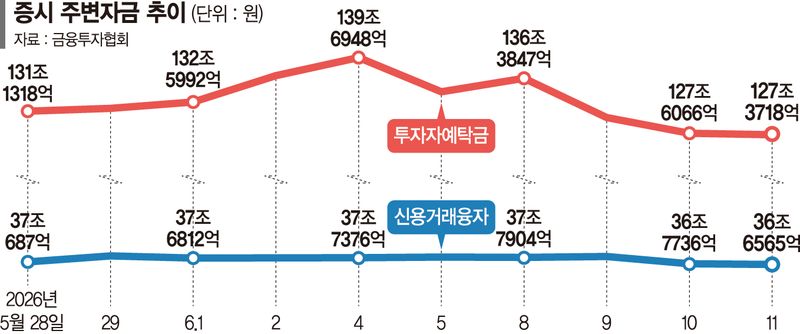
According to the Korea Financial Investment Association on the 14th, investor deposits stood at 127.3718 trillion won on the 11th. They had remained in the 130 trillion won range from the 28th of last month through the 9th, but fell below 130 trillion won starting on the 10th, when they came to 127.6066 trillion won. Investor deposits are seen as 'standby funds' for the stock market, referring to money investors leave in brokerage accounts to buy stocks or proceeds from stock sales that have not yet been withdrawn and can flow into the market at any time.
Balances in Comprehensive Asset Management Accounts (CMA), another source of standby funds for the stock market, are also declining. CMA balances had stayed above 110 trillion won from the 29th of last month through the 9th, but were recorded at 109.7643 trillion won and 109.338 trillion won on the 10th and 11th, respectively. A CMA is a demand deposit-style account offered by securities firms. Because the firm invests the customer's money in short-term financial products and pays out the returns, even one day of deposits can generate interest or earnings.
Not only standby funds, but also margin loans, a gauge of leveraged investing, have been falling. Margin loans hit a record high of 38.0227 trillion won on the 29th of last month, but dropped by about 2 trillion won to 36.6565 trillion won on the 11th, down over 10 trading days. Outstanding unsettled purchases, a short-term form of leveraged investing, also fell from 1.8293 trillion won on the 4th to 1.2072 trillion won on the 11th.
As the domestic market has swung sharply this month, investors appear to have become more wary of buying at the top. KOSPI has moved within a range of 7,394.46 to 8,933.62 this month, a swing of 20.81%. The KOSPI 200 Volatility Index, known as the 'fear index,' also climbed as high as 91.94 at one point on the 12th, marking its highest level this year.
Brokerage firms believe the market will return to a more stable uptrend. This is because geopolitical uncertainty, which had amplified volatility since March, is easing. Foreign investors bought a net 220.4 billion won in KOSPI on the 12th, when reports emerged that a ceasefire agreement between the United States and Iran was imminent.
Lee Jae-won, a researcher at Yuanta Securities Korea, said, "Foreign investors had been steadily net selling KOSPI since last month, but they have turned to net buying amid expectations that geopolitical tensions will ease." He added, "Volatility has not been fully resolved yet, but a selective strategy centered on earnings stocks will likely continue as long as the AI trend remains intact."
He continued, "Concerns over interest rate hikes, which are currently weighing on the market, could be eased if the negotiations are actually concluded, with the May Consumer Price Index expected to mark the peak. The May CPI came in below expectations, and there is no sign that inflation is worsening." He added, "Upcoming policy meetings, including the Federal Open Market Committee and the Bank of Japan, will act as volatility factors, but unless there is an unexpectedly hawkish response, the market's attention will shift to strong second-quarter earnings."
[email protected] Im Sang-hyeok Reporter