SpaceX Jumps to No. 6 in U.S. Market Cap Rankings as Funds Flow Into AI Infrastructure
- Input
- 2026-06-14 18:17:16
- Updated
- 2026-06-14 18:17:16
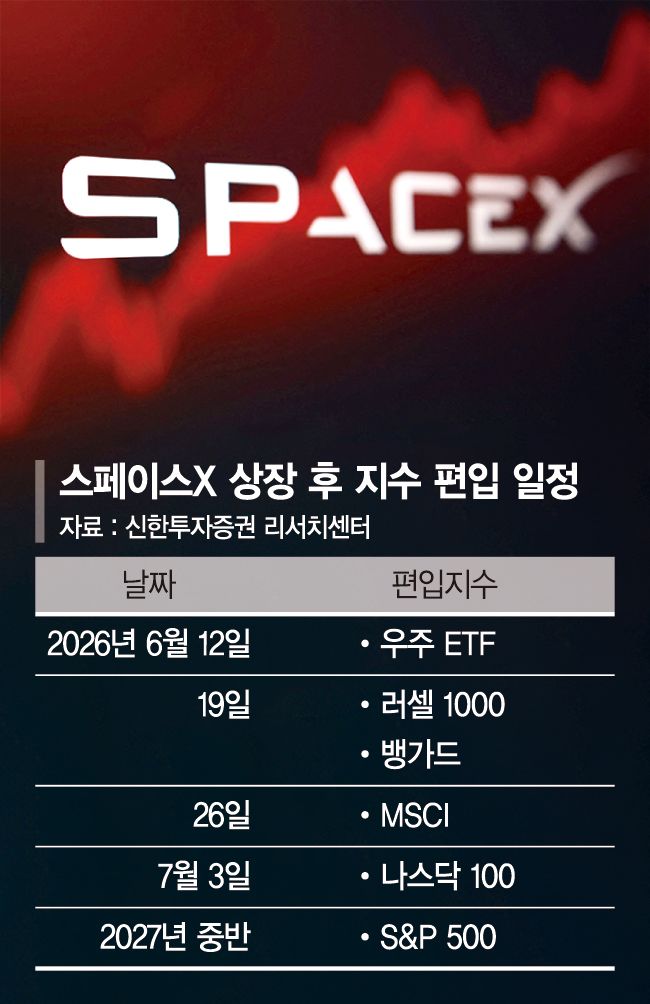
According to the investment banking industry on the 14th, SpaceX closed at $161.11 on its first day of trading on Nasdaq on the 12th local time, up 19.3% from its offering price of $135. At one point during the session, it climbed as high as $176.52, and its market capitalization at the close topped $2 trillion.
With its listing, SpaceX immediately became the sixth-largest company in the U.S. stock market by market capitalization, behind NVIDIA, Alphabet Inc., Apple, Microsoft, and Amazon.com, Inc. It is being viewed as a platform company spanning not only space but also artificial intelligence, satellite communications, and data center infrastructure, and has quickly joined the ranks of the market's flagship names.
Brokerage analysts expect SpaceX's market influence to expand further. That is because it has already entered the top tier by market cap and is also scheduled to be added to major indexes. Lee Joo-eun, a researcher at Shinhan Securities, said, "SpaceX is expected to be added to major indexes such as the Nasdaq-100 (NDX), Russell 1000 Index, and MSCI, so passive fund inflows are likely to continue after the listing." She added, "As the free float expands gradually, its weight in major indexes will also increase."
Some analysts also say SpaceX could emerge as a key stock influencing the direction of major indexes, much like NVIDIA has driven the U.S. market recently. If inclusion in major indexes and ETFs accelerates, its influence in the U.S. market is expected to grow even more. Jo Seung-bin, a researcher at Daishin Securities, said, "SpaceX is highly likely to establish itself as a core holding in global space-themed ETFs shortly after its listing." He added, "If investment inflows into the space industry begin in earnest, broader demand across the space ecosystem centered on SpaceX could also expand."
Investor attention is also broadening beyond the space industry to AI infrastructure as a whole. Expectations for growth in Starlink subscribers and expansion of the data center business are seen as lifting the company's valuation. Lee Jae-kwang, a researcher at LS Securities, said, "SpaceX is an infrastructure company that spans space, connectivity, and AI at the same time." He added, "Considering Starlink, AI data centers, and even future space data center projects, it is hard to view it as just a space company." He also noted that it is highly likely to benefit directly from the growth of the AI infrastructure market.
Recently, the Korean market has been dominated by Samsung Electronics Co., Ltd. and SK hynix, which effectively determine the direction of the indexes. Last week, the market saw extreme volatility as shock from U.S. employment data and geopolitical risks in the Middle East triggered a series of circuit breaker mechanism and sidecar activations. Even amid the heightened volatility, market funds continued to concentrate on large semiconductor stocks.
A brokerage industry official said, "Just as the Korean market is seeing a supply-and-demand rally centered on Samsung Electronics Co., Ltd. and SK hynix, the U.S. market could also see a concentration of funds around SpaceX." The official added, "SpaceX's stock trend going forward will likely have a meaningful impact not only on the U.S. stock market but also on investor sentiment toward Korean semiconductor stocks."
Kim Se-hwan, a researcher at KB Securities, said, "The recent rebound in the U.S. market was also led by semiconductor and AI infrastructure stocks." He added, "As global funds are refocusing on AI infrastructure following SpaceX's listing, the stock's future performance will likely affect not only the U.S. market but also fund flows into Korea's semiconductor sector."
Meanwhile, major Korean asset managers have repeatedly failed to include SpaceX in their IPO ETFs.
Mirae Asset Securities, which effectively handled the SpaceX IPO subscription alone among Korean brokerages, drew intense interest as the second round of subscriptions closed early within one minute. However, it ultimately failed to secure enough shares. As a result, plans by Mirae Asset Global Investments Co., Ltd. and Korea Investment Management Co., Ltd. to include the IPO shares in their own ETFs were also disrupted. Financial authorities are also reported to have begun looking into the circumstances.
[email protected] Choi Doo-sun, Kim Kyung-ah Reporter