"SpaceX, Caution Is Needed on Chasing the Rally"...A Warning From the Dutch East India Company 400 Years Ago
- Input
- 2026-06-14 04:37:48
- Updated
- 2026-06-14 04:37:48
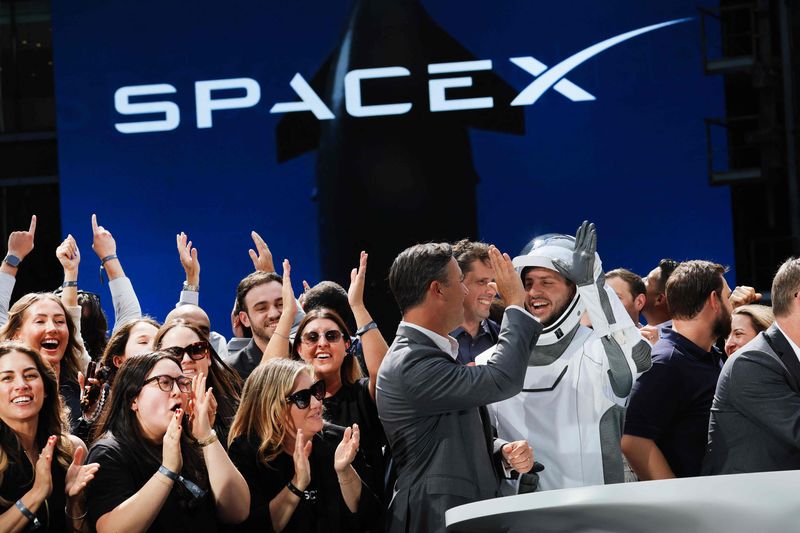
SpaceX, a key part of Elon Musk's 'orbital economy,' made a splash on the day it debuted on the New York stock market on the 12th (local time).
Even before the listing, fierce competition among investors around the world to secure shares drove strong demand. SpaceX opened at $150 in its first trade, more than 11% above the $135 offering price, and ended the day up 19% at $160.95.
During the session, it surged as much as 31% to $176.52, and after regular trading ended, it rose another 3.7% in after-hours trading.
Yahoo Finance, however, pointed out on the 13th that even investors who failed to get in on the offering do not need to feel too bitter about missing the first-day surge.
Looking at the history of previous initial public offerings (IPOs), it may take a long time before SpaceX's share price stabilizes, so no one knows when today's success could turn into a disaster.
Experts are advising investors who have not yet bought SpaceX shares to wait for a while instead of chasing the stock.
SpaceX and the Dutch East India Company 400 Years Ago
J.C. Parets, founder and analyst at TrendLabs, said the strong debut of SpaceX, the largest IPO in Wall Street history, resembles the first trading of Dutch East India Company (VOC) shares in 1602.
Trading in VOC shares also gave momentum to the opening of the Amsterdam Stock Exchange, allowing investors to take part in global trade without boarding ships themselves.
SpaceX's listing is not much different in that it allows investors to participate in the space economy, or orbital economy, without having to ride a spacecraft.
Owning SpaceX shares gives investors exposure to space infrastructure, including SpaceX launches, Starlink's satellite internet service, and the space AI data centers Musk envisions.
Even pioneers need patience
SpaceX is similar to VOC in that it has real substance. Rather than merely presenting rosy projections on paper, it is a company that is actually generating profits.
The Dutch East India Company was a giant enterprise backed by ships, trade routes, armies, and government support, and SpaceX is also a massive space company with annual revenue of up to $19 billion.
Still, SpaceX's valuation has risen so sharply that it is hard to compare it even with the Dutch East India Company, raising concerns about a bubble.
The Dutch East India Company was unmatched in its time, yet it took 30 years for its value to double.
By contrast, SpaceX's valuation, estimated at about $125 billion in mid-2022, had climbed to $2.105 trillion based on the closing price on the 12th. That means its valuation increased roughly 17-fold in four years.
IPO 60%, Back to Square One Three Years Later
Based on the typical performance of IPO stocks, chasing the stock on the first day of listing is extremely risky.
An analysis of more than 9,000 stocks listed between 1975 and 2021 found that three years after listing, 60% of all stocks were trading below their first-day closing price. Only 16% had more than doubled.
According to Cass Donnelly, author of 'Lifecycle Trade,' most IPO stocks fall below their first-day intraday low within three weeks of listing. They also undergo a correction of more than 10% within 10 weeks.
In other words, even if investors do not rush in on the first day, they may still get a chance to buy later at a better price.
A Signal of a Market Peak?
Some are also pointing out that the success of SpaceX's IPO, along with the expected IPOs of AI startups Anthropic and OpenAI this year, could be a signal that the market is nearing a peak.
The 1901 listings of U.S. Steel and RCA came near the end of a rally in the Dow Jones Industrial Average, and after those two companies went public, the index was cut in half.
Palm, the PDA company often seen as a predecessor to smartphones, went public at the height of the Nasdaq bubble in 2000. Glencore listed at the peak of the commodities boom in 2011, after which the market plunged toward collapse.
Coinbase and Rivian both went public in 2021, just before the peaks in Bitcoin and the Nasdaq.
Frontier
SpaceX, Anthropic, and OpenAI may still move differently from the past, as they are frontier companies expected to lead the Fourth Industrial Revolution.
Their valuations are rising rapidly as frontier players in orbital economy and AI, but that alone does not mean they can be dismissed as bubbles.
They are the main actors in a new paradigm, building massive supply chains and business ecosystems in the real world and proving their value.
Because they are companies opening a new era, Anthropic's valuation, which stood at about $4 billion to $5 billion in early 2023, rose roughly 200-fold to $965 billion last month.
OpenAI's valuation, estimated at $29 billion in 2023, jumped about 29-fold to $852 billion in March.
The question is when they will reach the profitability needed to support such enormous valuations.
After NVIDIA's Nasdaq debut on Jan. 22, 1999, the stock soared nearly 3,000-fold, but it also went through turmoil, including a drop of more than 80% from its peak during the 2008 financial crisis.
It took nearly 30 years for the company to become the world's No. 1 by market capitalization, powered by its monopoly-like infrastructure.
The new frontier opened by pioneers must endure the harsh test of time before it settles into true market value.
[email protected] Song Kyung-jae Reporter