A Smart Suit That Vividly Conveys the Feeling of Being Shot in Virtual Reality Has Arrived [Unboxing Lab]
- Input
- 2026-06-13 08:06:00
- Updated
- 2026-06-13 08:06:00
Do you remember the excitement of opening a delivery box? Even now, university labs are producing remarkable discoveries that could change our lives. They are simply wrapped in the thick packaging of academic papers. In "Unboxing Lab," we skip the complex equations and theories and focus on the essentials you want to know. So, shall we open the box? Today’s featured research is this one.
The findings were published in the prestigious international journal Nature Communications, underscoring the technology’s promise as a next-generation neural interface.
■ The convergence of virtual reality and therapy
Existing tactile reproduction devices have been limited by technical constraints and were mostly made in glove form, delivering stimulation only to specific areas such as the fingers or palms. Therapeutic electrical stimulation, however, is better suited to broad body areas such as the arms, legs, and chest, making it difficult for conventional glove-type devices to provide both tactile feedback and body stimulation therapy at the same time.
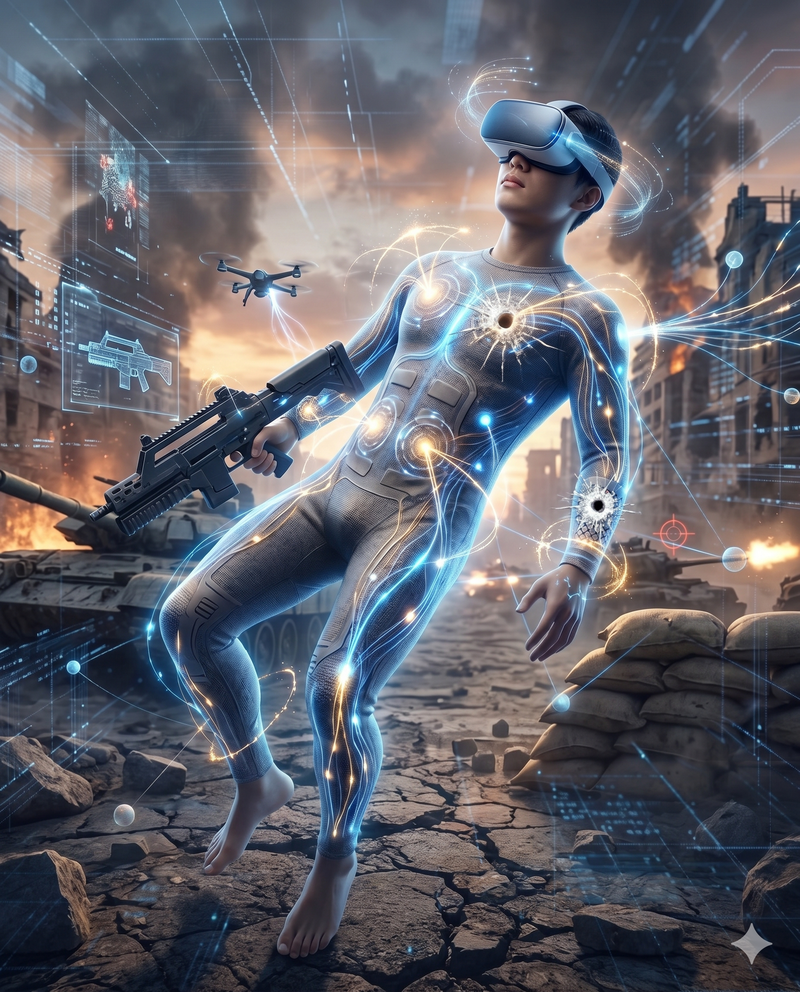
The newly developed electrical stimulation suit is a full-body platform that integrates tactile feedback, muscle and nerve stimulation functions, and an XR interface into a single system. It opens the door to experiencing immersive virtual reality for gaming or training while simultaneously enabling a range of stimulation-based applications, including cell regeneration, wound healing, pain management, and neural rehabilitation.
■ A non-drying electrode material
The first step in this research was an innovation in the electrode material that makes direct contact with the skin to deliver electrical stimulation. Conventional electrodes had a drawback: over long periods of use, moisture evaporated, reducing performance or causing skin irritation.
The research team developed a flexible, low-impedance electrode structure by combining a silver (Ag)-based stretchable conductor with a conductive hydrogel (DMCH) that prevents moisture evaporation. Using the hygroscopic properties of lithium chloride (LiCl), the new electrode material retains moisture stably for 24 hours in air and can stretch up to six times its original length to match human body deformation. By using conductive ink that can be printed onto fabric, the team integrated the electrodes directly into thin, breathable polyurethane textile, creating a lightweight and comfortable fit similar to ordinary underwear.
■ Body-type-specific voltage correction
After developing the material, the team built a system to deliver consistent stimulation across the entire body. Because body shapes differ from person to person, and the pressure applied by the suit varies by area, the strength of electrical stimulation can change and may cause pain or unpleasant sensations on the skin.
To solve this problem, the researchers combined a pressure-based sensing system with an intelligent feedback control system that uses an automatic voltage correction algorithm. Pressure sensors built into the suit detect in real time how strongly the clothing presses against the body. The system then raises the voltage in areas where contact is loose and lowers it where pressure is high, ensuring a uniform current supply. As a result, it can deliver consistent and safe tactile stimulation across the body regardless of the wearer’s body type or movement.
■ Confirmed effect in suppressing hand tremors
The team used the suit in a series of experiments linked to diverse XR content. In a VR shooting game, the "bullet" mode delivered short, strong 5 Hz stimulation to targeted areas such as the chest and arms to recreate a sharp impact sensation, while the "grenade" mode generated rough 70 Hz stimulation across the entire front panel for eight seconds to vividly reproduce the shock of a large-area explosion.
In particular, the researchers induced artificial exercise fatigue through dumbbell workouts and then applied precise 100 Hz electrical stimulation to the radial nerve area of the wrists of healthy participants who developed hand tremors to verify the system’s suppressive effect. The results showed that without electrical stimulation, tremor intensity continued to increase as fatigue accumulated over time. But when stimulation was applied through the suit, the progression of hand tremors was effectively suppressed and a stable state was maintained. The technology is expected to serve in the future as a key platform for digital therapeutics, advanced neural rehabilitation, and the Brain-Computer Interface (BCI) market, a technology that directly connects the brain and computers.
[email protected] Kim Man-ki Reporter