President Lee's approval rating drops 7 points, falls below 60%; People Power Party hits highest level since the current administration took office
- Input
- 2026-06-12 14:07:48
- Updated
- 2026-06-12 14:07:48
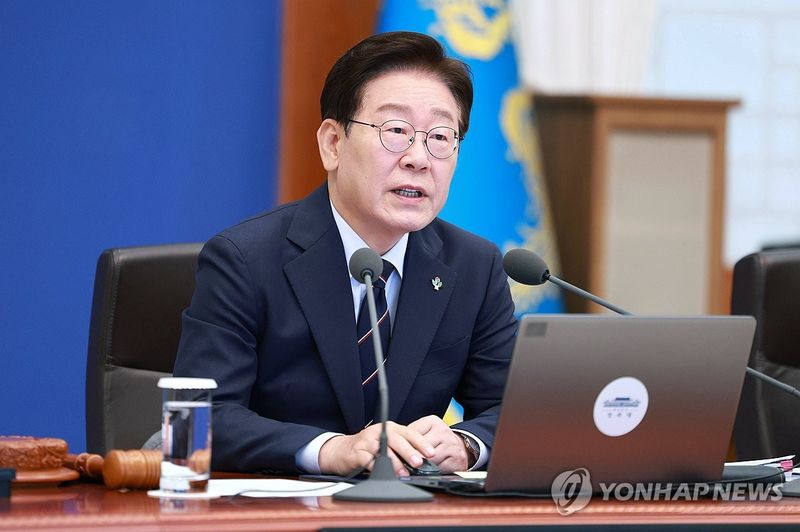
[Financial News] A public opinion poll released on the 12th showed that President Lee Jae Myung's approval rating for state affairs fell 7 percentage points in a week to 57%.
The main reasons for his negative ratings were poor election management, livelihood issues and real estate policy.
According to a Gallup Korea Research Institute survey of 1,002 eligible voters aged 18 and older nationwide from Sept. 9 to 11, positive ratings of the president's performance fell 7 points from the previous week to 57%. Negative ratings rose by the same margin, reaching 35%.
The most notable point in this survey was the reason for the drop in support. Among respondents who viewed the president's performance negatively, the most common reason was 'poor or fraudulent elections / National Election Commission issues' at 16%. That was followed by 'economy / livelihoods / high exchange rates' at 14%, 'real estate policy' at 9%, and 'moral issues / avoiding his own trial' at 8%.
Gallup Korea Research Institute explained that 'the National Election Commission issue was cited most often as the reason for negative evaluations' and that 'the recent shortage of ballots was directly reflected in the president's approval rating.'
In fact, 67% of respondents, or seven out of 10 people, said the ballot shortage during this election was a case of 'poor election management and infringement of voting rights,' showing that distrust in election administration had reached a peak.
Only 25% described it as an attempt at fraudulent elections, such as illegal election interference. By political leaning, 89% of progressives and 72% of moderates said the incident was 'administrative failure' rather than systematic election fraud.
Regional gaps in support also became more pronounced. The president still maintained solid support in the Gwangju–Jeolla region at 79% and in the Daejeon, Sejong and Chungcheong region at 66%, which are traditional strongholds. But in the conservative-leaning Busan-Ulsan-Gyeongnam (PK) and Daegu–Gyeongbuk (TK) regions, support stood at 51% and 48%, respectively, barely holding around or below the 50% mark. As political risks grow, defections appear to be spreading across the board.
Democratic Party of Korea support at 41%, People Power Party at 29%... gap narrows
Party support also fluctuated sharply. Support for the ruling Democratic Party of Korea fell 4 percentage points from the previous week to 41%, while the People Power Party rebounded 7 points to 29%. The Reform Party, Rebuilding Korea Party and Progressive Party each registered 2%, and 21% of respondents said they supported no party. Gallup Korea Research Institute said that 'even after major elections in the past, there were sharp swings in support for both ruling and opposition parties.'
Meanwhile, the survey was conducted through telephone interviews using randomly selected virtual mobile numbers. The margin of error is plus or minus 3.1 percentage points at the 95% confidence level, and the response rate was 11.3%.
[email protected] Sung Min-seo Reporter