Did foreigners cause the KOSPI to plunge?... "The game is changing now"
- Input
- 2026-06-12 10:22:33
- Updated
- 2026-06-12 10:22:33
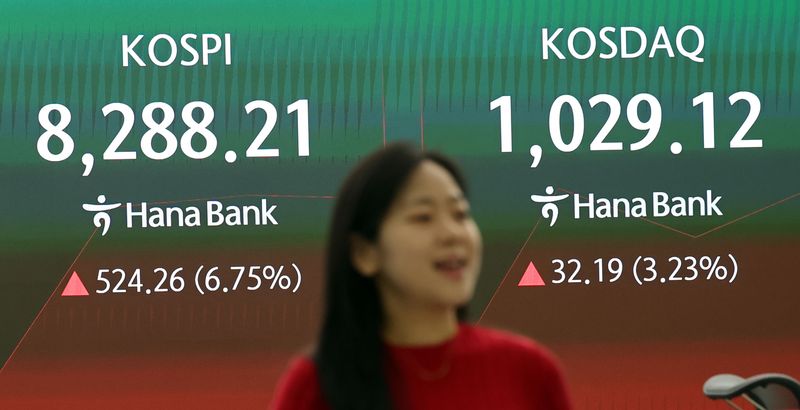
[Financial News] A recent sharp drop in KOSPI was not caused by net selling by foreign investors, according to a new analysis. Instead, the argument is that supply-and-demand shocks from single-stock leveraged exchange-traded funds (ETFs) amplified volatility. Kim Ji-hyun, a researcher at Daol Investment & Securities, said in a report on the 12th, "The decline in the index was not a trend reversal driven by foreign selling, but a supply shock that occurred during the process of reducing leveraged ETF positions."
According to Daol Investment & Securities, on the 8th, when KOSPI fell 9.2%, foreign investors ended the day with net selling of 180 billion won, narrowing their net selling in the cash market. The basis between the spot and futures markets also narrowed to minus 8 basis points, drawing in arbitrage selling.
However, financial institutions led the day's plunge, posting net sales of 2.5 trillion won. They had been the main buyers in the cash market since the March stock index futures expiration, with net purchases of about 39 trillion won. As demand for single-stock leveraged ETF creation and arbitrage concentrated, they were seen as the main force behind the index's gains since mid-May.
In fact, single-stock leveraged ETFs attracted 630 billion won in net buying from their listing through the 4th of this month.
The impact of leveraged ETF rebalancing was also visible in the stock futures market. It reflected large-scale futures buying by financial institutions as single-stock leveraged ETF creation surged.
Kim said, "So far this month, the index plunge and leveraged ETF rebalancing have coincided, causing the basis to narrow sharply." He added, "Open interest in SK hynix futures fell from 37 trillion won on June 1 to 10 trillion won as of the 10th." The stock price has also dropped about 20% from its peak.
He added, "This correction is not a trend reversal caused by new negative factors." He said it is "a normalization process in which demand for leveraged ETF creation, which had expanded excessively since May, overvaluation in stock futures, and the buildup of arbitrage positions are being unwound."
Kim also forecast that "after the simultaneous expiration of futures and options, index volatility, which has been reflected in the VKOSPI 90 level, is likely to ease."
[email protected] Han Young-joon Reporter