"Investors Using Borrowed Money Forced to Liquidate 169.8 Billion Won in One Day" — Fear Over Forced Sales at 10% of Outstanding Margin Debt
- Input
- 2026-06-12 08:17:45
- Updated
- 2026-06-12 08:17:45
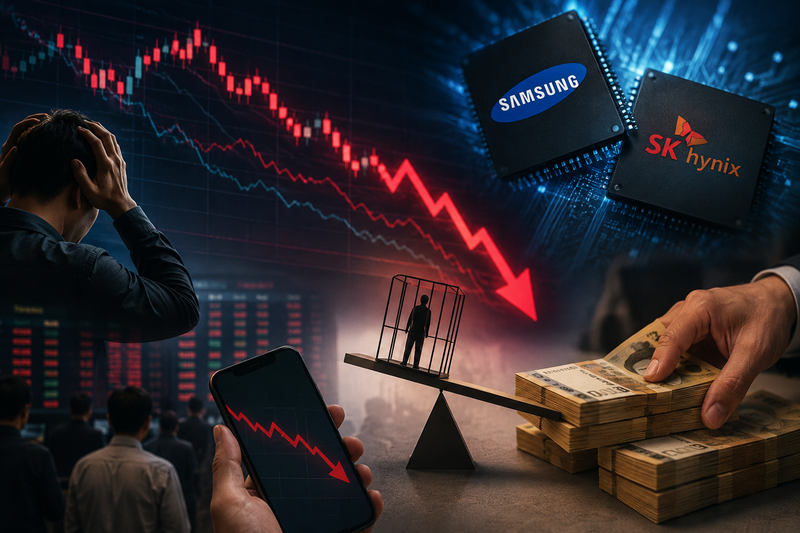
[Financial News] Since the launch of single-stock leveraged Exchange-Traded Funds (ETFs) tied to Samsung Electronics and SK hynix, market volatility has increased. As a result, the amount of investors who bought stocks with only partial margin and then failed to cover the shortfall has surged, leading to forced liquidations. For the first time this year, the ratio of forced sales to outstanding margin debt has exceeded 10%.
Forced sales topped 10% during the market plunge on the 9th, the first such case since the Youngpoong Paper Manufacturing incident
According to The Korea Herald Business on the 10th, the ratio of actual forced sales to brokerage margin debt stood at 10.5% as of the 9th. That is more than five times the yearly average of 1.8%. It was the first time the ratio had reached double digits since the Youngpoong Paper Manufacturing incident in October 2023.
The amount of forced sales also jumped sharply. On that day, the total reached 169.8 billion won, more than nine times the average daily figure of 18 billion won this year.
Forced liquidation occurs in margin trading. In this type of transaction, an investor buys stocks first after paying only part of the required margin, then settles the remaining balance by the settlement date, two trading days after the trade date (T+2). If the investor fails to cover the margin debt, the securities firm typically carries out a forced sale of the shares on the next trading day (T+3).
Single-stock leveraged ETFs are amplifying market volatility
Market watchers say the recent swings in the market have driven the surge in forced sales. The KOSPI rose more than 3% at the end of May and again in early June, showing strength. But it then reversed sharply. After falling 1.84% on the 4th, it dropped 5.54% on the 5th and 8.29% on the 8th, deepening investor losses.
The pressure from forced sales was even greater than during the sharp selloff in March, when geopolitical risks from the Middle East rattled markets. From March 5 to 7, forced sales totaled 196.3 billion won over three days. In the June selloff, however, 475.1 billion won was dumped over three days on the 5th, 8th, and 9th. The ratio of forced sales to margin debt was also higher than in March.
The securities industry also says single-stock leveraged ETFs are widening market volatility. Since the 2x leveraged ETFs based on Samsung Electronics and SK hynix were listed on the 27th of last month, the KOSPI has repeatedly swung by as much as 5% to 8% in a single day.
Han Ji-young, an analyst at KIWOOM Securities, told The Korea Herald Business, "The VKOSPI, which measures the future volatility of the KOSPI 200 Index, hit an all-time high of 91 points," and added, "As leveraged ETF money is concentrating in major semiconductor stocks, high volatility could continue for some time."
The structural features of leveraged ETFs are also seen as a factor behind the volatility. ETFs rebalance their positions every day to track twice the return of the underlying asset. When prices fall, they sell more to maintain the target leverage. When prices rise, they buy more. In the process, declines can trigger even heavier selling, while gains can lead to even more buying, amplifying volatility.
[email protected] Seo Yoon-kyung Reporter