Governor Shin Hyun-song: "Interest rates should be raised without delay"
- Input
- 2026-06-12 10:00:00
- Updated
- 2026-06-12 10:00:00
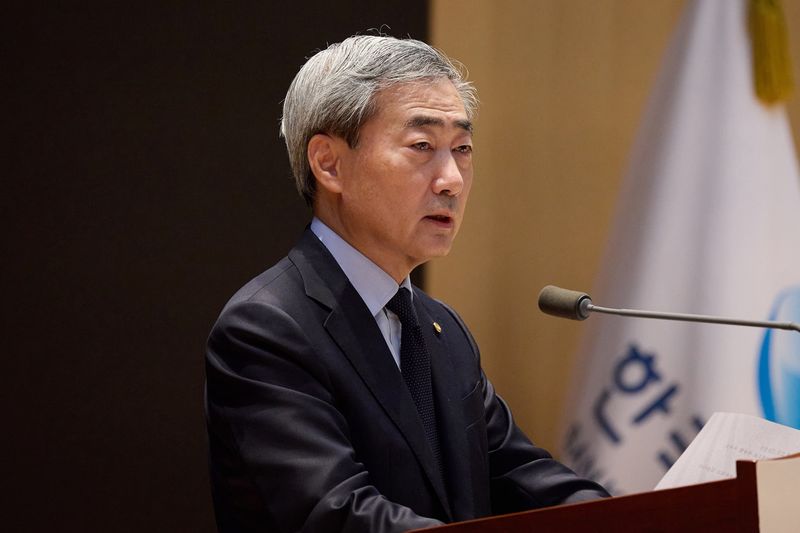
At the ceremony marking the central bank's 76th anniversary on the 12th, held at the Bank of Korea in Jung District, Seoul, Shin said, "Growth, inflation and financial stability are clearly pointing in one direction from a monetary policy perspective." He added, "With a focus on price stability, we need to raise rates without delay."
This is a clearer signal than the indirect hints he gave at a press briefing after the Monetary Policy Board meeting in May and at the "BOK International Conference" on the 1st, when he said that the timing and pace of rate hikes would be decided by reviewing incoming data, the extent of upward inflation pressure and the pace of economic improvement, or noted that there were few obstacles to adjusting monetary policy in response to inflation.
The market is effectively viewing July, when the next Monetary Policy Board meeting is scheduled, as the likely timing for a benchmark rate hike.
Stronger-than-expected growth has eased concerns that the Monetary Policy Board will have to focus on stabilizing inflation and the Korean won against the U.S. dollar. Preliminary data showed that South Korea's real Gross Domestic Product (GDP) rose 1.8% from the previous quarter in the first quarter. Nominal GDP grew 10.5%, while real Gross Domestic Income (GDI) expanded 8.7%.
Inflation, meanwhile, is climbing on the back of higher global oil prices caused by tensions in the Middle East. Shin also pointed out that "consumer price inflation rose into the 3% range in May, and core inflation also increased to the mid-2% range, partly due to higher prices for personal services." He added, "As demand-side price pressures are also building, inflation will remain above the target level for quite some time."
He went on to say, "Because the burden of rising prices falls more heavily on low-income households, preemptive efforts to stabilize inflation are the way to prevent that burden from worsening." He added, "Rate hikes inevitably increase the debt repayment burden on companies and households, but targeted support for these difficulties is more effectively delivered through fiscal policy."
Shin stressed that, from a financial perspective, the central bank should continue working with the government on macroprudential policy while monitoring potential risks in the housing market and household debt. He added, "In the medium to long term, efforts must continue to ease concentration in the Seoul metropolitan area and redirect funds toward productive sectors." He also said, "It is important to deepen our foreign exchange market and strengthen the fundamentals by promoting the internationalization of the Korean won."
On the real economy side, he warned against relying too heavily on the semiconductor boom driven by the Artificial Intelligence (AI) surge. Shin said, "We must recognize that a significant part of this is the result of more favorable external conditions." He added, "Based on the expanded fiscal room and stronger corporate balance sheets, it is important to increase investment to enhance future growth potential."
He also said, "Efforts to ease polarization across regions, generations and social classes must continue." He added, "We must keep coming up with solutions to accumulated structural problems, including changes in demographic patterns."
[email protected] Kim Tae-il Reporter