[Editorial] Korea-Japan cooperation in AI and semiconductors should grow into a win-win model for economic security
- Input
- 2026-06-11 19:31:34
- Updated
- 2026-06-11 19:31:34
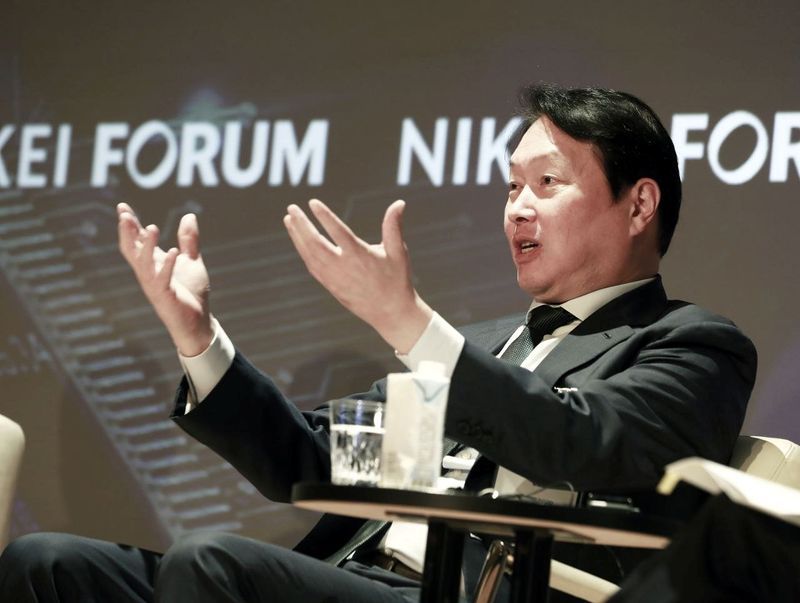
Earlier, Chey proposed a Korea-Japan economic community and stressed that the two countries need to respond together to structural crises such as energy insecurity and low birthrates. South Korea and Japan are both manufacturing powerhouses, yet both have low energy self-sufficiency. At the same time, they face common problems such as a shortage of new workers, regional decline, and heavier social welfare burdens due to record-low birthrates and rapid aging. Finding solutions separately would be too costly. If the two countries share experience and technology, they can respond to these crises far more efficiently.
Chey's proposal goes one step further: by using complementary industrial structures, the two countries can achieve economies of scale and become joint winners in an era of fierce technological competition. It is also worth noting his point that Korea-Japan economic cooperation is no longer optional amid the intensifying US-China technological hegemony competition.
Countries around the world are raising protectionist barriers, and global supply chains are being reshaped from one moment to the next. Semiconductors and AI have become core infrastructure for national competitiveness. South Korea stands out in memory semiconductors, manufacturing capabilities, and communications infrastructure. Japan has an excellent ecosystem in semiconductor materials, equipment, and precision manufacturing. If the two countries join forces, they can secure a much larger market and greater supply chain stability.
The AI Factory being pursued by SK and NVIDIA is not just a data center. It is an intelligent production facility that combines GPUs, High Bandwidth Memory (HBM), and ultra-fast networks to process AI model training and inference on a massive scale. In the future, it will become a key hub that shapes productivity across industries, from robotics and autonomous driving to drug development and energy management. SK plans to launch its first AI Factory in South Korea next year and then expand it to Japan. That move could create even greater synergy in the AI infrastructure of both countries.
Of course, the future of Korea-Japan cooperation cannot be viewed only optimistically. There are many hurdles to overcome. Historical issues, public sentiment, technology leakage, and competition for industrial leadership are all sensitive matters. Cooperation must not be seen as one-sided dependence. As Korea strengthens its AI capabilities across software and the use of manufacturing data, cooperation with Japan should be designed on the principle of mutual complementarity.
As companies in both countries move forward, the two governments should also build an institutional foundation for cooperation in regulation, taxation, power infrastructure, and Research and Development (R&D). AI Factories and semiconductor plants require enormous amounts of electricity, land, and skilled workers. The two countries also need to create a long-term cooperation platform that brings together AI, energy, talent, and the silver industry. In the AI era, a Korea-Japan alliance in core infrastructure carries major significance for economic security as well. Korea-Japan ties must now move beyond past trade cooperation and rise to the level of key partners in future industries. We hope the AI and semiconductor cooperation proposed by Chey Tae-won will take root as a new win-win model for both countries.