General Act on Digital Assets Gains Momentum in the Second Half of This Year [Tokenomy Korea 2026]
- Input
- 2026-06-11 16:55:24
- Updated
- 2026-06-11 16:55:24
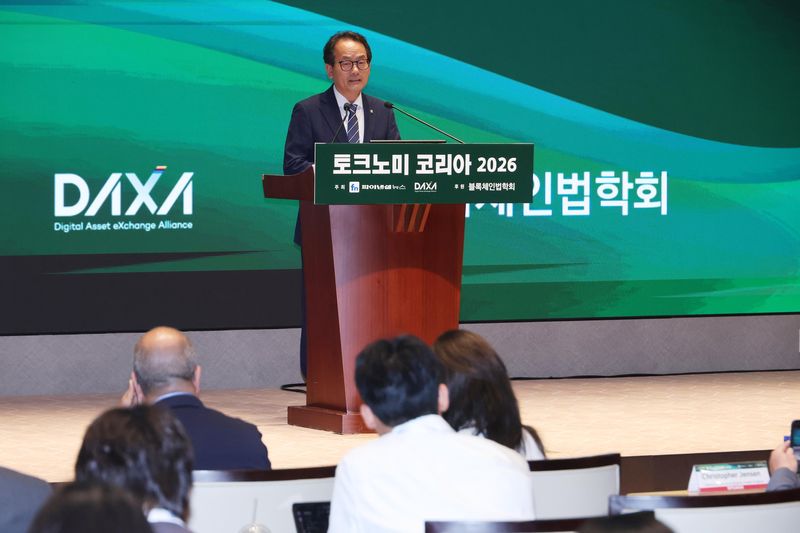
[Financial News] The General Act on Digital Assets, which includes a regulatory framework for virtual assets such as won-based stablecoins, is expected to gain momentum in the second half of this year.
At Tokenomy Korea 2026, co-hosted on the 11th by Financial News and DAXA at KRX in Yeouido, Seoul, Rep. Kang Jun-hyeon of the Democratic Party of Korea, secretary of the National Policy Committee, said, "If the General Act on Digital Assets can secure minimum safeguards such as investor protection, we will move forward with it first." He added, "Once the new National Policy Committee is formed in the second half of this year, I will make sure to resolve this issue and push for legislation within the year." He also expressed a strong willingness to begin discussions on drafting and revising the bill, saying, "There have been unresolved issues among stakeholders, including the Bank of Korea and the banking sector, but I deeply agree that Korea must keep pace, given the strong market demand and the rapid response of markets around the world."
Experts from the domestic and global financial investment and virtual asset industries who spoke at the event also praised the potential of the Korean market. They said, in unison, that swift and clear regulatory reform is needed if Korea is to avoid falling behind in global competition for virtual assets.
Joseph Chalom Sharplink, CEO of Sharplink, analyzed recent legislative moves in the United States, including the CLARITY Act, the country's market structure bill for virtual assets, as a "geopolitical frame" for defending global dollar dominance and the Treasury market. "The U.S. push to lead dollar-based stablecoins and on-chain transactions is a sophisticated geopolitical strategy aimed at increasing global dollar usage and absorbing demand for U.S. Treasuries," he said. He added that he understood why Korean authorities are concerned about consumer protection and preventing capital outflows, but noted that "as Asian hub countries such as Hong Kong and Singapore are embracing fiat-pegged stablecoins, Korea should also secure regulatory clarity and lead the digitalization of finance."
Calls also grew more concrete for allowing corporate investment as part of efforts to improve the structure of the Korean market. Catherine Chen, head of Binance's institutional division, said, "The Korean market is at a turning point for major change, as the institutional foundation for participation is being laid based on the government's Roadmap for Allowing Corporate Investment in Virtual Assets." She said that only when a timely and systematic regulatory framework is in place will large institutional investors be able to make formal decisions and deploy capital with confidence.
There was also a warning that the on-chain transition of traditional financial assets should not lose sight of its essence by being overshadowed by technological vision. Christopher Jensen, head of digital asset research at Franklin Templeton, said, "Real-world asset tokenization (RWA) does not change the intrinsic economic value or risk profile of an asset." He added, "True success depends not on technology itself, but on what legal rights investors are actually guaranteed, and on how robustly the regulatory framework and compliance structure are designed."
Experts agreed that real business opportunities must be captured on top of such a regulatory framework. Kyung-ho Kim, head of Deloitte Korea Digital Assets Center, stressed, "To gain the upper hand in the RWA and stablecoin markets, the key is not to issue coins directly, but to secure the infrastructure market across segmented value chains such as issuance, settlement, custody, verification and data evaluation." He added, "Rather than waiting endlessly for domestic legislation to be finalized, companies should proactively enter regulatory hubs such as Hong Kong and Singapore, obtain licenses, and test their business models before actively considering a roadmap to export those models back to Korea once domestic rules are refined." Special Reporting Team
[email protected] Kim Mi-hee Reporter