Prolonged Middle East war hits hard, pushing employment down for the first time in 17 months
- Input
- 2026-06-11 10:37:10
- Updated
- 2026-06-11 10:37:10
[Financial News] The prolonged Middle East war is beginning to shake the labor market in earnest. Rising raw material prices and supply disruptions have put pressure on manufacturing and construction, while youth employment has also weakened sharply. As a result, the number of employed people fell last month for the first time in 17 months. The government says it will devote all-out efforts to employment stabilization measures, but analysts say it is difficult to predict when recovery will begin as uncertainty grows with the war dragging on.
Employment falls for the first time in 17 months
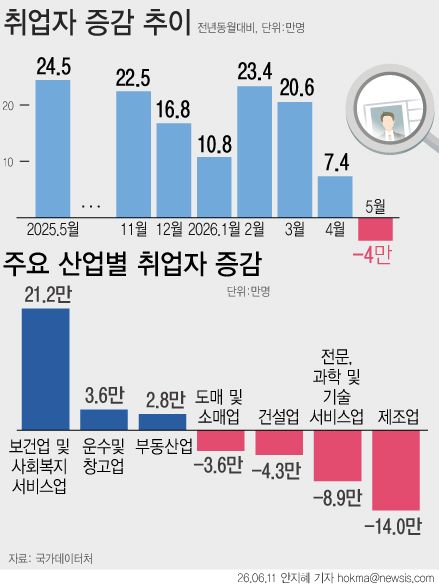
According to the May employment trends released by the National Data Office on the 11th, the number of employed people aged 15 and older stood at 29.12 million last month, down 40,000 from a year earlier. It was the first monthly decline since December 2024, when employment fell by 52,000, marking a 17-month gap.
The employment rate for people aged 15 and older came in at 63.3%, down 0.5 percentage points from a year earlier. The employment rate for those aged 15 to 64, the OECD comparison standard, fell 0.3 points to 70.2%. The number of unemployed people rose by 25,000 from a year earlier to 878,000, while the unemployment rate increased 0.1 points to 2.9%.
By industry, manufacturing stood out for its weakness. Manufacturing employment fell by 140,000 last month, down 3.2% from a year earlier. That was the largest drop since February 2019, when it fell by 151,000. Employment also declined across agriculture, forestry and fisheries (-121,000), professional, scientific and technical services (-89,000), and construction (-43,000).
The rise in raw material prices and supply chain instability caused by the prolonged Middle East war is seen as weighing on manufacturing employment. In particular, analysts say cost burdens have piled up in the auto and machinery sectors, which have high employment spillover effects, widening the decline in jobs. Semiconductor exports have recently led the overall export recovery, but the industry’s structure limits its job-creation effect, which also appears to have had an impact.
Bin Hyeon-jun, director of social statistics at the National Data Office, said, "Employment fell in the auto, rubber and plastics sectors," adding, "In the case of semiconductors, which have been driving recent export growth, the share of employment is not large."
By contrast, employment increased in health and social welfare services (212,000), arts, sports and leisure services (44,000), and transportation and warehousing (36,000). Analysts say job growth continued in some face-to-face service sectors.
Youth employment rate posts biggest drop since January 2021
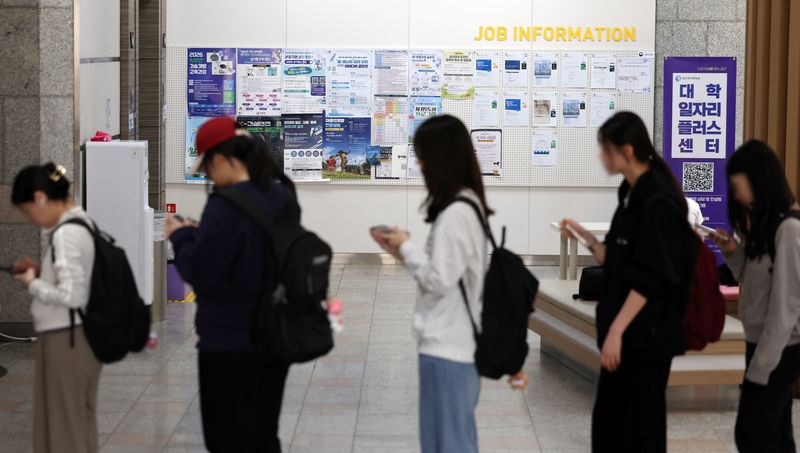
By age group, employment among young people weakened further. The number of employed people aged 15 to 29 fell by 255,000 last month, the largest drop since January 2021, when it fell by 314,000. The youth employment rate also dropped 2.4 percentage points, marking the steepest decline in the same period. In contrast, employment rose by 171,000 among those aged 60 and older, and by 62,000 among people in their 30s.
Kim Tae-woong, director of workforce policy at the Ministry of Finance and Economy, said, "Young people are facing a triple burden, including structural changes in industry and demographics, companies' expanded hiring of experienced workers, and a slowdown caused by the prolonged Middle East war," adding, "As the war-related economic downturn has been added, youth employment weakness is judged to have deepened further."
A rebound in the labor market in June also appears unlikely. With higher costs and economic uncertainty continuing due to the prolonged war, it is difficult to predict when recovery will come or how strong it will be. The government plans to review the impact by industry and by group through ministerial meetings and a dedicated jobs task force, while preparing employment stabilization support measures and additional follow-up steps.
Deputy Prime Minister and Minister of Economy and Finance Koo Yun-cheol held a meeting of relevant ministers at Government Complex Seoul on the day and said, "As rising raw material prices and supply difficulties continue, employment conditions are becoming more uncertain, with the number of employed people in May turning to a decline for the first time in 17 months," adding, "All ministries must respond with a heightened sense of vigilance and with all-out efforts."
To improve youth employment, the government will first move quickly to implement key tasks under the Youth New Deal Initiative, including capacity-building and work experience programs. It also plans to prepare without delay the second project of Startups for All, which is set to begin in July. In addition, the government will promptly draw up the Basic Plan for Employment Stability in Industrial Transition so that industrial restructuring, including AI transformation (AX) and Green Transformation (GX), does not lead to job shocks.
[email protected] Kim Chan-mi Reporter