SK Group to Build Next-Generation AI Data Center in Japan, Also Reviews Semiconductor Plant
- Input
- 2026-06-11 08:37:20
- Updated
- 2026-06-11 08:37:20
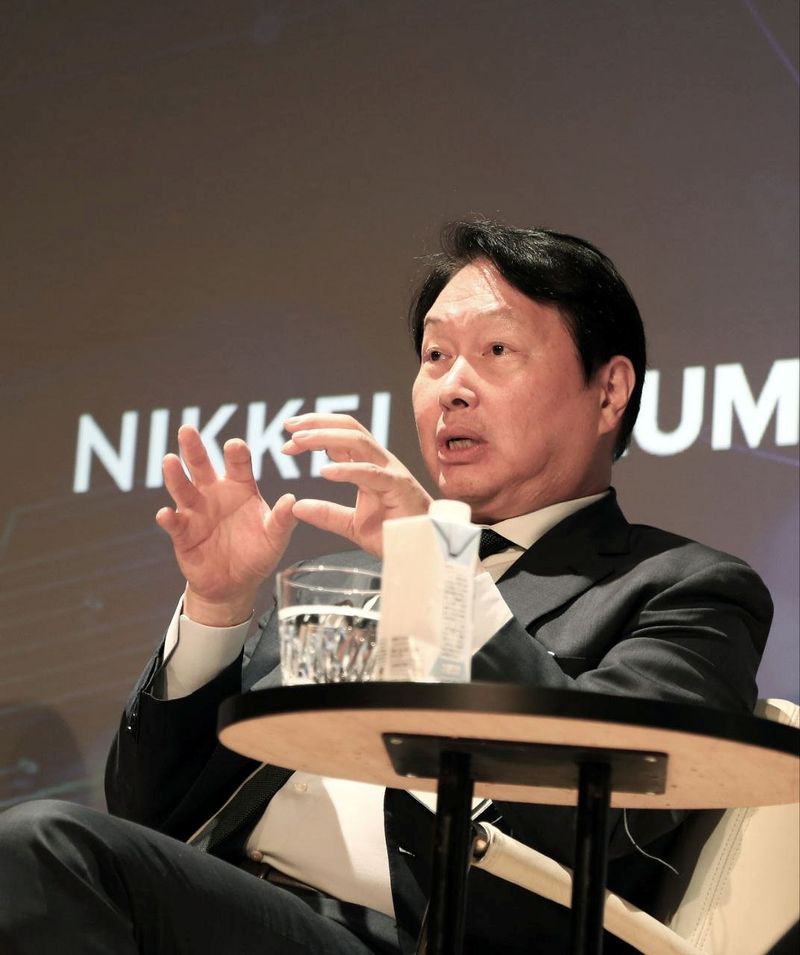
[Financial News, Tokyo = Seo Hye-jin] SK Group will build a next-generation data center dedicated to Artificial Intelligence (AI) in Japan, Nihon Keizai Shimbun reported on the 11th. The company plans to create a massive AI infrastructure that combines its High Bandwidth Memory (HBM) with NVIDIA's graphics processing units (GPU) to capture demand from Japanese companies seeking AI transformation.
In an interview with The Nikkei in Tokyo the previous day, Chey Tae-won, chairman of SK Group, said, "We plan to establish an AI-specialized data center in Japan with a target of 2028 to 2029."
The next-generation data center that SK is pursuing is called an "AI factory." Designed to optimize AI training and inference, it combines SK hynix's cutting-edge HBM with NVIDIA GPUs to improve both power efficiency and computing performance.
Working with NVIDIA, SK plans to first build its initial AI factory in South Korea next year. The Japan project would be its first overseas expansion after Korea.
SK is currently in talks with Japanese companies over construction. Although it did not disclose the investment size, the facility is said to be a massive data center with gigawatt-level power capacity. Industry observers say it would be a project on the scale of the electricity demand of a major city.
The company is reviewing candidate sites, focusing on locations with ample land and a stable power supply.
SK hynix, an affiliate of SK Group, is the world's No. 1 company in HBM, a core component for AI semiconductors. HBM is a memory semiconductor that stacks multiple DRAM chips vertically to enable ultra-fast, high-capacity data processing, and it is widely used in NVIDIA AI accelerators.
Chey expressed concern about supply-demand imbalances in memory semiconductors amid the spread of AI.
He said, "As investment in AI data centers expands, memory demand is surging, and semiconductor shortages are worsening across various industries, including automobiles, PCs and smartphones."
SK is also accelerating efforts to expand production capacity. It is currently building the world's largest semiconductor cluster in Yongin, Gyeonggi Province, and plans to begin plant operations several years earlier than originally scheduled. In particular, Chey said the company could also consider building overseas production bases if additional expansion is needed, and pointed to Japan as a strong candidate.
Chey said, "Japan has semiconductor equipment, materials and component companies concentrated there, so it has the full ecosystem needed," adding that it is "a very attractive investment destination."
Meanwhile, Chey again emphasized the idea of a so-called Korea-Japan Economic Community, in which the two countries strengthen economic cooperation to form a shared market. He argued that, amid the prolonged US-China conflict, companies in both countries need to build a cooperative framework through deregulation and joint procurement to enhance global competitiveness.
Industry observers say SK's AI data center project in Japan could become a symbolic example of both expanded AI infrastructure and deeper Korea-Japan semiconductor cooperation.
[email protected] Seo Hye-jin Reporter