Household debt expands by 7 trillion won in a month amid simultaneous surge in “yeongkkeul” and “debt investing”
- Input
- 2026-06-11 12:00:00
- Updated
- 2026-06-11 12:00:00

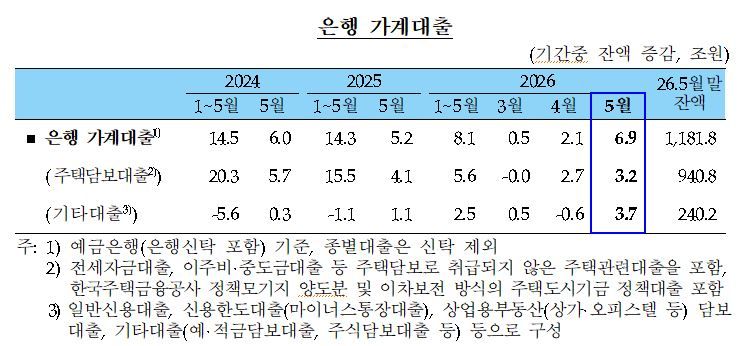
According to the Bank of Korea’s "Financial Market Trends in May 2026," released on the 11th, bank mortgage loans stood at 940.8 trillion won at the end of May. That was up 3.2 trillion won from the previous month.
It was the largest monthly increase in nine months, since August last year, when the figure rose by 3.8 trillion won.
The indicator had continued to rise for 34 straight months, from February 2023, when it fell by 300 billion won, before turning downward in December last year and then firming that trend in January. It rose by 300 billion won in February, was flat in March, and increased by 2.7 trillion won in April before expanding further this time.
The Bank of Korea attributed the increase to higher housing transactions centered on lower-priced homes in the Seoul metropolitan area and stronger demand for intermediate payments on newly sold units, while jeonse loans continued to decline. Jeonse loans fell for four straight months, by 200 billion won in February, 400 billion won in March, 600 billion won in April, and 600 billion won in May.
Housing transaction momentum, however, has not cooled. Apartment sales in the Seoul metropolitan area rose from 20,000 units in February to 23,000 in March and 27,000 in April. In Seoul, apartment sales appeared to ease from 5,800 units to 5,500, but then jumped to 8,500 in April.
Other loans expanded sharply this time. After falling by 600 billion won in April, they reversed course and surged by 3.7 trillion won in May. That was the largest increase in 5 years and 1 month, since the 11.8 trillion won jump in April 2021, when SK ie technology (SKIET) held its IPO. The outstanding balance at the end of May stood at 240.2 trillion won. The increase is seen as the result of large-scale individual stock purchases and seasonal funding needs tied to Family Month.
As a result, bank household loans totaled 1,181.8 trillion won, up 6.9 trillion won from the previous month. That was the biggest monthly increase in 1 year and 9 months, since August 2024, when the figure rose by 9.2 trillion won.
Park Min-cheol, head of the Market Management Team at the Bank of Korea’s Financial Markets Department, said, "Mortgage loans are linked to the housing market, and there is considerable uncertainty after the end of the temporary suspension of heavier capital gains taxes." He added, "In the stock market, leverage is being built through margin loans and other borrowing as individual investors absorb large-scale net selling by foreigners in May. If share prices correct due to an external shock, volatility could be amplified through forced selling."
Loans to large companies rose from 5 trillion won to 5.2 trillion won as banks continued lending and demand for working capital increased for corporate bond repayments. Loans to small and medium-sized enterprises rose from 5.7 trillion won to 5.4 trillion won, with the pace of growth slowing slightly. Even so, they increased as banks maintained a stance of expanding corporate lending for productive finance and related purposes.
Net redemptions of corporate bonds narrowed from 3.9 trillion won to 1.1 trillion won. Higher interest rates made issuance more burdensome, prompting companies to rely on alternative funding sources such as bank loans. Commercial paper (CP) and short-term corporate bonds shifted from net issuance of 4.9 trillion won to net redemptions of 2.1 trillion won, partly because companies used bank loans to cover funding needs. Equity issuance also increased from 400 billion won to 1.4 trillion won, driven by large Paid-in Capital Increase deals by some major companies.
Bank deposits reversed from a 6.8 trillion won decline to a 48.8 trillion won increase. Demand deposits alone rose by 32.8 trillion won. Despite household fund outflows, deposits of short-term surplus cash by some large companies played a major role.
Time deposits increased more than threefold, from 4.7 trillion won to 15.8 trillion won, as banks attracted corporate funds to secure lending resources and manage regulatory ratios, even amid withdrawals from household deposits.
Deposits at asset management companies continued to expand, although the pace slowed somewhat, rising from 99.6 trillion won to 86.4 trillion won. The figure is measured on a total net assets basis, reflecting valuation gains from the stock market rally.
Equity funds increased from 55.7 trillion won to 58.8 trillion won, while other funds rose from 12.9 trillion won to 21 trillion won. Money Market Funds (MMF) saw a smaller increase, at 1.8 trillion won, down from 24.5 trillion won the previous month.
[email protected] Kim Tae-il Reporter