Rising home prices deepen inequality, and in two years they could erode economic productivity
- Input
- 2026-06-11 12:00:00
- Updated
- 2026-06-11 12:00:00

According to the Bank of Korea’s report released on the 11th, titled 'The Reality and Spillover Effects of Household Polarization in Our Economy,' a dynamic panel regression using data from 120 countries between 1980 and 2023 found that a 1 percentage point increase in the asset share of the top 10% leads to a 0.16% decline in Total Factor Productivity (TFP) two years later.
In Korea, the net asset share of the top 10% rose from 43.0% in 2022 to 46.1% in 2025. If the analysis holds, productivity could fall significantly two years later.
Jaeho Lee, deputy head of the Research Coordination Team at the Economic Research Department of BOK, said Korea is especially vulnerable because aging intensifies the inefficiency caused by locked-up assets. Capital tends to remain in unproductive assets such as real estate, or in the hands of older households, rather than flowing into innovative companies or new technologies. As a result, the efficiency of asset allocation declines, and new business entry and innovation are constrained.
Lee noted, "Real estate held mainly by older households is difficult to trade or transfer because it is a physical asset for residential use, so intergenerational asset transfer and circulation do not happen smoothly." He added, "The timing of wealth transfer from older generations to their children has recently been delayed."
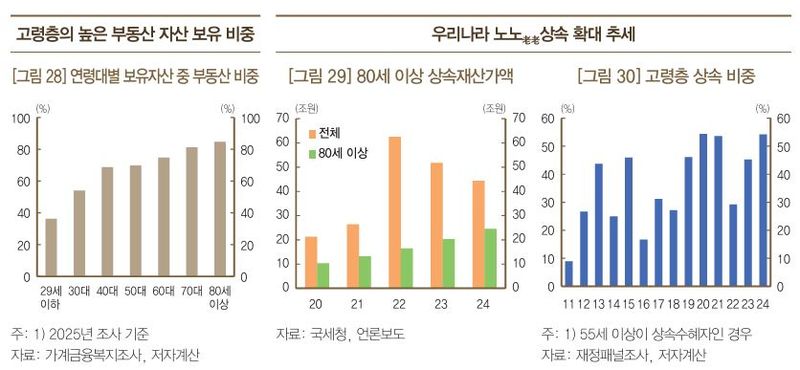
He explained, "As housing costs rise for households without homes and the barrier to buying a home becomes higher, the amount of savings needed to purchase a house also increases." He added that this reduces discretionary spending and weakens domestic demand across the economy.
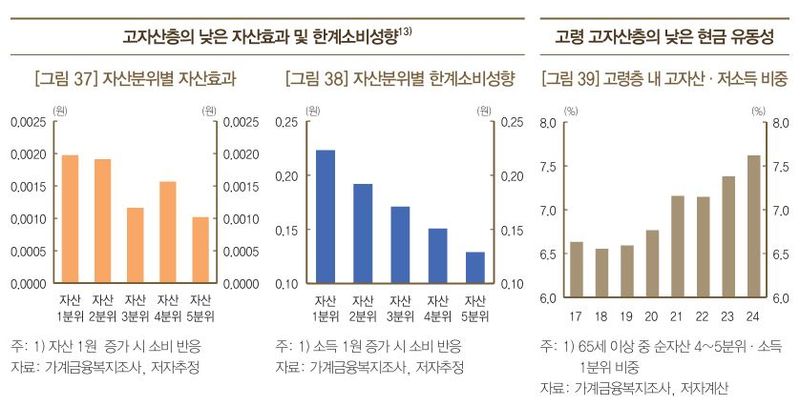
The consumption boost from rising assets is also smaller among high-wealth households than in other groups. In other words, even when their assets grow, the link to spending is weaker than it is for low-asset households. Older asset-rich households may own real estate, but their cash liquidity is limited, leaving them with less money available for consumption. Excessive dependence on high-income and high-wealth households, he said, weakens the household sector’s overall buffer against shocks.
Asset and income polarization also creates social costs. Lee said, "If more people come to believe that wealth gaps cannot be overcome through work alone, social trust in the link between effort and reward will weaken, and intergenerational conflict will grow." He added that housing costs are also likely to constrain marriage and childbirth.
Instead, the priority should be improving the household asset structure, which is centered on real estate. Excessive expected returns should be lowered so that household funds flow into productive sectors. Lee said, "The most important path to asset formation is through labor income, and we need to expand opportunities for young people to engage in challenging productive activities such as entrepreneurship." He added, "We also need to diversify asset-building channels, including the stock market."
Lee also said, "We need to design a system that allows the benefits of technological progress to spread across the economy." He added, "For occupations with a high risk of being replaced by technology, we should strengthen vocational training support in advance." Finally, he said, "To overcome the difficulties facing non-IT industries, we must boldly invest in key sectors such as shipbuilding, defense industry, and nuclear power plants to diversify the nation’s growth engines."
[email protected] Kim Tae-il Reporter