"This Really Is the Last Time"... Retail Investors Rush Into the Bull Market Using Overdraft Lines [Salary Workers' Joys and Sorrows]
- Input
- 2026-06-10 07:35:43
- Updated
- 2026-06-10 07:35:43

[Financial News] "Should I get in now? It feels like I’ll be too late if I only keep saving my salary."
A salaried worker in his 30s, identified as A, recently checked his overdraft limit again. He said he felt increasingly anxious as Samsung Electronics and SK hynix shares surged and the KOSPI showed strength. He does not have much money sitting in deposits, and payday is still far away. He admitted, "I know it is risky to buy stocks with borrowed money, but when I hear people around me talking about their gains, even doing nothing starts to feel like a loss."
As the stock rally continues, salaried investors are facing a different kind of dilemma. The question is no longer where to put spare cash, but whether to borrow money and jump into the market now. Yet overdraft lines and margin trading can amplify gains only by also increasing interest costs and repayment burdens.
Overdraft lines reopen in a hot market
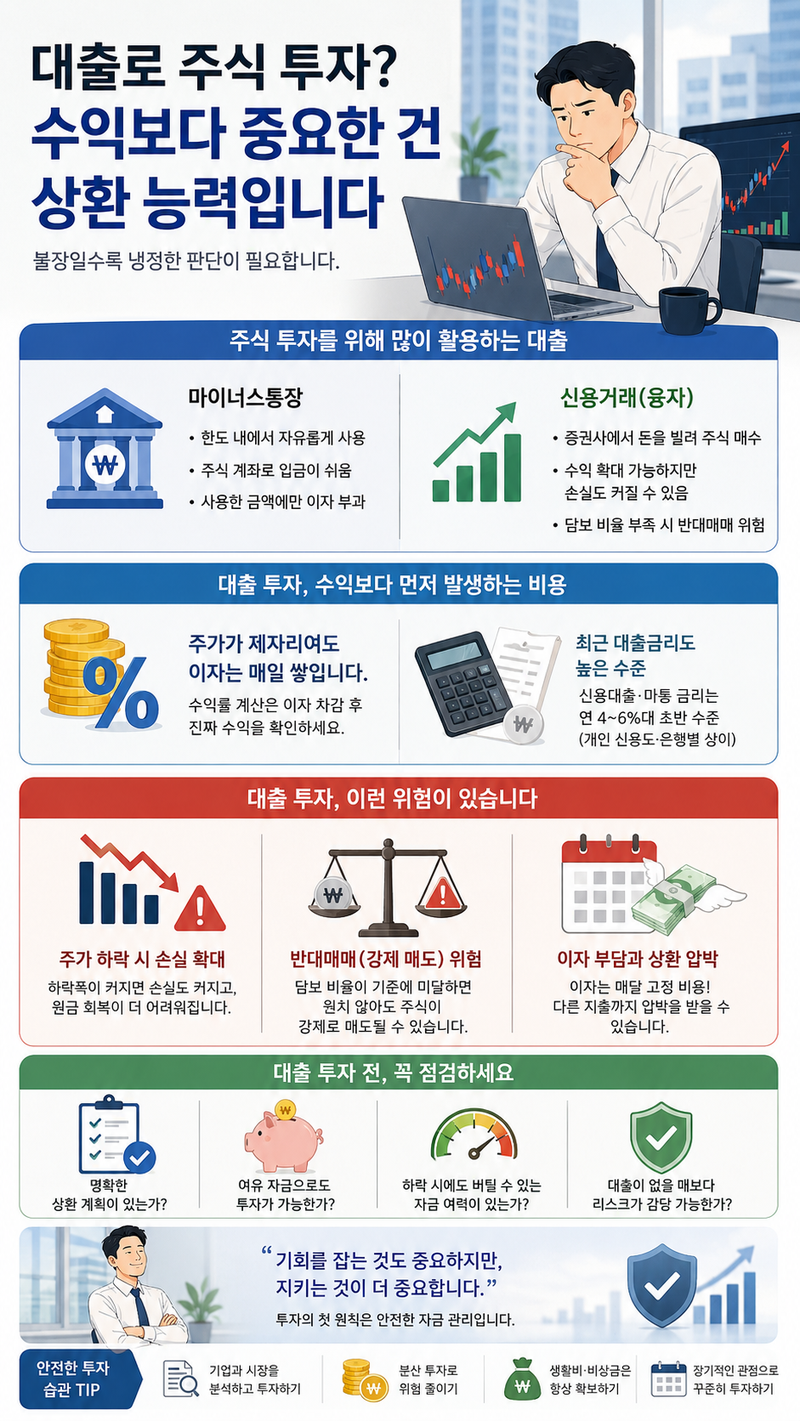
The easiest loan for salaried workers to think of is an overdraft line. It can be used whenever needed within the limit, without repeatedly applying for a separate loan. It is also easy to transfer directly into a stock account, and the belief that it can be used only for a short period lowers the barrier to entry.
According to the financial sector, the outstanding balance of personal overdraft loans at the five major banks — KB Kookmin Bank, Shinhan Bank, Hana Bank, Woori Bank, and Nonghyup Bank — stood at 40.5029 trillion won as of the 7th of last month. That was up by 715.2 billion won in just three business days from 39.7877 trillion won at the end of April. The figure reflects actual borrowed balances, not credit limits.
Borrowing to buy stocks through securities firms is also increasing. The Korea Financial Investment Association said margin loan balances stood at 36.5675 trillion won as of the 15th of last month. Margin loans are the amount investors have borrowed from securities firms to buy stocks and have not yet repaid. When share prices rise, profits grow, but when they fall, losses deepen. If collateral ratios become insufficient, forced selling can also be triggered.
A salaried worker in his 40s, identified as B, said, "It is easy to think you can just repay an overdraft as soon as your salary comes in." He added, "But if stock prices fall, it becomes awkward to sell and repay, and if you hold on, interest keeps piling up."
Interest starts before the return calculation
Investing with borrowed money creates costs from the moment of purchase. Even if the stock price goes nowhere, interest keeps accumulating. And even when prices rise, actual profit must be calculated after subtracting loan interest.
The burden of borrowing has also not been light lately. According to the financial sector, KB Kookmin Bank raised the mixed-rate mortgage loan rate by 0.10 percentage point at the end of last month. As a result, the lower end of that product’s rate rose to 5.07% per year. It was the first time in about three years and seven months, since late October 2022, that KB Kookmin Bank’s fixed-rate floor exceeded 5%.
Interest rates on credit loans and overdraft lines vary depending on an individual’s creditworthiness and each bank’s conditions. For salaried workers, however, they become fixed monthly expenses deducted from paychecks. When card bills, housing costs, insurance premiums, and living expenses are already set, the burden rises quickly once investment-loan interest is added.
A said, "At first, I thought I would use it for just two or three weeks and pay it back." He added, "But if the stock slips for a day or two, you start telling yourself to wait a little longer. Before you know it, the period you are using the loan gets longer."
Impatience moves faster than the rally
What fuels borrowed investing is not stock prices themselves, but the stories of profits circulating around them. When people at work talk about making money on a particular stock, or when screenshots of returns from stock apps appear on social media, impatience grows. Salaries arrive once a month, but stock prices move several times a day.
Psychological barriers can be especially low for familiar large-cap semiconductor stocks. Samsung Electronics and SK hynix are not unfamiliar theme stocks to domestic investors. The line, "It is not like the company is going to fail," can easily turn into a justification for borrowing to invest.
But familiar names do not mean smaller price swings. In a market like the current one, where the index and large-cap stocks move sharply, daily declines can also be steep. If shares are bought with margin loans or overdraft funds, the time available to withstand a downturn becomes shorter.
A salaried worker in his 30s, identified as C, said, "Everyone else was posting proof of profits, and I felt anxious because it seemed like I was the only one just holding deposits." He added, "But when I actually tried to use borrowed money, I stopped because it suddenly felt like this was not my money."
An overdraft line is money to repay, not investment capital
An overdraft line may look like money has been deposited into the account, but it is ultimately debt that must be repaid. If the investment fails, the investor is left not only with losses but also with principal repayment and interest payments. The same goes for margin trading. If the stock moves against expectations, the securities firm’s collateral rules can kick in before the investor has time to wait it out.
In the financial investment industry, the bigger concern is not the rise in leveraged investing during a bull market itself, but investments made without a repayment plan. When stock prices are rising, borrowing costs may look small. In a downturn, however, interest and losses are calculated together.
B recently left his overdraft limit untouched and postponed buying stocks. He said, "Missing the bull market is less frightening than borrowing to get in and then not being able to get out." He added, "I realized I should first look at when I can repay the money, not the return rate."
[email protected] Han Seung-gon Reporter