"Buy on the Dip" Turns Into Liquidation: Forced Selling Tops 160 Billion Won for the First Time in 2 Years and 8 Months
- Input
- 2026-06-09 15:50:53
- Updated
- 2026-06-09 15:50:53
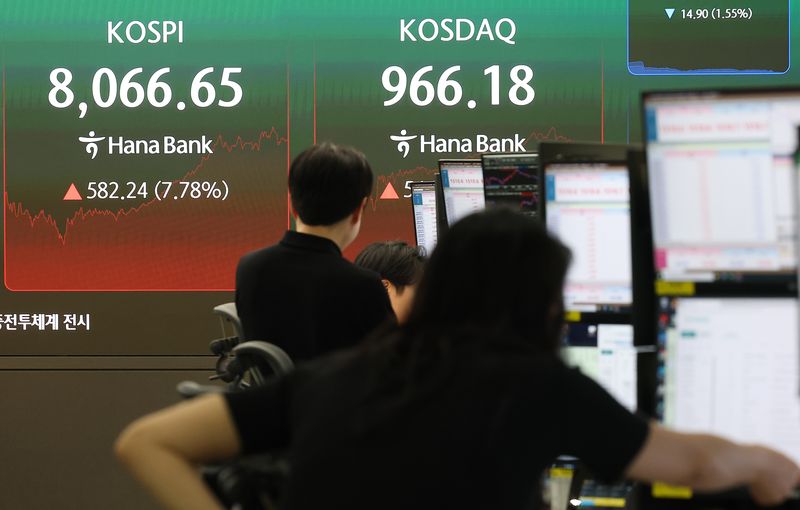
[Financial News] As volatility in the domestic stock market has widened, the scale of forced liquidation of unpaid margin purchases has surged.
According to the Korea Financial Investment Association (KOFIA) on the 9th, the actual amount of forced selling against brokerage margin receivables on the 5th came to 166.2 billion won, the highest level this year.
The amount of forced selling topping 160 billion won is the first in about two years and eight months since Oct. 24, 2023, when it reached 548.7 billion won. The all-time high was set on Oct. 20, 2023, at 549.7 billion won. The ratio of forced selling to margin receivables also stood at 9.1% on the 5th, the highest this year. It was also the first time the ratio exceeded 9% since Oct. 24, 2023, when it reached 53.2%.
Brokerage margin receivables refer to a very short-term form of credit in which individual investors borrow money from securities firms to buy stocks and repay the amount within two business days. When the collateral value of stocks purchased on margin falls below a certain level, the brokerage firm forcibly sells the shares in a process known as forced selling.
The market is believed to have seen large-scale liquidation after investors, expecting a rebound amid the stock market decline, took aggressive positions only to face another drop the next day. The KOSPI rose 28.45% last month, jumping from the 6,000 level to the 8,000 level in one move. After the index fell 1.84% on the 4th, margin traders emerged, and when it plunged another 5.54% on the 5th, forced selling surged sharply. On the 8th, the KOSPI also dropped 8.29% from the previous day, so the scale of forced selling is expected to have increased further as of the 9th.
The brokerage industry expects volatility to continue for the time being and advises caution when using borrowed money to invest. The prolonged conflict in the Middle East has heightened geopolitical uncertainty, while other variables that could affect the market, such as international oil prices and interest rates, remain significant.
Kim Seok-hwan, a researcher at Mirae Asset Securities, said, "In a sharp selloff, the biggest risk is not the price drop itself, but forced liquidation. Investors should reduce leverage, secure cash, and respond with a focus on high-quality assets." He added, "The recent plunge is painful, but it has not destroyed the earnings strength of all domestic companies, so it may be time to prepare for the next opportunity."
He also emphasized, "In the current market, investors should not just look at stock prices. They should also check whether the factors behind the volatility are easing." He added that they need to monitor exchange rates, interest rates, foreign investor flows, and whether large semiconductor stocks are stabilizing on the downside.
There are also warnings that because a large amount of borrowed investment money has already piled into the market, losses could widen during a correction. Labor economist Noh Dong-gil at Shinhan Securities said, "The average entry level for recently increased credit funds is estimated at around the KOSPI 8,200 to 8,400 range. When losses approach 15%, voluntary reductions tend to appear, and around a 20% loss, the likelihood of forced selling rises." He added, "Therefore, the KOSPI 7,000 to 7,200 range is not a fundamental support line, but a volatility acceleration zone. Investors should be wary if the correction turns out deeper than expected."
[email protected] Lim Sang-hyuk Reporter