After a Sharp Drop, the Rebound Still Revolved Around Semiconductors... Brokerage Houses Say a Focused Response Is Effective
- Input
- 2026-06-09 16:21:20
- Updated
- 2026-06-09 16:21:20
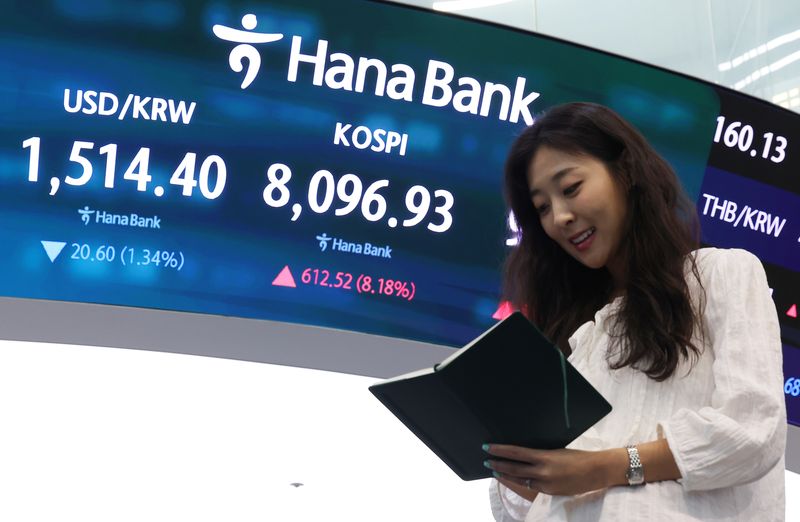
[Financial News] South Korea's stock market, which had plunged the previous day, rebounded within a day and reclaimed the 8,000 level on the KOSPI. Buying spread across the market, but the rebound was again led by semiconductors and information technology (IT). Brokerage houses say it is more effective to focus on a narrow set of sectors rather than broaden the buying theme.
According to the Korea Exchange (KRX) on the 9th, the KOSPI closed at 8,096.93, up 8.18% from the previous trading day. The index, which had fallen to the 7,400 range the day before, recovered the 8,000 level in just one day.
The share of rising stocks suggests that the rebound spread across the market. Of the KOSPI's 948 listed companies, 774 rose while only 133 fell. On the KOSDAQ, 1,435 of 1,822 stocks advanced, while 258 declined.
Still, semiconductors were once again at the center of the rebound. The KRX Information Technology Index rose 11.99%, the highest gain among all indices. The KRX Semiconductor Index and the KRX 300 Information Technology Index also climbed 11.88% and 11.70%, respectively, ranking second and third. With Samsung Electronics, SK hynix, SK Square, and Samsung Electro-Mechanics among the largest constituents of the KRX Information Technology Index by market capitalization, the strength in the IT index is being interpreted as an extension of the rebound in large semiconductor stocks.
The semiconductor tilt was also clear in individual stocks and related products. Samsung Electronics rose 7.87%, while SK hynix jumped 14.18%. Samsung Electro-Mechanics gained 16.17%, and SK Square advanced 11.72%, helping drive the index rebound. As large semiconductor stocks surged, KODEX SK Hynix Single Stock Leverage ETF rose 31.42%, and Samsung Electronics Single-Stock Leveraged ETF climbed 18.97%, partially recovering their earlier losses.
On the supply-and-demand side, institutional buying stood out. In the Korea Exchange Main Board Market that day, institutions bought a net 270.5 billion won. By contrast, individuals sold a net 112.9 billion won, and foreigners sold a net 167.56 billion won. If retail buying had supported the index during the previous day's selloff, institutions turned to net buying in Tuesday's rebound and helped lift the market.
Brokerage houses view the latest correction not as damage to earnings expectations, but as a price adjustment driven by overheated valuations, along with concerns over interest rates and oil prices.
Analysts say there is no need to abandon the medium-term outlook for the domestic market as long as semiconductor earnings expectations remain intact. However, since the market's internal momentum has been weakened, they argue that investors should narrow their focus rather than spread buying across all sectors. The preferred areas are a small number of sectors where earnings upgrades are confirmed, including spot semiconductors, shipbuilding, defense industry, Capital Goods and Trading Companies, and power equipment.
Noh Dong-gil, a researcher at Shinhan Investment Corp., said, "Although the KOSPI and large semiconductor stocks plunged, the KOSPI 12-month forward earnings per share and operating income estimates fell only 0.01%, and semiconductor estimates were unchanged." He added, "This decline is less the end of the bullish case than a revaluation of risks in a market that had concentrated on AI semiconductors. A spot-focused approach is possible, but investors should be cautious about aggressively expanding leveraged products."
[email protected] Bae Han-geul Reporter