"Foreign Investors Are Forced Sellers"... IB Sees KOSPI Rising to 12,000
- Input
- 2026-06-09 07:27:36
- Updated
- 2026-06-09 07:27:36
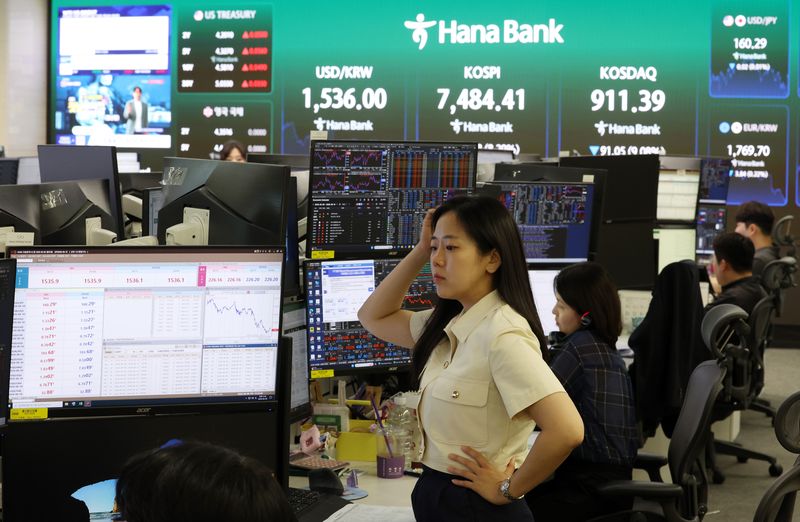
[Financial News] As the KOSPI market has continued its record-setting rally since the start of the year, foreign investors have been dumping billions of dollars’ worth of shares. Analysts say this is not a sign of deteriorating fundamentals in the Korean stock market, but rather a form of “mechanical selling” driven by efforts to rebalance sharply expanded exposure to Korean equities.
Foreign investors sell on KOSPI surge... Analysts call it a “technical correction”
On the 8th local time, CNBC reported that foreign investors had sold billions of dollars’ worth of shares in the Korean stock market, which has hit record highs, and said KOSPI’s “excessive rise and success” had fueled the selling.
Foreign investors were net sellers of about 70 trillion won in the main bourse from May 7 to June 8. Goldman Sachs also estimated that, as of the end of May, the amount of capital foreign investors had pulled out of the KOSPI market had already reached about $62 billion, or roughly 85 trillion won.
However, market experts at home and abroad said the massive foreign selling was not because “the fundamentals of the Korean economy or companies have collapsed.” Chetan Seth, Asia-Pacific Equity Strategist at global asset managers and Nomura Securities, described the current situation as “forced selling that investors and clients had no choice but to make.”
As large-cap tech stocks such as Samsung Electronics and SK hynix surged, the weight of the Korean market in global and emerging market benchmark indices rose sharply. As a result, investors had no choice but to reduce their exposure mechanically in order to comply with limits on holdings in specific countries or stocks and with risk-management rules.
Nick Wilcox, a director at Man Group in the UK, also said the rapid growth of the Korean market is creating structural selling pressure for overseas investors. He noted that “a significant amount of selling is unavoidable because investors are hitting buying limits.”
"KOSPI fundamentals remain solid.... It is part of the rebalancing process"
The huge amount of stock sold by foreigners is being absorbed by domestic funds, led by individual investors in Korea. Wilcox said that “the outflow from foreign investors is being more than offset by domestic investors,” adding that about $70 billion in retail money has flowed in this year alone and that securities account openings have also surged.
Although concerns have emerged that the recent KOSPI rally is overly concentrated in Samsung Electronics and SK hynix, experts remain upbeat about the medium- to long-term outlook. They stress that the current selling is purely a matter of rebalancing, not a negative view of the Korean market.
In fact, Goldman Sachs said in a report released on the 2nd that its 12-month target for KOSPI is 12,000, implying about 37% upside from current levels. The analysis suggests that foreign investors are likely to return after the correction, looking for a bottom.
[email protected] Kim Hee-sun Reporter