"South Korea Is the Global Economy's Winner Amid Booms in Semiconductors, Shipbuilding and Defense," Says Financial Times
- Input
- 2026-06-09 04:59:47
- Updated
- 2026-06-09 04:59:47
South Korea is emerging as a winner in the global economy, driven by semiconductors, shipbuilding and defense, the Financial Times (FT) reported on the 8th local time.
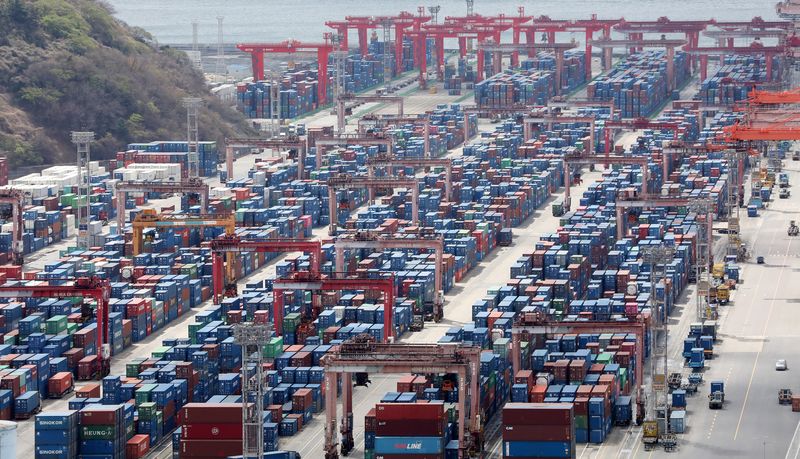
In an analysis article that day, FT noted that South Korea's economy grew 3.6% year on year in the first quarter, far outpacing the 1.6% growth recorded in the fourth quarter of last year amid a semiconductor and defense boom. It added that exports also surged 38% to a record $220 billion.
Michael Breen, CEO of Insight Communications, said, "Many sectors of the South Korean economy are now enjoying a golden age." Despite challenges such as high living costs, youth unemployment and dependence on overseas energy, Breen stressed that "South Korea's growth engine is still running very strongly."
AI
South Korea is riding the global artificial intelligence (AI) boom and enjoying a strong run.
Of the total $85.89 billion in exports in April, $31.9 billion came from memory semiconductors. That was a record high.
Samsung Electronics and SK hynix each surpassed a market capitalization of $1 trillion and ranked among the world's 20 largest companies.
The power boom triggered by AI, the "energy hog," is also a boon for the South Korean economy.
Manufacturers of ultra-high-voltage transformers are surging.
Hyosung Heavy Industries, HD Hyundai Electric and LS ELECTRIC have all gained momentum. FT reported that the combined order backlog of the three ultra-high-voltage transformer makers has reached 32 trillion won, and that Hyosung Heavy Industries' stock price has soared more than 50-fold over the past five years.
Shin Hyun-song, governor of the Bank of Korea, forecast last week that despite the shock from the war in Iran, the strong semiconductor sector will lift this year's gross domestic product (GDP) growth rate by 0.7 percentage point.
Shipbuilding
FT said South Korea and China are the two leaders of global shipbuilding, while other countries are losing competitiveness. As a result, the United States and its allies are increasingly relying on South Korea.
HD Hyundai Heavy Industries, the world's largest shipbuilder, won orders for 16 liquefied natural gas (LNG) carriers this year. That is more than double the seven vessels it secured in all of last year.
A worker at a shipyard on Geoje Island said, "We are using every available space right now," adding that "equipment utilization is at 100%, or even higher."
The big three — Samsung Heavy Industries, Hanwha Ocean and HD Korea Shipbuilding & Offshore Engineering, the parent of HD Hyundai Heavy Industries — won $19.1 billion worth of orders from January to May this year. Their annual order intake is expected to exceed last year's $36.3 billion.
In April, the U.S. Department of Defense set aside $1.85 billion for a feasibility study to determine whether warships can be designed and built in South Korea and Japan. The move breaks with a decades-old rule that warships must be built only in the United States. As the Government Accountability Office (GAO) declared last year that the U.S. shipbuilding industry was "essentially in collapse," outsourcing warship production to South Korea and Japan is gaining traction.
One finance industry source said that if the United States wants to maintain control in the Asia-Pacific region, naval and merchant shipbuilding is essential. The U.S. will have no choice but to rely on the shipbuilding capabilities of South Korea and Japan, especially South Korea, the source added.
Defense
FT reported that Russia's full-scale invasion of Ukraine in February 2022 gave new momentum to South Korea's defense export industry as security concerns rose across Europe, Asia and the Middle East.
Korean weapons are popular because they are cheaper than Western arms and come with few of the delivery delays or usage restrictions associated with U.S. systems.
Along with $6.5 billion in exports of fighter jets, rockets and tanks to Poland, South Korea signed arms export deals this year alone with Peru, Norway and the United Arab Emirates (UAE). Its defense export backlog, for goods not yet shipped, reached 113.3 trillion won, up 24% over the past year.
K-Beauty, Tourism
The softer side of South Korea's industries is also booming.
South Korea's cosmetics exports rank second in the world, behind France.
As K-pop and K-dramas gain popularity around the world, cosmetics exports have also risen sharply.
Tourist arrivals in South Korea are also surging. The number of foreign visitors in the first quarter reached 4.76 million, up 23% from a year earlier.
China's catch-up is a double-edged sword
However, some industries are struggling as China closes the gap.
While semiconductors are driving manufacturing growth, some sectors such as steel and petrochemicals are struggling under China's low-price offensive and high oil prices.
Small and medium-sized companies, which face heavy wage and energy costs, are also under pressure.
Many experts worry that as China transforms from a low-cost, low-value-added industrial base into a high-tech powerhouse, South Korea faces an existential threat. Korean industries such as machinery, batteries, displays and automobiles are already gripped by fears of losing their leading positions.
Young-Han Kim, a professor of economics at Sungkyunkwan University (SKKU), said, "It is only a matter of time before South Korea is pushed out of the market after losing the technology race with China," adding that "South Korea appears to be being driven into a relative disadvantage in almost every field except semiconductors."
On the other hand, FT reported that some argue this sense of crisis has always served as a catalyst for South Korean industry.
[email protected] Song Kyung-jae Reporter