[Editorial] Financial markets are wobbling, and a stronger-than-expected response is needed
- Input
- 2026-06-08 19:07:14
- Updated
- 2026-06-08 19:07:14
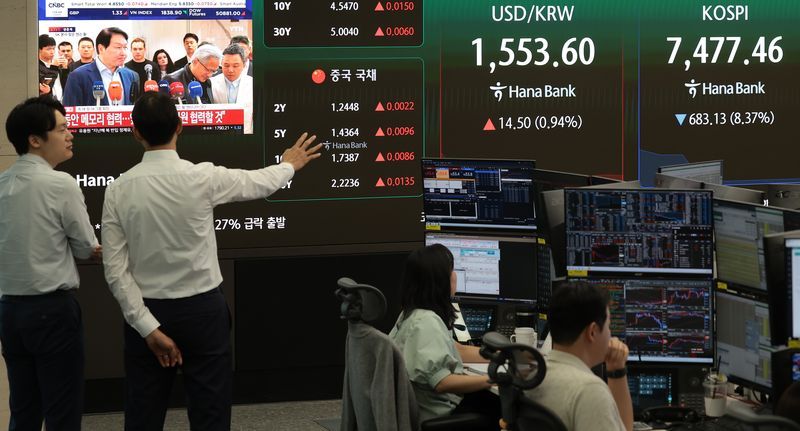
KOSPI and KOSDAQ both plunged on the 8th, triggering circuit breakers one after another. KOSPI fell below the 8,000 level early in the session and then lost the 7,500 mark as well. KOSDAQ also broke below 1,000. The shock originated from the collapse in U.S. semiconductor stocks. The market value of major chipmakers such as NVIDIA, Micron, and AMD evaporated by more than $1.3 trillion in a single day over the weekend.
Broadcom's earnings release fueled concerns that investment in AI data centers and the semiconductor boom may have already peaked. On top of that, talk of additional U.S. interest rate hikes has intensified risk aversion. Korea's stock market, which is heavily dependent on semiconductors, has taken the full force of the shock from the United States.
The foreign exchange market is in even worse shape. The won-dollar rate climbed above 1,555 won early in the day, and in overnight trading the previous day it even broke through the 1,560 won level. Higher oil prices caused by the prolonged Middle East war, along with foreign capital outflows, are pushing the currency higher. In the bond market, the yield on the three-year Korean Treasury Bond rose to its highest level in 2 years and 7 months.
Conditions surrounding the Korean economy are hardly favorable. Thanks to the competitiveness of key industries such as semiconductors, the Current Account Balance has remained in surplus and country creditworthiness has held up relatively well. Even so, the prolonged instability in the Middle East, now stretching beyond 100 days, has kept demand for the safe-haven USD strong. Despite the export boom, dollars earned by companies are not flowing back into the country sufficiently, and the planned $350 billion in U.S. investment also adds pressure. In other words, the market is betting on further weakness in the won. Foreign investors have also been net sellers for more than 20 trading days, deepening market unease.
The authorities have not stood still. They have issued repeated verbal warnings and even held an emergency market monitoring meeting on a holiday to discuss response measures. They have also said they will respond firmly to speculative moves and market-disrupting behavior. Measures such as raising the National Pension Service (NPS)'s foreign-exchange hedging ratio are also being discussed. But many say these steps alone will not be enough to stabilize the market. The problem is that the authorities have only a limited set of tools available.
What is needed now is a stronger response that can calm market anxiety. Measures that go beyond expectations are required, including a possible revival of the Korea–US currency swap agreement, which served as a safety net during the GFC and the COVID-19 pandemic. The government should also reexamine its medium- to long-term strategy for strengthening the competitiveness of the semiconductor industry and prepare in advance for risks tied to rising interest rates, including household debt and leveraged stock investments. The warning sent by the market should not be dismissed as a temporary shock. Of course, both overreaction and underestimation are dangerous. This may be the golden time to assume the worst and prepare countermeasures.