A market unafraid of threats... The era of the 1,600 won exchange rate
- Input
- 2026-06-08 11:34:13
- Updated
- 2026-06-08 11:34:13
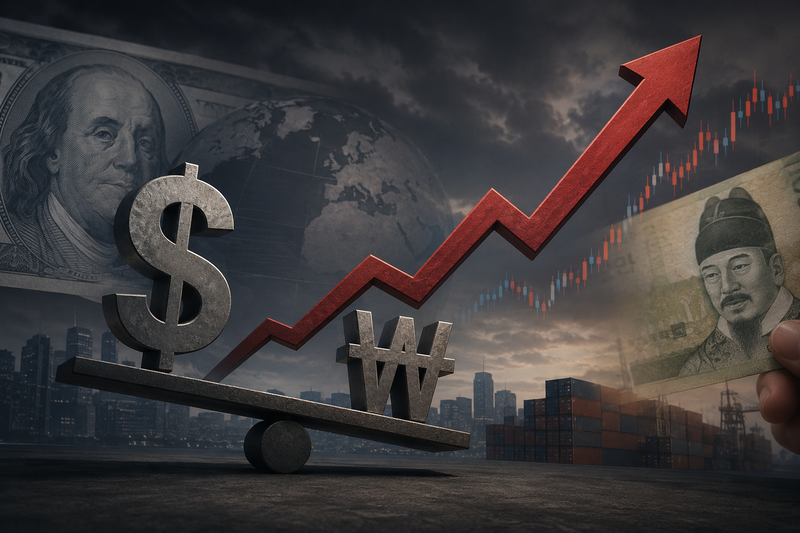
0 won), during the global financial crisis. The closing price has also remained in the 1,500 won range for 14 consecutive trading days, from the 15th of last month to the 5th of this month. It has effectively become the 'new normal. ' Of course, given the changed macroeconomic environment, it cannot be evaluated on the same level as exchange rates during past crises, but the general market assessment is that it cannot be considered a low level.
0 won during night trading, closely approaching the 1,600 won mark, and the purchase exchange rate for dollar cash at airports has already surpassed that threshold. The basis of this upward trend in the exchange rate is the interest rate gap between Korea and the U. S. Not only is the difference in base rates widening, but the gap in market rates, which have a more direct impact on the foreign exchange market, is also expanding.
The yield on 10-year U. S. 0% range.
As the dollar is drawn toward the side with higher market rates, the 'strong dollar, weak won' dynamic is becoming more solidified. The market was also stimulated by the fact that U. S.
May non-farm payrolls increased by 172,000, exceeding expectations (85,000) and raising the possibility of a policy rate hike by the U. S. Federal Reserve (Fed).
This is because it was determined that the relatively robust economy has created an environment where the focus can be on curbing inflation, which is soaring due to high oil prices resulting from the Middle East crisis. There is also upward pressure on the exchange rate as foreign investors convert won into dollars after selling domestic stocks for purposes such as portfolio adjustments and profit realization. As of the 5th, foreign investors have net sold over 59 trillion won worth of domestic stocks in the past month.
8 trillion won). This current account balance marks the second-highest record in history and is the highest ever for the month of April. Even if the real economy achieves results, the factors in the financial sector that could drive up the exchange rate are effectively offsetting them all and have not yet been exhausted.
Moon Hong-cheol, a researcher at DB Securities, explained, "Existing explanatory models are collapsing because the supply and demand of dollars in exports or the current account balance are moving independently of each other. " He added, "The commonality among countries with recently weakened currencies is that they are 'currencies with strong foreign exchange regulations where the government manipulates the exchange rate through foreign exchange reserves. '" The problem is that the influence of foreign exchange authorities in the market is diminishing.
On the 7th, Deputy Prime Minister and Minister of Finance and Economy Koo Yun-chul warned at a market situation review meeting that severe measures would be taken if speculative trading was detected, stating, "We have decided not to tolerate excessive volatility and one-way bias. " However, as market sentiment has already shifted toward a rise in the exchange rate, the effect was minimal. Rather, unlike in the past, verbal intervention is being interpreted as a sign of the authorities' anxiety rather than a threat.
There are also no suitable physical measures for the foreign exchange authorities to respond. In effect, selling dollars is the only means to alleviate downward pressure on the won. However, while foreign exchange reserves amount to approximately $430 billion for this purpose, the reality is that these reserves cannot be indiscriminately released for the purpose of defending the exchange rate, as the interest and earnings from them must be used to raise $20 billion annually for investment in the U.
S. Moon Da-woon, a researcher at Korea Investment & Securities, pointed out, "The reason the exchange rate is frightening is its self-fulfilling nature; expectations of a rise create a one-way supply and demand bias toward buying dollars, causing the rate to jump even further in reality. " He added, "We have no choice but to wait for bearish factors, such as the May Consumer Price Index (CPI) and the Federal Open Market Committee (FOMC), which is expected to be hawkish, to resolve sequentially.
"
[email protected] Kim Tae-il Reporter