"Avoid panic selling right after the opening amid Black Monday fears," securities firms say, calling it a 'buy-the-dip opportunity'
- Input
- 2026-06-08 08:09:59
- Updated
- 2026-06-08 08:09:59
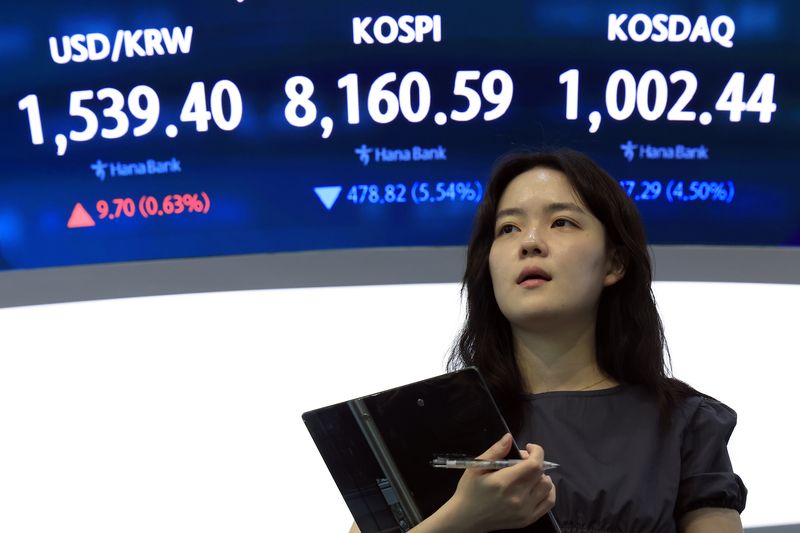
[Financial News] As global financial markets reel from the shock of so-called Black Monday, analysts say the current stock market correction may actually offer a chance to buy key leading stocks at lower prices. In particular, the possibility that NVIDIA may reduce the amount of memory in its products, a concern that has rattled the market, is being interpreted not as a sign of weakening demand, but as evidence of an extreme supply shortage.
Hana Securities: "The trigger for the anxiety was the exchange rate.... Semiconductor earnings are still intact"
In a report released on the 8th titled 'Fear Came from the Exchange Rate, Opportunity Comes from Earnings,' analysts Du-eon Kim and Kim Rok-ho at Hana Securities said, "The current market decline is not the result of a collapse in fundamentals or an economic downturn." They added, "It is a temporary compressed correction caused by heightened volatility in the foreign exchange market, the Fed's move to reset interest rates, and a flood of profit-taking in the semiconductor sector after a steep rally."
The report said the biggest source of market anxiety lies not in the stock market but in the foreign exchange market. It explained that the U.S. Dollar Index, which measures the dollar's value against major currencies, climbed back above the 100 level, while the won–dollar exchange rate surged to as high as 1,560 won, prompting foreign investors to pull money out of the domestic market. Because foreign flows tend to focus first on exchange-rate stability rather than stock prices themselves, even companies with strong earnings can be pushed down on the supply-demand side if the won does not stabilize.
On top of that, stronger-than-expected U.S. Employment Report data have weakened expectations for rate cuts by the Federal Reserve System (Fed) and even led markets to begin pricing in the possibility of rate hikes, putting pressure on growth stock valuations. In other words, the analysis is that corporate earnings forecasts have not deteriorated; rather, the discount rate used to convert future profits into present value has risen.
Regarding the sharp sell-off in leading semiconductor names in the previous trading session, including Samsung Electronics Co., Ltd. (-6.4%), SK hynix (-9.9%), and Micron, which fell about 20% over two days in domestic and overseas markets, the report said the market had overreacted.
Recently, some in the tech industry predicted that the LPDDR5X memory capacity installed in NVIDIA's next-generation AI platform, Rubin, could be cut in half from the previous forecast of 54TB to 27TB. The market took this as a sign that demand for memory chips was weakening, but the report argued that the opposite interpretation is correct. It said the change was not driven by falling demand, but by a 'design change caused by supply constraints,' as manufacturers simply cannot keep up with explosive AI demand. Even if the installed capacity is reduced to 27TB, that would still represent a 50% increase from the previous-generation Grace Blackwell platform, which used 18TB.
According to Hana Securities' analysis, when Rubin shipments begin in earnest in 2027, NVIDIA's required LPDDR volume is expected to account for at least 36% and as much as more than half of global total supply capacity. That is a level that is realistically close to impossible for a single company to absorb, meaning NVIDIA's review of a lower installed memory capacity is, paradoxically, proof of a severe LPDDR supply shortage.
"Do not blindly dump stocks in panic right after the opening," the report advised
Hana Securities also offered a concrete strategy for navigating this volatile market. First, it identified panic selling right after the opening, when investors are swept up by fear and dump shares indiscriminately, as the behavior to avoid most. Instead, it advised calmly monitoring whether the won–dollar exchange rate settles around the 1,560 won level or continues to surge.
Once the market begins to find balance, it suggested selective bargain hunting in large-cap memory stocks with clear earnings visibility in the second half of the year, as well as in key companies that can ease bottlenecks in the Artificial Intelligence Supply Chain. However, it added that exposure to KOSDAQ growth stocks, which are relatively vulnerable to macroeconomic variables, would be safer only after the foreign exchange market has clearly stabilized.
The analysts repeatedly stressed, "Although stock prices have swung wildly, the compass of corporate profits is still pointing upward." They added, "The current fear is noise that should be let pass, while actual earnings are a clear signal. The louder the noise and the more irrational the market becomes, the more investors should focus on the clear earnings signal."
[email protected] Sung Min-seo Reporter