[Editorial] Jensen Huang’s Series of Meetings Could Cement AI Leadership
- Input
- 2026-06-07 18:45:46
- Updated
- 2026-06-07 18:45:46
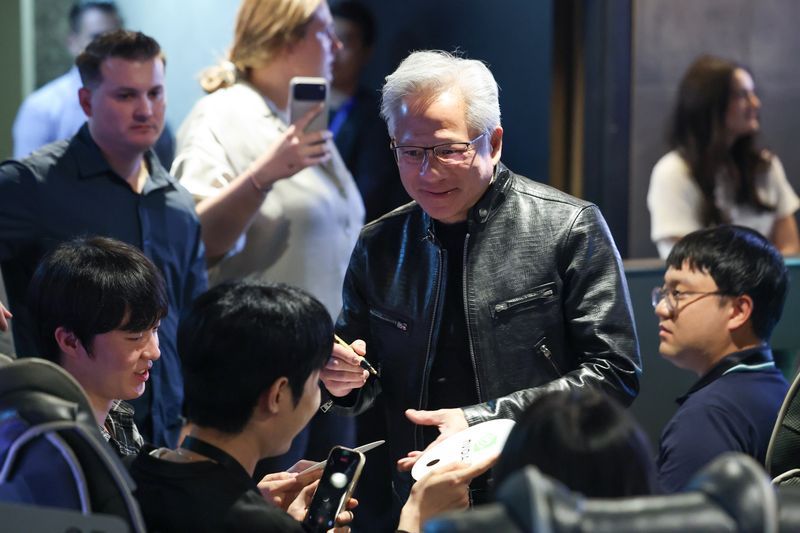
There is no shortage of signs that NVIDIA places great importance on Korea. From the moment he arrived, Huang drew attention by saying, "We have prepared a surprise gift for Korea." He also assessed Korea’s AI foundation, saying, "Korea has outstanding manufacturing capabilities and a vast ecosystem that can support the robot industry." The gift Huang has prepared is said to be a domestic cooperation project related to NVIDIA’s next-generation AI accelerators, Vera Rubin, and the Vera CPU. There is also a possibility that the company will place large orders for semiconductors such as high bandwidth memory (HBM) and low-power DRAM. It is also noteworthy that NVIDIA has formally proposed establishing an R&D Center, reaching out to Korea as a key partner in the next-generation AI ecosystem.
From Korea’s perspective, there is no reason to turn down cooperation with NVIDIA. NVIDIA’s graphics processing unit (GPU) and software ecosystem are now close to the de facto standard for the global AI industry. The ecosystem NVIDIA has built has become a massive infrastructure that companies around the world rely on. Through the NVIDIA platform, Korea’s memory, foundry, semiconductor packaging, and robotics technologies can connect directly to the global market. There are many areas where Korea can create synergies with NVIDIA.
The issue is how the cooperation is structured. It is necessary to ride NVIDIA’s momentum to reach the global market, but Korea must not stop at supplying parts and buying NVIDIA chips for use. Korea should guard against being reduced to a subcontractor supplier in the core value chain of the AI era. It must not become intoxicated by the outward boom in semiconductors and lose sight of the essence of industrial leadership.
The key issue is, once again, leadership in Physical AI. If generative AI changed the world on a screen, Physical AI is a technology that shakes up the entire real-world production system in robots, cars, factories, and logistics sites. Korea has a strong physical base in automobiles, batteries, shipbuilding, electronics, and semiconductor manufacturing processes. Real competitiveness will come only when AI models, robot operating systems, industrial data, and other related technologies are combined on top of that base. Huang’s emphasis on Korea’s robotics potential was also in this context.
We hope cooperation with NVIDIA can serve as a lever for building a Korean-style Physical AI ecosystem and help Korean companies rise even higher. The government should consider practical strategies to turn Korea’s manufacturing sites into AI testbeds. Companies must also commit themselves to using vast manufacturing data as an asset to create new technologies and standards. In addition, broad social support is needed so that corporate profits can be used for technology development and future investment.