"Elderly Poverty and Lonely Deaths Are Not Just Japan's Problem... They Are Challenges South Korea Will Soon Face" [Global Report]
- Input
- 2026-06-07 18:38:05
- Updated
- 2026-06-07 18:38:05
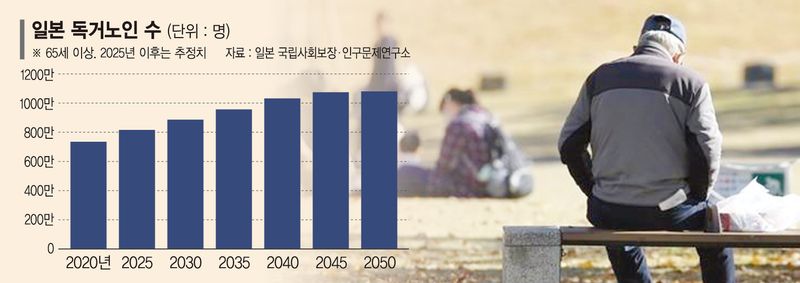
According to the National Institute of Population and Social Security Research (IPSS), one-person households are expected to account for 44.3% of all households in 2050. In particular, the number of elderly people aged 65 or older living alone is projected to reach 10.83 million, including 4.5 million men and 6.33 million women.
The issue is not simply that more older people are living by themselves. Many elderly people living alone today still have close family members such as children or siblings. But in the future, the number of older adults entering old age after remaining unmarried for life or having no children is expected to surge. The unmarried rate among older single men is forecast to rise from 33.7% in 2020 to 59.7% in 2050, while the rate for women is expected to increase from 11.9% to 30.2%. In effect, Japanese society is entering an era of "old age without family."
The rise in elderly people living alone is also feeding into the problem of elderly poverty. According to the Ministry of Health, Labour and Welfare (MHLW), the number of Public Assistance (seikatsu hogo) recipients reached 1.99 million in 2023, roughly double the 1.03 million recorded in 2000. Among recipients, the share of people aged 65 or older rose from 37% in 2000 to 53% in 2023. More than half of all Public Assistance recipients are now elderly. This is also why the Japanese government is pushing pension reform. Experts say that unless the problem of low pensions is addressed, reliance on Public Assistance will continue to expand, and they are calling for a minimum income guarantee and housing allowances.
Local governments in Japan are actively encouraging families to live together in an effort to curb the growth of elderly people living alone. A representative example is Atsugi City in Kanagawa Prefecture. Atsugi has an elderly single-person household rate of 16.8%, the lowest in the region. The city provides up to 1 million yen, or about 9.73 million won, if adult children live with their parents, and up to 800,000 yen, or about 7.78 million won, if they choose to live nearby. The subsidies are offered when households buy or renovate homes. Between 2018 and 2021, the city provided support in 122 cases and helped attract 372 new residents.
Japan is also building a tighter care system that uses the entire community. In Hagamachi, Tochigi Prefecture, 47 businesses, including shops, post offices and taxi companies, take part in monitoring signs of trouble among elderly people living alone. If they find mail piling up for a long time or a home where the curtains remain closed, they immediately notify local authorities.
Senior-only share houses have also appeared in Tokyo. The nonprofit organization Seongsae Hyeonhyeok House opened a share house for older women living alone in Edogawa Ward in 2021. The ward office helped by introducing vacant homes and covering part of the renovation costs. Women in their 60s and 70s now live there together.
Experts warn that "the problems Japan is facing today -- elderly people living alone, elderly poverty and lonely deaths -- are likely to become South Korea's future in a few years." They say the country must move beyond a system that relies only on family care and adopt comprehensive measures that include support for cohabitation and nearby living, community care networks, housing assistance and income security in old age.