U.S. semiconductor stocks lose 2,000 trillion won in market value as fear of a 'Black Monday' grips the market [Stock market shockwaves from semiconductors]
- Input
- 2026-06-07 18:25:17
- Updated
- 2026-06-07 18:25:17
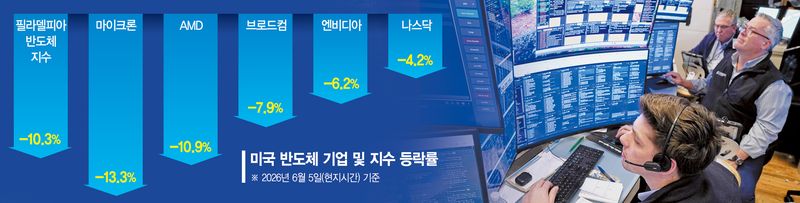
According to the financial investment industry on the 7th, the Philadelphia Semiconductor Index, which tracks 30 major U.S. semiconductor stocks, fell 10.3% on the 6th local time from the previous trading day. It was the steepest drop since March 2020, when global financial markets were thrown into panic by the spread of COVID-19.
As AI chip names such as NVIDIA, Broadcom Inc., AMD, and Micron all plunged, the market value wiped out in one day reached $1.3 trillion, or about 2,027 trillion won. Analysts say this marks the first broad-based profit-taking phase after the AI semiconductor rally that has continued since last year.
On the 5th, the KOSPI closed at 8,160.59, down 5.54% from the previous day. The KOSDAQ also finished at 1,002.44, down 4.50%. During the session, a sell-side sidecar was triggered on the KOSPI, and the KOSDAQ briefly fell below the 1,000 mark. The won–dollar exchange rate also surged to as high as 1,549 won intraday, the highest level since 2009. Samsung Electronics Co., Ltd. fell more than 6%, while SK hynix dropped over 9%. AI-related stocks that had surged on expectations of Jensen Huang's visit to South Korea also weakened as profit-taking orders flooded the market.
Im Jeong-eun, a researcher at KB Securities, said, "Sentiment deteriorated, especially in the U.S. semiconductor sector, after Broadcom's AI revenue outlook fell short of expectations." She added, "The burden of the won–dollar exchange rate and profit-taking triggered by short-term overheating also widened volatility in the domestic market."
Foreign investors' persistent selling this year is also fueling market anxiety. According to the Korea Exchange (KRX), foreign investors sold a net 119.0516 trillion won worth of KOSPI shares alone from Jan. 2 through the 5th this year. Individual and institutional investors absorbed that supply with net purchases of 72.7507 trillion won and 32.4308 trillion won, respectively, helping drive the index higher. Still, Goldman Sachs viewed the latest correction as a temporary pause. The bank raised its KOSPI target from 9,000 to 12,000 and maintained its "overweight" view, citing rapidly improving earnings forecasts for KOSPI-listed companies and the likelihood that the memory semiconductor shortage will continue through 2028.
Goldman Sachs in particular said the market is underestimating how long the memory semiconductor cycle will last. Its forecast for KOSPI earnings growth this year was raised from 48% to 277%, while the earnings growth outlook for companies excluding Samsung Electronics Co., Ltd. and SK hynix was also lifted from 20% to 67%. The firm also remained optimistic about the recent slump in U.S. stocks. John Flood, head of U.S. equity trading at Goldman Sachs, said, "We see this decline as a buying opportunity," adding, "There is a clear path for the S&P 500 Index to move above 8,000 this year."
The prevailing view in South Korea's brokerage sector is also that this is more likely a release of short-term overheating than the start of a structural downtrend. Lee Jae-won, a researcher at Yuanta Securities, said, "Profit-taking emerged after Broadcom's earnings release, but this was more a disappointment that the company did not raise guidance enough relative to elevated expectations than a sign of slowing AI demand." He added, "Alphabet's large-scale expansion in capital expenditure can be interpreted as a signal that AI infrastructure investment will continue for the long term." He went on to say, "If demand for AI services continues to exceed supply capacity, the positive view on the Korean value chain, including HBM, memory, AI servers, and power infrastructure, will remain intact." He concluded, "This correction should be seen as a process of easing short-term overheating rather than a slowdown in the AI industry."
[email protected] Choi Du-seon, Han Young-joon Reporter