"Half of Their Salary Goes to Their Children’s Education"... Vietnam Sees an 'Entrance Exam Fever'
- Input
- 2026-06-07 18:18:58
- Updated
- 2026-06-07 18:18:58
June in Vietnam is when the 'entrance exam war' begins. It is even hotter than Hanoi’s 40-degree Celsius weather. From this point, students and parents across the country face two major admissions hurdles. The first is the high school entrance exam, held from late May to early June. That is followed in mid-June by the unified high school graduation and university entrance exam.
■The admissions battle starts with high school entrance exams... university applicants hit an all-time high
According to local media on the 7th, more than 120,000 people in Hanoi are taking this year’s public high school entrance exam. However, the acceptance rate is only around 55% to 60%. Tens of thousands of students who fail to get into public high schools must choose between expensive private schools or vocational schools. Starting on the 11th, the university entrance exam will be held, with 1.22 million applicants. That is the largest number since the current unified exam system was introduced in 2015. This year is especially tense because the revised 2018 curriculum is being applied for the first time, increasing the share of essay-style questions that require logical thinking.
■Half a salary goes to private education to send children to top universities
Jang, the parent of an 11th grader whom this paper met, said, "We spend 9 million to 10 million dong a month, or about 530,000 to 590,000 won, on private education." He added, "My child studies math, literature, physics, and English through cram schools and private tutoring." He said IELTS prep classes account for the largest share, at 3 million dong a month.
Major universities in Vietnam operate special admissions tracks that use IELTS scores. In some cases, students who achieve a certain score are granted full marks for the English section of the college entrance exam. As a result, demand for private English education has steadily increased, especially among middle-class families and above. "The entrance exam questions are getting harder, and many now ask about material beyond the textbook, so school classes alone are not enough," Jang said. "My child wants to enter HUST, a top science and engineering university in Hanoi, but needs higher grades, so I am considering sending the child to another academy."
Jang, who is the sole breadwinner in the family, said nearly half of household income goes toward his child’s education. "Some parents even rent temporary housing in Cau Giay District, where cram schools are concentrated, and prepare for the exams there with their children," he said. "The belief remains strong that prestigious high schools and universities ultimately determine employment and the future."
■Korean classes emerge as a blue ocean... preparation starts in elementary school
As competition for high school admissions intensifies, families are also engaged in a strategic game over how to improve their chances. Some classes at elite schools such as Hanoi–Amsterdam High School for the Gifted, Chu Van An High School, Nguyen Hue High School, HNUE High School for Gifted Students, and the Science High School for the Gifted affiliated with the College of Natural Sciences had competition ratios above 20 to 1.
In particular, applicants are flocking to special foreign-language tracks such as Russian, Chinese, Japanese, and Korean. These tracks are seen as a differentiated admissions strategy because competition and cutoff scores are relatively lower than in general classes.
Pham, who graduated from a Korean language department at a university in Hanoi and now works as a specialist instructor for Korean classes in high school admissions, said, "In Hanoi, only two schools operate special Korean-language tracks: Chu Van An High School and the University of Languages and International Studies High School." He added, "Each has a quota of 35 students, but this year there were 104 applicants and 228 applicants, respectively."
Pham said, "Recently, more families have been focusing on Korean from the upper grades of elementary school if their children do not stand out in math or science, with the goal of entering a Korean class." He added, "The number of students has been rising by 20% to 30% every year, so we cannot accept everyone who applies."
■OECD: "The best results relative to education spending"
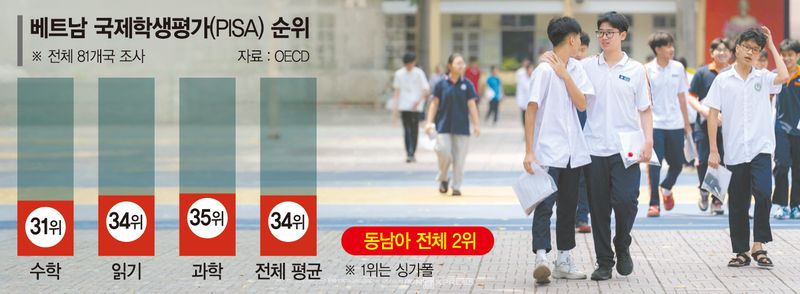
Hang, a history teacher at a high school in Hanoi, said, "Vietnam still carries the influence of the old examination culture, like Korea and China, so every family is extremely passionate about their children’s education." That enthusiasm is also reflected in the Programme for International Student Assessment (PISA). According to the Organisation for Economic Co-operation and Development (OECD), Vietnam ranked 34th out of 81 countries in average math, reading, and science scores. In Southeast Asia, it is second only to Singapore.
The OECD views Vietnam as a model case of achieving strong academic results despite a limited education budget. In fact, students at Hanoi–Amsterdam High School for the Gifted and Chu Van An High School have steadily gone on to top overseas universities, including Ivy League schools in the United States, without studying abroad. The Vietnamese government also plans to make educational competitiveness a driving force for national growth. The Politburo of the Communist Party of Vietnam has set a goal of placing at least eight universities among Asia’s top 200 by 2030 and producing universities ranked among the world’s top 100 in specific fields.
[email protected] Reporter