Bank credit loan balances nearly jump by 1 trillion won in three days... Authorities watch overheated speculative stock buying
- Input
- 2026-06-07 18:17:56
- Updated
- 2026-06-07 18:17:56
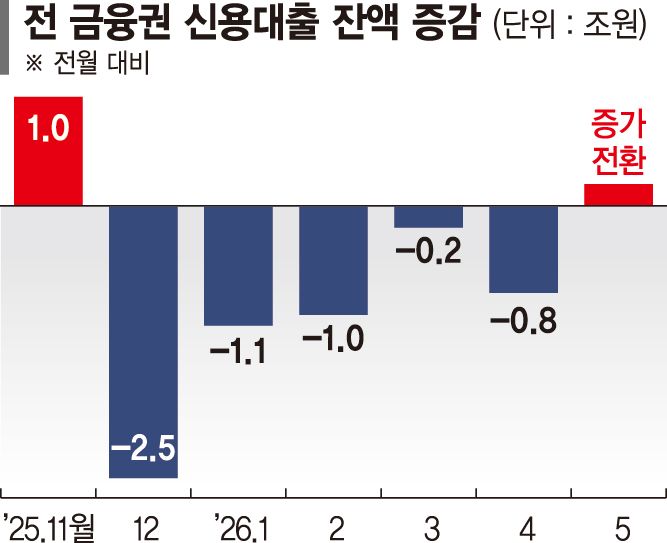
According to the financial sector on the 7th, total credit loan balances across the industry rose last month for the first time since November of last year. The increase was especially pronounced at The five major banks. As of the end of last month, the five banks' combined personal credit loan balance stood at 104.9 trillion won, up 2.1 trillion won from the end of the previous month. In just three business days this month, it also increased by 989.4 billion won from the previous month.
A financial industry official said, "As funds are moving rapidly into the stock market, demand for speculative investing using credit loans and overdraft accounts is rising." The official added, "Margin loan balances, which reflect borrowing from securities firms to invest in stocks, have also surpassed 38 trillion won."
Financial authorities are watching closely to see whether speculative stock buying will not remain just a side effect of the stock market rally, but instead lead to a sharp rise in credit loans. When recently launched leveraged ETFs tied to Samsung Electronics and SK hynix showed signs of overheating, the FSC convened a review meeting with financial investment industry officials on the 5th. The FSS has also begun examining Mirae Asset Securities, which sold public offering subscriptions for SpaceX, to determine whether there was any mis-selling or false or exaggerated advertising.
However, credit loan regulations have already been tightened, and recent loan rate increases have been steep, making it difficult to introduce additional restrictions. Under last year's June 27 measures, the government limited credit loan ceilings to within 100% of a borrower's annual income. In addition, the third-stage stress DSR has been implemented, applying an additional interest rate of at least 1.5 percentage points. The stress DSR is a system that calculates borrowing limits by adding a premium to loan rates to reflect the risk of future interest rate changes.
A financial authority official said, "Regulations are already tight, so it does not seem to be the stage for additional measures right now." The official added, "We will monitor conditions on a daily basis and review household lending trends with the banks before making a decision."
Concerns over high interest rates are also growing as the Bank of Korea's possible shift toward monetary tightening is being discussed. As of the 5th, the five major banks' mixed-type mortgage rates, based on five-year bank bonds, were recorded at 4.39% to 7.33% per year. Compared with 4.40% to 7.00% on the 8th of last month, the upper end of the range rose by 0.33 percentage point in just one month. It is the first time in about three years and eight months, since late October 2022, that fixed rates at the five major banks have exceeded 7.3%. Credit loan rates also stood at 4.31% to 5.93% per year, based on Grade 1 borrowers and one-year maturities, bringing the upper end close to 6%.
A financial industry official said, "There are also forecasts that the Bank of Korea could raise the benchmark rate in both July and August." The official added, "Borrowers who have taken on aggressive speculative stock buying may face a heavier interest burden."
[email protected] Ye Byeong-jeong, Park So-hyeon Reporter