"Pensions and deposits alone total 200 million won": A man in his 50s who owns a home without stocks says, "I can't sleep thinking about what I'll live on after retirement" [Retiree X’s Plan]
- Input
- 2026-06-20 07:30:00
- Updated
- 2026-06-20 07:30:00

[Financial News]An annual salary of 70 million won, 130 million won in retirement pension savings, 40 million won in a pension savings fund, and 20 million won in deposits. His expected National Pension Service (NPS) benefit is around 1.5 million won a month, and although he still has a sizable mortgage in the Seoul metropolitan area, he owns one apartment.That is the retirement preparation status of Senior Manager Sung Tae-hwan, 57, a pseudonym, who is three years away from the mandatory retirement age. He has worked in human resources for nearly 30 years. According to the 2025 Household Finance and Welfare Survey jointly conducted by the National Data Office, the Bank of Korea and the Financial Supervisory Service (FSS), the average financial assets of households in their 50s are 165.07 million won, with a median of 81 million won. The manager's combined retirement pension, pension savings and deposits are above both the median and the average.
People around him see him in much the same way."You've prepared a lot for someone your age." "You probably won't have much to worry about financially even after retirement."He had quietly thought the same thing. Even so, he recently found himself unable to sleep because of a vague sense of anxiety. He realized what that anxiety really was during an evening gathering with his college classmates.
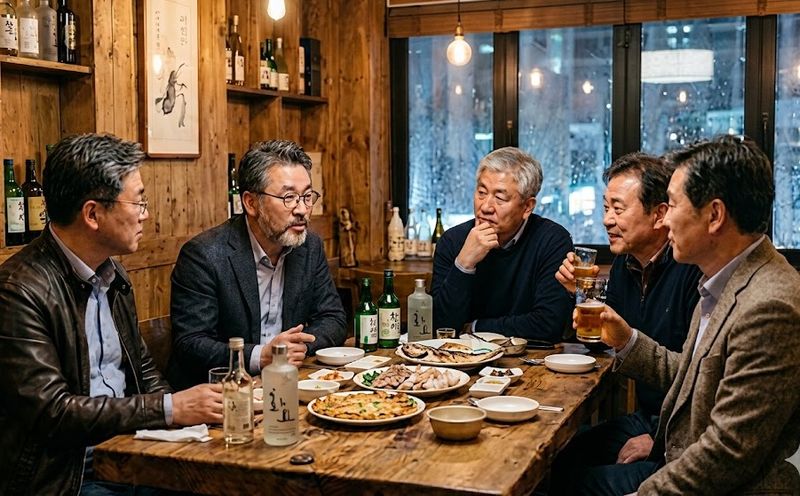
After a few rounds of drinks, the conversation naturally turned to retirement. As they talked about assets and how to manage pensions, one friend's blunt question brought the table to a brief halt."So what are you going to do after you retire?"Sung, and the others, could not answer right away.
He knew the estimated amount of his National Pension Service (NPS) benefit and had calculated the size of his retirement pension. But he had no answer to the question of how he would make a living after leaving the company. He does not plan to stop working. Still, he cannot picture what kind of work he could do.
He wants to work until 73.4
Sung's concerns are not just personal.
According to the National Data Office's May 2025 supplementary survey on older adults in the economically active population survey, the average age at which older adults with work experience left the job they held the longest in their lives was 52.9. That is more than seven years earlier than the legal retirement age of 60. In other words, only a minority actually make it to the full retirement age.
By contrast, 69.4% of older adults, or 11.42 million people, said they wanted to keep working in the future. Their desired working age averaged 73.4.
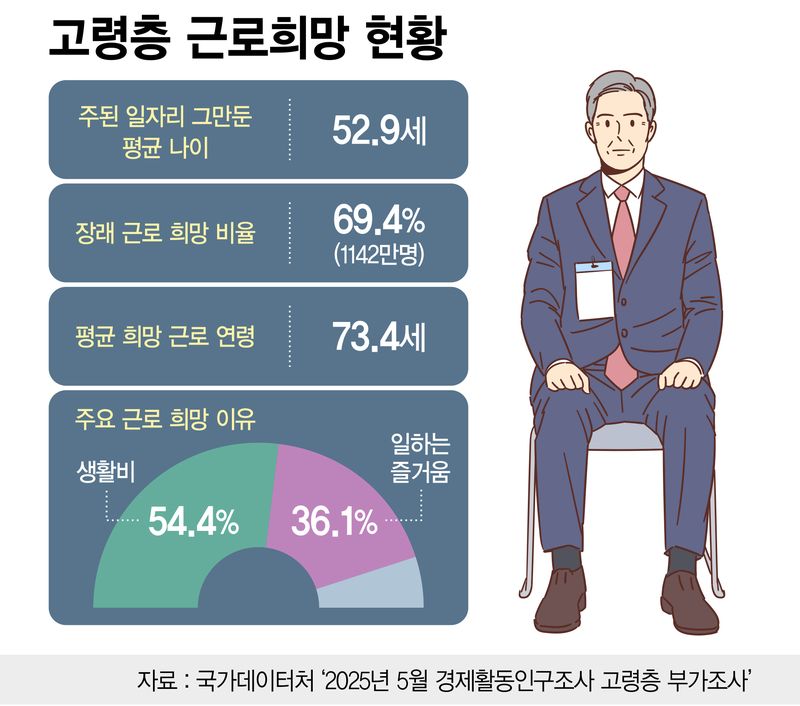
They leave their main job at 52.9, but want to keep working until 73.4.That leaves a 20-year gap.
This determination is also reflected in the statistics. According to KOSIS, the number of employed people aged 60 and older last year reached 6.834 million, surpassing those in their 50s, who numbered 6.679 million, for the first time. Since age-based employment data began in 1963, this is the first time the 60-and-over group has overtaken the 50s group. The number of employed people aged 70 and older also reached 2.162 million, topping 2 million for the first time ever.
The problem is what kind of work they will do during those 20 years. More older adults are working, but they do not often return to the same kind of job they held throughout their careers. Their willingness to work is clear, but there are not enough jobs willing to take them.
Security, facility management, taxis... narrowing options
As Sung began seriously thinking about his future job, he first considered his career. Having worked in human resources for nearly 30 years, he looked for positions that could make use of that experience. He considered recruitment outsourcing, HR consulting for small and midsize companies, and training instructor roles. But when he looked more closely, there were not many openings. Even when jobs existed, the conditions were far below what his experience would suggest.
In the end, the search results were filled with jobs unrelated to his career: security, facility management, parking management, parcel delivery, courier work, taxis and small franchise businesses. The more he scrolled, the narrower the options became. If he could work, he felt the exact job mattered less. Still, he regretted how hard it was to find a role connected to nearly 30 years of experience hiring, evaluating and training people.
The statistics point in the same direction. By occupation, among employed older adults, simple labor workers accounted for the largest share at 22.6%. Managers made up only 2.1%, and office workers 8.3%.
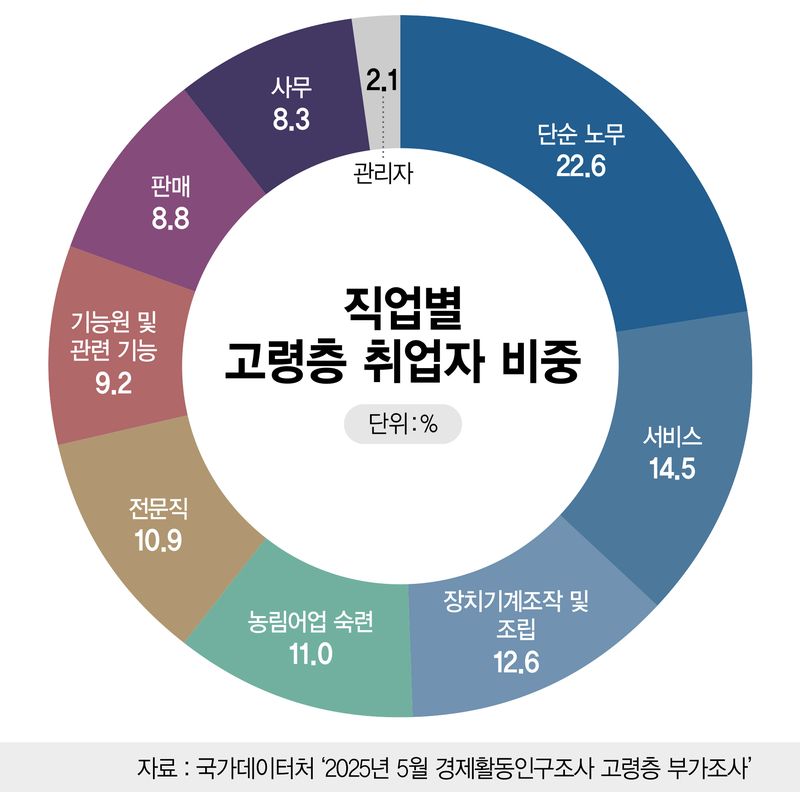
The quality of the jobs they move into also declines.
According to the 2024 Job Mobility Statistics released by the National Data Office in June 2025, 41.3% of wage workers who changed jobs moved to positions with lower pay.Only 37.0% of those who left large companies moved to another large company.And 56.6% moved to small and midsize companies. This reflects the trend of retirees leaving large firms and moving to smaller ones when they are rehired after retirement.
Career continuity is also rare.
According to the May 2025 supplementary survey on older adults, 71.0% of older adults who found jobs in the past year said their most recent job was related to their main job over their lifetime. The remaining 29% moved into jobs unrelated to the work they had done throughout their careers.
When the business card disappears, does the career disappear too?
The same pattern appeared among people around him. Former executives from large companies, branch managers from financial firms and department heads from manufacturers were all doing work different from their previous careers after leaving their companies. Even when they managed to secure consulting or contract positions, the terms were short and the pay was far below what they had earned before.
Sung said,"When my seniors were working at the company, they were managers, directors or vice presidents. But once they left, they just became 'middle-aged men.'"He added, "They may laugh about it now, but I think it must have been hard to adjust at first."
One of Sung's seniors, who retired last year, opened a YouTube channel in an effort to make use of his career. He thought that if he shared nearly 30 years of work experience, someone would watch. He bought a camera, learned editing and uploaded a few videos. But the subscriber count barely grew, and the channel stopped after a few months.
The senior said, "I thought my experience could become content, but I didn't know how to shape it or who I should share it with."
Professor Shin Su-rim of Polytechnic University of Korea said, "When you look at middle-aged and older students, many of them have made difficult decisions to get here." She added, "Learning a new skill that has nothing to do with what you have done for nearly 30 years is not easy to accept yourself, and it is not easy to explain to others either. Even so, those who sit in the classroom with the goal of earning a certificate and working again have already made a major decision."
Professor Shin also focused on the learning attitude of middle-aged and older adults. She said, "People in their 40s and older are not at an age where they study for fun. They come with very real concerns about living expenses, supporting their families and finding work again, so their motivation is clear." She added, "Even in fields unrelated to their previous careers, such as electrical work or industrial equipment, they are highly determined to learn until the end."
Sung faces a similar dilemma. He can calculate his National Pension Service (NPS) payments. He can also check his retirement pension balance.But he still has not found an answer to where he can put his 30 years of HR experience to use again.
Still, there is a way
There are at least some channels for people with concerns like Sung's.
The Senior Job Center run by the Ministry of Employment and Labor (MOEL) can be used by anyone aged 40 or older, even while still employed. It is not just a job placement service. It also offers counseling on how to reuse the career you already have.
The Seoul 50 Plus Foundation also runs life-design counseling and career exploration programs for Seoul residents aged 40 to 64.
If a direction is set, people can receive vocational training support through the National Tomorrow Learning Card. Those who have already retired can also use the Polytechnic University of Korea's specialized programs for later-life workers.
However, a study published in the 2025 Journal of Service Management by Park Ga-yeol, Jo Jeong-yun and Lim Seon-mi identified the low level of awareness as the biggest problem with these services. In other words, the services exist, but people do not know about them. Sung, who is three years away from retirement, also learned about these programs only recently.
Four retirement resources that cost nothing
■ Senior Job Center (Ministry of Employment and Labor)Target: Unemployed people and workers aged 40 or older
Benefits: One-on-one customized life and career planning, free transition consulting
■ Seoul 50 Plus FoundationTarget: Seoul residents aged 40 to 64
Benefits: Middle-aged internship programs, life-planning counseling and education
■ National Tomorrow Learning Card (Ministry of Employment and Labor)Target: Large-company workers aged 45 or older, small and midsize company workers, job seekers and others
Benefits: 3 million to 5 million won in vocational training support over five years
■ Polytechnic University of Korea (specialized programs for later-life workers)Target: Unemployed people aged 40 or older, with some employed workers also eligible
Benefits: Full coverage of hands-on technical training, practice fees and meals
The old formula that equated retirement with stepping out of life is breaking down. In an era when life expectancy reaches 83, Generation X is entering full retirement age, and the very concept of retirement is being redefined. Every Saturday morning, we bring readers the stories of their second act in life.[Retiree X’s Plan]Subscribe to the reporter page to receive it conveniently.
[email protected] Kim Ki-seok Reporter