Should an Air Conditioner or a Dishwasher Be Turned Off for the Same Reward? ... "Energy-Saving Incentives Should Also Be Customized"
- Input
- 2026-06-07 13:07:59
- Updated
- 2026-06-07 13:07:59

[Financial News] A study has found that the Demand Response (DR) system, which compensates households for reducing electricity use, should be designed more precisely by appliance and time of day.
The current system gives the same reward whether a household turns off an air conditioner or a dishwasher. The researchers said this makes it difficult to spread electricity demand effectively. They also warned that overly generous compensation could push delayed power use into the evening and create another peak.
According to KU on the 7th, Professor Woo Jong-ryul's research team at the Graduate School of Energy and Environment presented an analysis showing that the compensation structure for household Demand response should be differentiated by appliance and by time of day.
The study was published online on May 18 in Utilities Policy, an international journal in the energy and environment field.
Demand response is a system that compensates consumers when they reduce electricity use during peak hours. It is designed to ease pressure during periods of concentrated demand and help operate the power system more stably.
Solar power generation produces abundant electricity during the day, but output drops sharply between 5 p.m. and 8 p.m. after sunset. This is when households increase their use of televisions, washing machines, clothes dryers, electric rice cookers, dishwashers, air conditioners and heaters after returning home from work. As power generation falls and consumption rises, the electrical grid faces growing strain from the so-called evening peak.
Under the current system, the same compensation is paid regardless of which appliance is turned off. But the level of inconvenience differs by appliance. It is relatively easy to reduce the use of a television or an electric rice cooker, while it is much harder to cut back on an air conditioner in summer or a heater in winter.
The research team said reflecting these differences in the compensation structure would improve the effectiveness of demand response. The team surveyed 1,124 households nationwide on seven commonly used home appliances: televisions, washing machines, clothes dryers, electric rice cookers, dishwashers, air conditioners and heaters. Respondents were asked how much compensation they would want for delaying use during the evening peak from 5 p.m. to 8 p.m., and when they would use the appliance again.
The survey found that air conditioners and heaters required relatively high compensation to encourage participation, while more than half of households were willing to participate with comparatively low compensation for televisions and electric rice cookers. Dishwasher and clothes dryer use could be shifted more easily to weekends or other times, but their penetration rates were only in the 30% to 40% range, limiting their overall impact on the grid. According to the team, air conditioners have a penetration rate of about 97% and consume around 2,000 to 2,200 watts, making them a key appliance for shifting load. Washing machines also have a high penetration rate and are considered another major appliance with strong load-shifting potential.
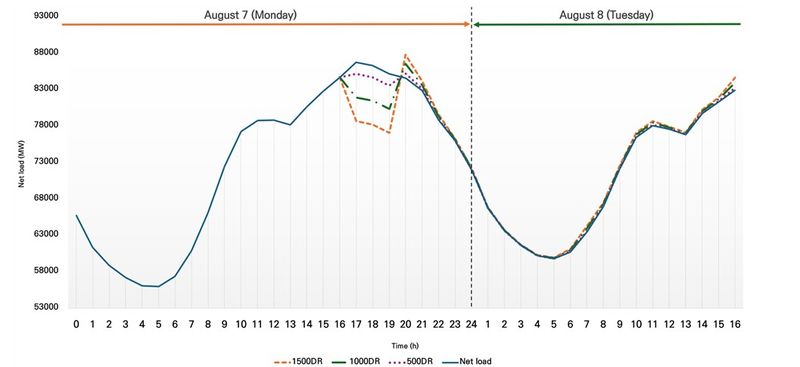
The research team also applied its appliance-level findings to nationwide electricity demand data from August 7, 2023, when DR was actually activated, and simulated how the electrical grid would change under different compensation levels. With the current rate of 1,500 won per kWh, the evening peak fell by about 9.3% (8,101 MW). But delayed usage concentrated between 9 p.m. and 10 p.m., creating a "second peak" that was actually higher than before, with a balloon effect of plus 1,042 MW compared with the original level.
A different result emerged when compensation was lowered to 500 won per kWh. The reduction in the evening peak was smaller at about 1.8% (1,605 MW), but delayed usage was spread more evenly across several time slots, keeping the electrical grid much more stable. In other words, simply increasing the size of the reward does not make it easy to achieve grid stability.
The study shows that the design standard for demand response should expand from how much electricity should be reduced to what should be reduced and when.
Professor Woo Jong-ryul of KU said, "As the share of renewable energy grows rapidly, volatility in the power grid also increases." He added, "Customized incentive design that reflects appliance characteristics, household types and grid conditions by time of day will become a key factor in determining the stability of the power system in the era of carbon neutrality."
[email protected] Lee Bo-mi Reporter