"I Bought It Trusting the Domestic Market"... Only Foreign Investors Were Smiling
- Input
- 2026-06-06 06:00:00
- Updated
- 2026-06-06 06:00:00
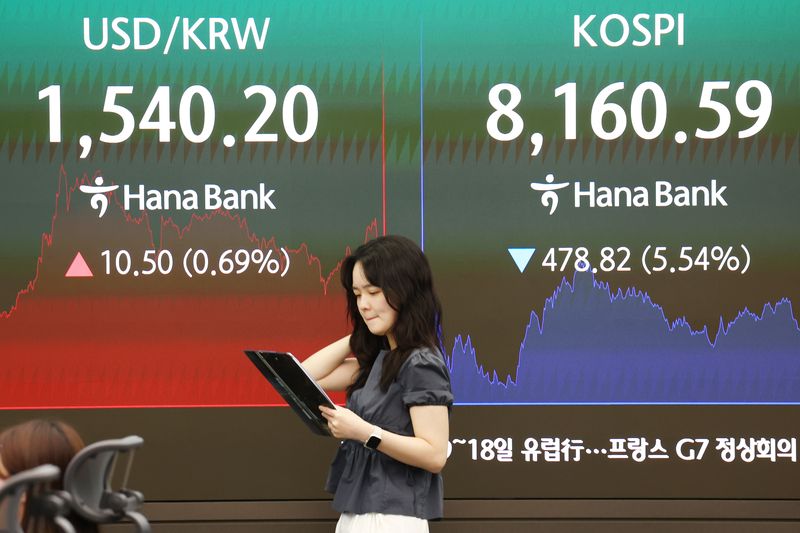
[Financial News] As the KOSPI surpassed the 8,000 mark for the first time ever this year, the contrasting moves of foreign and individual investors became clear. Foreign investors dumped more than 100 trillion won in stocks, while individual investors stepped in aggressively to buy and support the market. Even as foreign investors sold, their market-cap-based holding ratio rose, an unusual development that has drawn attention to shifts in market leadership.
According to the Korea Exchange (KRX) on the 6th, foreign investors had posted net sales of 119.0516 trillion won in the main board market so far this year through the 5th. By contrast, individual investors bought a net 72.7507 trillion won, while institutions bought a net 32.4308 trillion won. In effect, individuals and institutions absorbed most of the foreign selling and supported the KOSPI's rise.
The pace of individual buying was especially faster than during the 2020 'Donghak Ants Movement.' Individual investors bought a net 113 trillion won in 2020 and 2021 combined, but this year they have poured more than 70 trillion won into the domestic stock market in just a little over six months.
In terms of investment performance, however, foreign investors appear to have been ahead. Korea Investment & Securities analyzed that in Samsung Electronics Co., Ltd. and SK hynix, which led this year's rally, foreign investors bought at relatively low prices and sold at higher prices, while individual investors had a higher share of chasing the rally upward.
What stands out is that even though foreign investors were net sellers of more than 119 trillion won, their share of the domestic stock market's total market capitalization actually rose. This is believed to reflect the sharp increase in the market value of Samsung Electronics Co., Ltd. and SK hynix, where foreign ownership is high, amid the artificial intelligence (AI) semiconductor supercycle. In other words, even though foreigners sold shares, the prices of the key stocks they still held rose even more sharply, pushing up their overall market share.
Kyung-min Lee, a researcher at Daishin Securities, said, "Foreign investors' KOSPI holding ratio is currently 39%, and it is actually on the rise." He added, "Recent foreign net selling can be interpreted not as an exit from the domestic market, but as selling for rebalancing amid the sharp rise in leading stocks."
Foreign selling also affected the exchange rate. Normally, when foreign investors sell Korean stocks, the process of converting won into dollars increases upward pressure on the won–dollar exchange rate. In fact, this year the exchange rate has remained at a high level above 1,500 won despite a narrowing interest-rate gap with the United States and a current account surplus.
Jeong Yong-taek, a researcher at IBK Investment & Securities, said, "One of the most convincing factors behind the recent rise in the won–dollar exchange rate is the massive stock selling by foreign investors." He explained, "Since mid-May, the scale of foreign selling has increased sharply, and that has acted as upward pressure on the exchange rate."
Market experts say the broader uptrend remains intact despite the recent correction in semiconductors. Lee Jae-won, a researcher at Yuanta Securities Korea Co., Ltd., said, "The recent correction in semiconductor stocks is less about a slowdown in the AI cycle and more about short-term noise and profit-taking caused by overheating." He added, "Given the increase in semiconductor exports and the improvement in earnings, the possibility of upward revisions to future profit forecasts remains open."
[email protected] Choi Du-seon Reporter