"The gender wage gap is more than twice the OECD average" ... women's labor groups urge gender-equality policies on the administration's first anniversary
- Input
- 2026-06-05 15:37:47
- Updated
- 2026-06-05 15:37:47
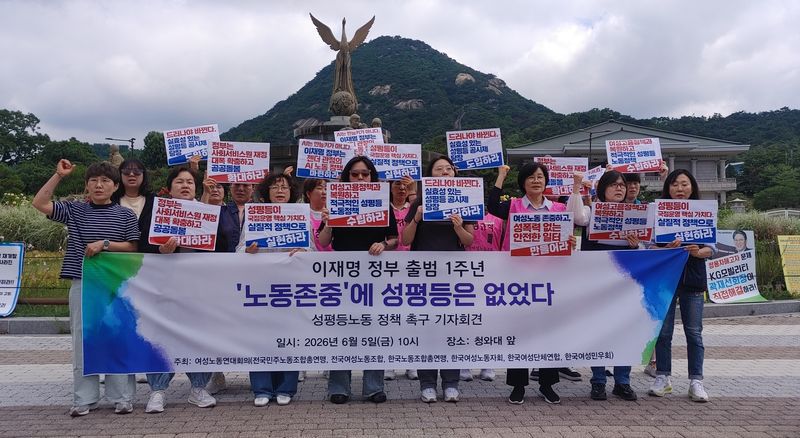
[Financial News] Marking one year since the administration took office, women's labor groups called for stronger gender-equality labor policies. They said the government should introduce the Gender Equality Disclosure System, one of its national policy pledges, while also expanding public care, preparing measures to protect women workers during the artificial intelligence (AI) transition, and restoring women employment policies.
The Women's Labor Solidarity Conference, made up of six groups including the Federation of Korean Trade Unions (FKTU), the Korean Confederation of Trade Unions (KCTU), the National Women’s Trade Union, the Korean Women Workers Association, Korean Women's Associations United (KWAU), and Womenlink, held the press conference on the morning of the 5th in front of the Blue House in Jongno-gu, Seoul.
Lee Jeong-a, co-chair of KWAU, criticized President Lee for having presented gender equality as a core value for a sustainable society even during his campaign, only for concrete policies to disappear after taking office. She said, "Over the past year, it has been difficult to find any substantive gender-equality labor policies to address the undervaluation of women's labor, occupational segregation by gender, sexual harassment and bullying in the workplace, and the realities faced by women workers during AI and industrial transitions." She added, "The promises and declarations were clear, but they did not lead to concrete policies, budgets, or implementation that could change the reality of women's labor."
Kim Doona, a lawyer with Minbyun's Women's Rights Committee, stressed the need to introduce the Gender Equality Disclosure System. She said, "Korea's gender wage gap stands at 29.3%, more than twice the OECD average of 11.3% among its 38 member countries." She added, "If wage information is not disclosed, the gap remains hidden, and hidden gaps are difficult to improve."
She continued, "The Gender Equality Disclosure System is a policy starting point for making long-structured employment inequality visible and improving it in practice." She said disclosure items should be broken down by employment type, occupation, rank, job, and length of service, and that the disclosure obligation should be expanded beyond large companies to include small and medium-sized firms. She also said worker representatives should be guaranteed participation in the disclosure process.
No Helena, secretary general of the Korean Women Workers Association, explained why the Women Employment Policy Division at the Ministry of Employment and Labor (MOEL) should be restored. She said, "The Women Employment Policy Division was a key unit dedicated to gender-equality labor policies, including closing the gender wage gap, responding to gender discrimination in hiring, preventing career breaks, and promoting work-life balance." She argued, "The disappearance of the division is effectively a declaration that the state will no longer address the problems faced by women workers in an independent and systematic way."
She also called for the restoration of the Private Employment Equality Counseling Center. She said, "For workers facing gender discrimination, sexual harassment, and discrimination related to pregnancy, childbirth, and childcare in the workplace, the center is the closest channel for remedying their rights." She added, "For women workers who do not have a labor union or who find it difficult to receive legal support, the center is effectively the last safety net. But after it was abolished and then restored, budget cuts have created serious difficulties in maintaining the center and continuing counseling services."
There were also calls for measures on care work and the AI transition. Kim Sook-kyung, head of the women's bureau at the KCTU, said, "Care is the foundation of a sustainable society." She added, "We demand the swift establishment of the Public Agency for Social Service, a major expansion of the budget, and uninterrupted public care. The value of care work must also be properly assessed." Ki I-seul, an activist with Womenlink's women's labor team, said, "Behind the push to adopt AI in the name of cost-cutting and efficiency, low-wage jobs such as those held by women and non-regular workers are being rapidly replaced." She noted that the ILO has said women workers could be hit harder during the AI transition, but that the government's basic AI plan contains no concrete measures to protect women workers. "A gender perspective must be built into AI labor policy," she emphasized.
[email protected] Park Sung-hyun Reporter