Former U.S. Ambassadors to South Korea Reject Claims That Lee Jae-myung Administration Is 'Anti-U.S., Pro-China'
- Input
- 2026-06-05 05:45:50
- Updated
- 2026-06-05 05:45:50
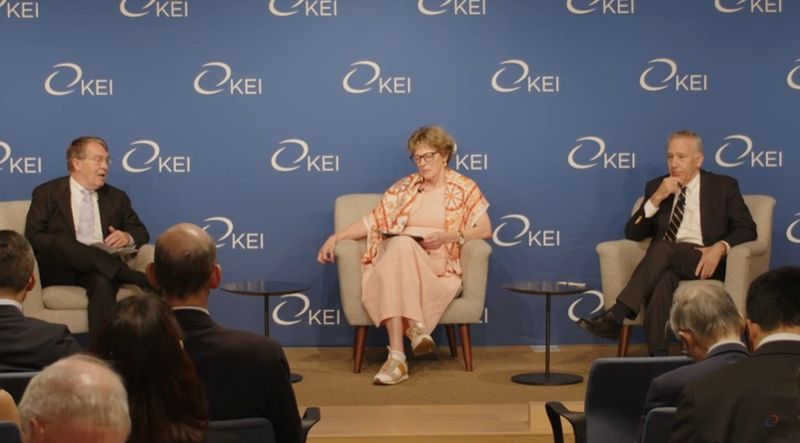
[Financial News] Former United States ambassadors to South Korea who previously served in the country said they cannot agree with the recent controversy in the United States over the Lee Jae-myung administration's alleged 'anti-U.S., pro-China' stance.
Former United States Ambassador to South Korea Philip Seth Goldberg referred to the Lee Jae-myung administration's foreign policy direction at a seminar hosted by the Korea Economic Institute of America (KEI) in Washington, D.C. (DC), on the 4th local time. He served as U.S. ambassador from 2022 to 2025.
Goldberg explained that South Korea's "left-leaning governments tend, in some ways, to be less reflexively pro-American in their approach to our international policy." He also said he did not know where the idea came from that President Lee Jae-myung is "some kind of radical communist." "I have met him, and I did not get that impression. He is an outstanding politician. That was once again demonstrated by yesterday's election results (the 63 local elections)," he emphasized.
Goldberg argued that President Lee "understands very well the value of the alliance with the United States, especially the U.S. nuclear umbrella. He has tried to work with U.S. President Donald Trump on very difficult issues such as trade and investment." He also said he "disagrees" with assessments such as a column in The Wall Street Journal (WSJ). On the Lee Jae-myung administration's diplomacy, Goldberg explained that "this is more of a rebalancing than a full-fledged pro-China policy, as some in Washington see it."
Earlier, Nicholas Eberstadt, a senior fellow at the American Enterprise Institute for Public Policy Research (AEI), and Lawrence Peck, an adviser to the North Korea Freedom Coalition, argued in a WSJ column on the 1st that threats to the ROK-U.S. Alliance have grown since the launch of the Lee Jae-myung administration.
In addition, Republican Party Representative Darrell Issa of California said at a U.S. House Committee on Foreign Affairs hearing on the 3rd that "South Korea's democracy has shifted sharply to the left," adding that it is benefiting Chinese companies while suppressing U.S. companies. In response, Marco Rubio, the United States Secretary of State, who attended the hearing, said that "in democratic countries, people sometimes elect leaders more favorable to U.S. interests, as in Japan, and sometimes elect leaders with different views."
Kathleen Stephens, former United States Ambassador to South Korea from 2008 to 2011, who attended the KEI event on the 4th, said public opinion polls in South Korea show that "bipartisan support for the ROK-U.S. Alliance continues to rise." She added that "President Lee knows that the vast majority of the South Korean people want a strong ROK-U.S. relationship."
Stephens said that "he also knows there is a difference between anti-Americanism and opposition to specific policies," adding that "when talking about politics in South Korea today, the term 'anti-Americanism' sounds very anachronistic." She said there had been concerns in South Korea that there had not been enough consultation between Seoul and Washington ahead of President Trump's visit to China last month, and added that "South Korea is concerned not only about worsening relations with the United States and China, but also about the two countries becoming too close, as in a G2 scenario."
[email protected] Park Jong-won Reporter