Foreign investors’ 7 trillion won sell-off still prompts Wall Street experts to say, “Don’t sell Samsung Electronics and SK hynix” — an unexpected diagnosis
- Input
- 2026-06-05 05:10:00
- Updated
- 2026-06-05 05:10:00
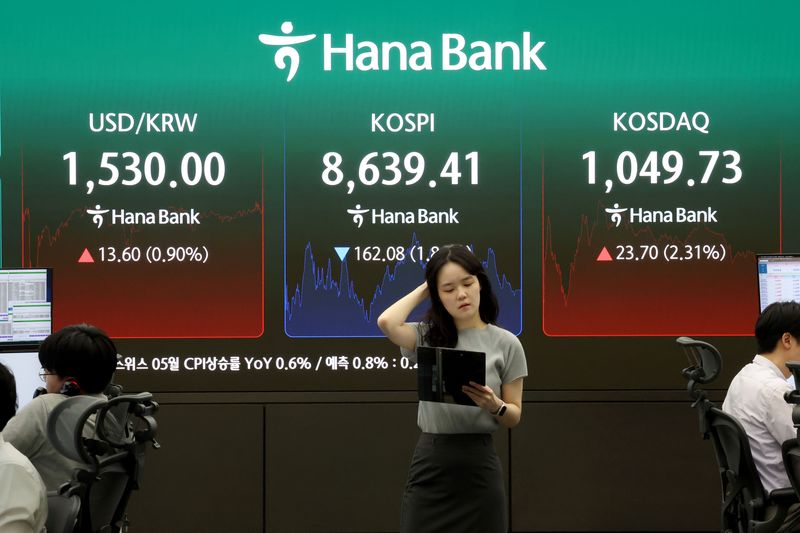
[Financial News] The KOSPI ended the day down more than 1% as foreign investors unloaded a record amount of profit-taking shares. However, brokerage firms and experts said the massive foreign selling was simply a mechanical rebalancing triggered by the recent sharp rally in so-called “Samsung Electronics and SK hynix,” not a sign of damaged fundamentals or an exodus from the Korean stock market.
According to the Korea Exchange (KRX) on the 4th, the KOSPI finished trading at 8,639.41, down 162.08 points, or 1.84%, from the previous trading day.
The index was dragged down by heavy foreign selling. In the Korea Exchange Main Board Market, individuals and institutions bought a net 5.1125 trillion won and 1.8124 trillion won, respectively, to support the market. But foreigners alone sold 6.9529 trillion won worth of shares, pushing the index lower.
Foreign investors have continued selling for 19 straight trading days, from the 7th of last month through the 4th. Their cumulative net selling this year has reached 109.5688 trillion won, far exceeding the levels seen during the 2007-2008 financial crisis, when it totaled 62 trillion won, and during the 2020 COVID-19 pandemic, when it reached 25 trillion won.
Most large-cap IT stocks among the market’s biggest companies also fell. Samsung Electronics Co., Ltd. (-2.50%), SK hynix (-2.63%), and Samsung Electro-Mechanics (-5.35%) all declined. In contrast, Samsung C&T Corporation jumped 10.2% on expectations that the value of its subsidiaries’ stakes would rise.
The won–dollar exchange rate closed at 1,529.7 won, up 13.3 won from the previous day. During the session, it opened in the 1,530 won range for the first time in 17 years, since 2009, extending the currency’s steep climb.
“Foreign selling is rebalancing... the memory supercycle is not over”
The financial investment industry says the massive foreign sell-off was not driven by a pessimistic outlook for the Korean market, but by “mechanical rebalancing” after the recent surge. As Korean stocks and semiconductors rose sharply, their weight in funds became too large, forcing investors to sell to restore balance.
Yeo Un-bong, a doctor who worked on Wall Street in New York, also kept a positive view in a YouTube video posted on the 1st. He said the recent daily selling of Samsung Electronics and SK hynix shares by foreigners was part of profit-taking after the short-term rally and a move to adjust portfolio weights.
Yeo said, “Explosive demand for AI and a shortage of High Bandwidth Memory (HBM) have pushed up even DRAM prices, locking in an enormous profit structure for both Samsung Electronics and SK hynix.” He added, “Experts see the current boom as the early stage of a long-term supercycle, so the upward trend remains intact.”
Still, given that stock prices have already risen significantly, he advised four conservative investment approaches: avoiding all-in bets and chasing prices, investing a fixed amount in stages, using spare cash excluding living expenses, and making use of domestic semiconductor ETFs.
Meanwhile, as large semiconductor stocks corrected, the momentum spread to small- and mid-cap stocks and neglected sectors. The KOSDAQ rose more than 2% on the day, supported by institutional buying and policy expectations, moving in contrast to the KOSPI. In particular, semiconductor materials, parts, and equipment stocks such as Jusung Engineering and WONIK IPS, whose 2026-2027 estimates were raised after first-quarter earnings releases, surged more than 20% and led the market.
Brokerage firms expect that once the concentration of funds into large semiconductor stocks eases in the second half of the year, securities stocks that have been overlooked until now will begin a full-fledged rebound.
In fact, as the KOSPI recently broke above the 8,800 level for the first time ever, the average daily trading value across both markets surged to as much as 65.8 trillion won.
[email protected] Moon Young-jin Reporter