Focus on Expanding Union Power ... Risks Grew, Including the 'Performance Bonus Crisis' [One Year of the Lee Jae Myung Administration]
- Input
- 2026-06-04 18:23:07
- Updated
- 2026-06-04 18:23:07
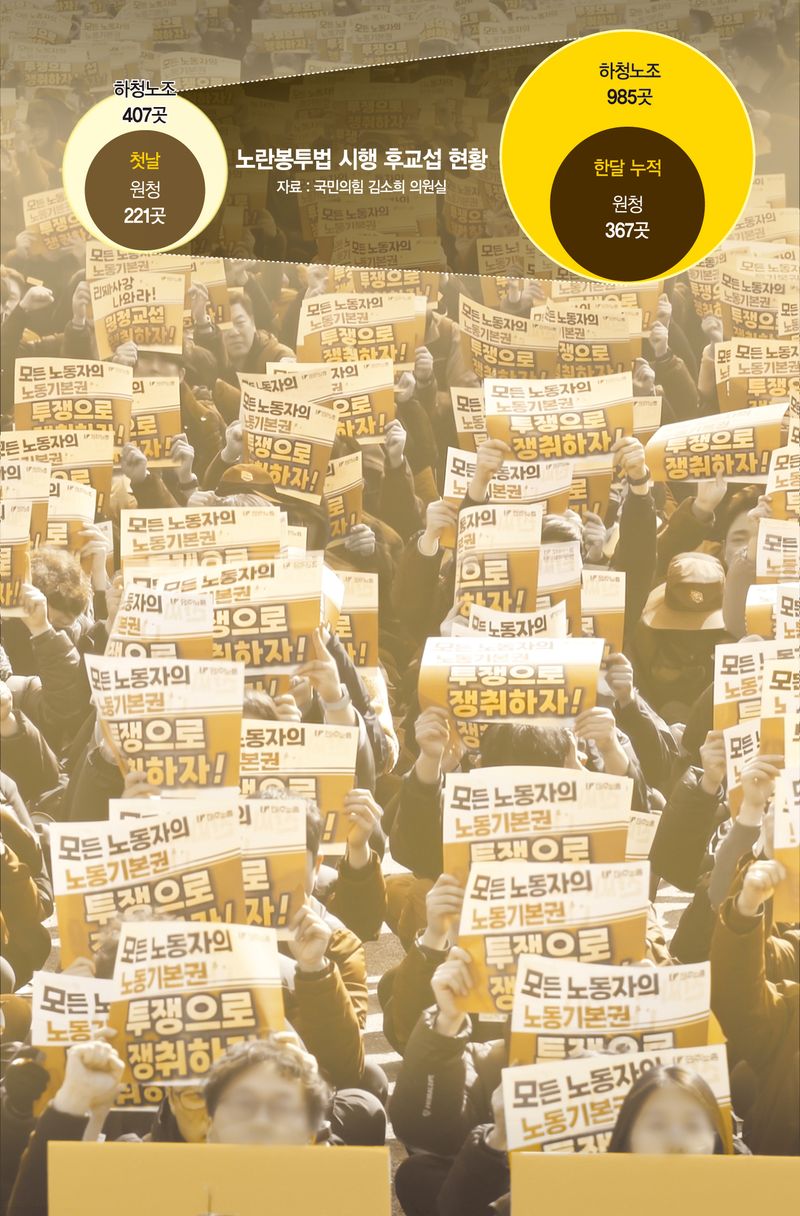
While the labor community views it as a historic advance in labor rights, companies are expressing concern that they are now focusing more on responding to labor-management disputes than on short- and long-term management strategies.
The business community warns that the law could lead to a vicious cycle of greater union risk, weaker corporate competitiveness, and reduced jobs and investment. It is calling for balanced policy implementation between labor and management after the Yellow Envelope Act takes effect.
■ Companies shaken by uncertainty
According to industry sources on the 4th, just one month after the Yellow Envelope Act took effect in March, 1,011 subcontractor unions nationwide had demanded bargaining with 372 parent companies. The groups involved represent about 146,000 workers. Business circles say parent companies are finding it difficult to determine which union they should negotiate with first.
Critics say the expanded and ambiguous scope of employer liability under the Yellow Envelope Act has created uncertainty that is becoming a major obstacle for companies.
In a survey on labor-management relations outlook this year, the Korea Employers Federation said 72.9% of companies expected labor relations to become unstable, and 83.6% of those respondents cited the Yellow Envelope Act as a major factor.
Hyundai Motor Company is currently waiting for a third hearing after a ruling on whether it must respond to bargaining demands from subcontracted union members, including cafeteria workers and security staff, was delayed again. Labor and management are locked in a drawn-out standoff over whether bargaining is required for subcontracted union members in different work areas, including production, security, dining, sales, and research.
The review session began after KMWU sent Hyundai Motor Company a bargaining request covering 1,675 subcontracted union members following the Yellow Envelope Act's implementation. KMWU warned that if Hyundai Motor Company's status as an employer is denied or narrowed, it will launch an all-out struggle.
Unlike in the past, when wages and working conditions were the main focus of labor negotiations, the Yellow Envelope Act could also make restructuring, business reorganization, and mergers and acquisitions (M&A) subject to bargaining. That has greatly increased the potential for labor disputes.
Concerns are spreading that union risk could become a drag on sectors such as semiconductors, automobiles, batteries, shipbuilding, and the steel industry, where global competition is especially intense.
Major conglomerates that have issued corporate bonds or carried out rights offerings have directly cited the possibility of expanded strikes under the Yellow Envelope Act as an 'investment risk factor,' underscoring those concerns.
A senior official at a domestic conglomerate said, "At this point, responding to unions has become more important than investment." The official added, "As uncertainty grows over whether employer status will be recognized, it has become difficult to draw up investment plans in response to union issues."
Another industry official said, "The fact that so many large companies explicitly mentioned the Yellow Envelope Act while raising funds shows how strongly the business community sees labor issues as a source of instability." The official added, "For companies, the burden has grown further with the Yellow Envelope Act on top of the Serious Accidents Punishment Act."
■ Concerned looks from overseas as well
The bigger issue is how overseas investors view the situation. AMCHAM Korea and ECCK have publicly warned that the Yellow Envelope Act could undermine investment predictability.
The recent case involving Samsung Electronics is seen as a symbolic example of how those concerns can become reality at any time. The situation became serious enough for the government to consider emergency mediation powers after Samsung Electronics labor union announced a general strike. It was a crisis in which a one-day shutdown of a Samsung Electronics semiconductor plant could have caused direct losses of up to 1 trillion won.
Overseas investors are now criticizing the situation, saying it has shown that a key national industry can be shaken by labor-management conflict.
A researcher at a think tank said, "If this continues, companies may have to devote more resources to labor disputes than to investment and R&D." The researcher added, "In the end, union risk could weaken national competitiveness, so even the government needs to step in and manage the pace more carefully."
[email protected] Kim Hak-jae Reporter