Public sentiment favors political stability... The ruling party has even taken control of local power [June 3 public choice]
- Input
- 2026-06-03 20:52:48
- Updated
- 2026-06-03 20:52:48
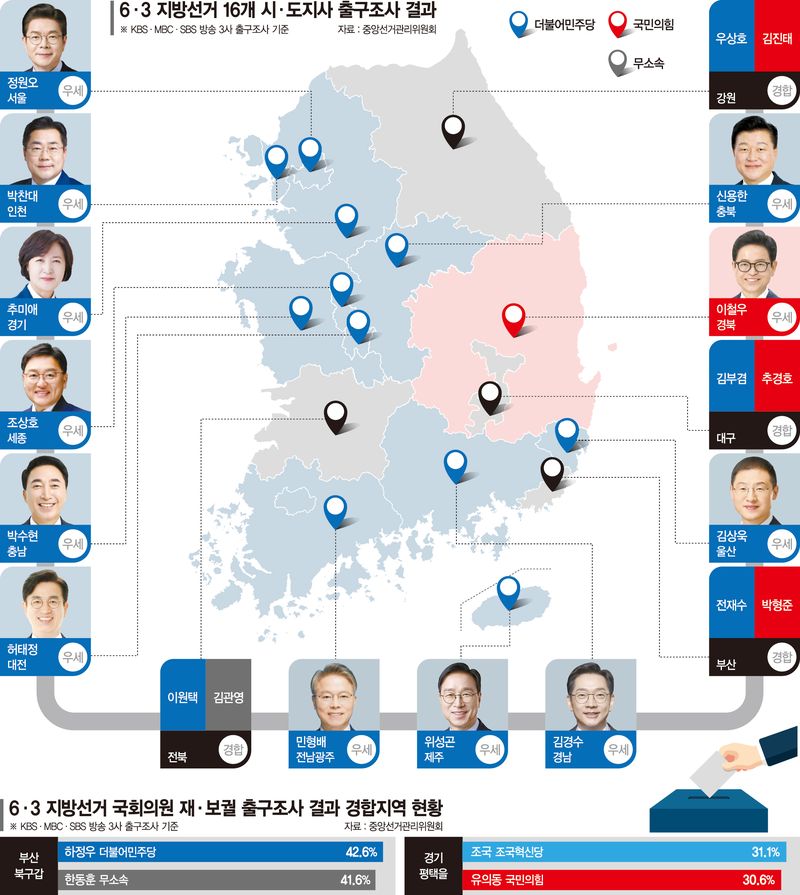
On the 3rd, exit polls from the three broadcasters showed the People Power Party clearly ahead only in the race for North Gyeongsang Province governor, where Lee Cheol-woo was the candidate. In the remaining metropolitan and provincial governor races, the DPK was either far ahead or in close contests. The DPK was also leading in many superintendent of education races. The margin of error was within a 95% confidence level of plus or minus 1.7 to 4.1 percentage points, with races decided by 3.4 points or less classified as competitive.
The DPK was ahead in 11 races, including the Seoul mayoral race, the Incheon mayoral race, the Gyeonggi Province governor race, the Chungcheongnam-do governor race, the North Chungcheong Province governor race, the Daejeon mayoral race, the Sejong City mayoral race, the Ulsan mayoral race, the South Gyeongsang Province governor race, the Jeonnam-Gwangju Special Mayor race, and the Jeju governor race. The People Power Party was leading in only one race, the North Gyeongsang Province governor race.
In the Seoul metropolitan area, DPK candidate Jeong Won-oh led People Power Party candidate Oh Se-hoon by 5.4 percentage points, 51.4% to 46%. In Gyeonggi Province, DPK candidate Choo Mi-ae was far ahead of People Power Party candidate Yang Hyang-ja, 60.4% to 34.1%. In Incheon, DPK candidate Park Chan-dae also led People Power Party candidate Yoo Jeong-bok, 53.7% to 45.5%.
In the Chungcheong region, DPK candidates Heo Tae-jeong and Jo Sang-ho were far ahead in the Daejeon and Sejong mayoral races, with 55.9% and 64.3%, respectively, compared with 42.9% for Lee Jang-woo and 32.9% for Choi Min-ho of the People Power Party. In the Chungcheongnam-do and North Chungcheong Province governor races, DPK candidates Park Soo-hyun and Shin Yong-han were ahead of People Power Party candidates Kim Tae-heum and Kim Young-hwan, 52.1% to 47.9% and 56.2% to 43.8%, respectively.
In the Yeongnam region, DPK candidate Kim Sang-wook led the Ulsan mayoral race with 52.8%, well ahead of People Power Party candidate Kim Doo-gyum at 43.2%. In South Gyeongsang Province, DPK candidate Kim Kyoung-soo also outpaced People Power Party candidate Park Wan-su by nearly 10 percentage points, 54.3% to 45.7%.
The remaining Gangwon Province governor race and the Daegu and Busan mayoral races were projected to be close contests between DPK and People Power Party candidates. In the conservative stronghold of Gangwon Province, DPK candidate Woo Sang-ho and People Power Party candidate Kim Jin-tae were expected to be in a tight race, separated by 2.6 percentage points at 51.3% and 48.7%. In North Jeolla Province, DPK candidate Lee Won-taek was shown leading independent candidate Kim Kwan-young by just 2.2 points, 48.5% to 46.3%.
The most notable races were in Daegu and Busan, two areas that have traditionally leaned conservative. In Daegu, DPK candidate Kim Boo-kyum was projected to receive 49.1%, while People Power Party candidate Choo Kyung-ho was at 49.9%, a razor-thin gap of just 0.8 percentage points. In Busan, DPK candidate Chun Jae-soo was forecast to get 50.2%, narrowly ahead of People Power Party candidate Park Heong-joon at 48.3%.
[email protected] Kim Yun-ho Reporter