No major upset expected... Democrats may sweep the country except North Gyeongsang
- Input
- 2026-06-03 19:04:55
- Updated
- 2026-06-03 19:04:55
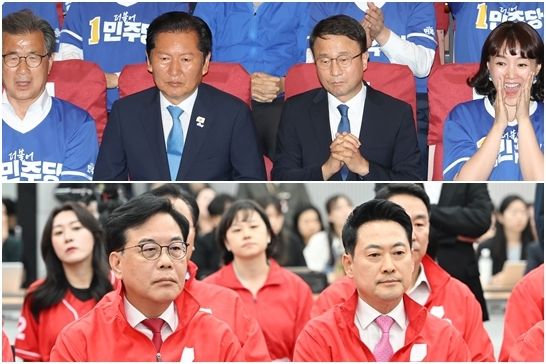
[The Financial News] The June 3 local elections began with the balance tilted toward the Democratic Party of Korea (DPK) after former President Yoon Suk Yeol was removed from office and the Lee Jae-myung administration took power. But according to exit polls, there were no major surprises. Exit polls from KBS, MBC, and SBS suggested that the DPK could win all metropolitan and provincial governors' races except in North Gyeongsang Province. The polls also projected that most superintendent of education races could go to progressive candidates.
In the exit polls released by the three broadcasters on the 3rd, the People Power Party was clearly ahead only in the North Gyeongsang gubernatorial race, where candidate Lee Cheol-woo held a strong lead. In the remaining metropolitan and provincial races, the DPK either led by a wide margin or was in a close contest. Many superintendent races also showed the DPK ahead. The margin of error was within a 95% confidence level of plus or minus 1.7 to 4.1 percentage points, with races decided by 3.4 points or less classified as too close to call.
The DPK was ahead in 11 races, including the Seoul mayoral race, Incheon mayoral race, Gyeonggi Province governor race, South Chungcheong governor race, North Chungcheong governor race, Daejeon mayoral race, Sejong mayoral race, Ulsan mayoral race, South Gyeongsang governor race, Jeonnam-Gwangju Integrated Metropolitan City race, and Jeju governor race. The People Power Party led in only one race, the North Gyeongsang governor race.
In the Seoul metropolitan area, DPK candidate Jeong Won-oh led People Power Party candidate Oh Se-hoon by 5.4 points, 51.4% to 46.0%, in the Seoul mayoral race. In Gyeonggi Province, DPK candidate Choo Mi-ae was far ahead of People Power Party candidate Yang Hyang-ja, 60.4% to 34.1%. In Incheon, DPK candidate Park Chan-dae also led People Power Party candidate Yoo Jeong-bok, 53.7% to 45.5%.
In the Chungcheong region, DPK candidates Heo Tae-jeong and Jo Sang-ho led the Daejeon and Sejong mayoral races with 55.9% and 64.3%, respectively, well ahead of People Power Party candidates Lee Jang-woo and Choi Min-ho, who had 42.9% and 32.9%. In the South and North Chungcheong governor races, DPK candidates Park Soo-hyun and Shin Yong-han were ahead of People Power Party candidates Kim Tae-heum and Kim Young-hwan, 52.1% to 47.9% and 56.2% to 43.8%, respectively.
In the Yeongnam region, DPK candidate Kim Sang-wook was projected to dominate the Ulsan mayoral race with 52.8%, ahead of People Power Party candidate Kim Doo-gyum at 43.2%. In South Gyeongsang Province, DPK candidate Kim Kyoung-soo also led People Power Party candidate Park Wan-su by nearly 10 points, 54.3% to 45.7%.
The remaining Gangwon Province governor race and the Daegu and Busan mayoral races were forecast to be close contests between DPK and People Power Party candidates. In North Jeolla Province, DPK candidate Lee Won-taek and independent candidate Kim Kwan-young, who was expelled from the DPK, were also expected to be neck and neck.
In the conservative stronghold of Gangwon Province, DPK candidate Woo Sang-ho was projected to edge People Power Party candidate Kim Jin-tae by 2.6 points, 51.3% to 48.7%. In North Jeolla Province, DPK candidate Lee Won-taek was ahead of independent candidate Kim Kwan-young by just 2.3 points, 48.5% to 46.3%.
The most notable races were in Daegu and Busan, two cities traditionally known for strong conservative support. In Daegu, DPK candidate Kim Boo-kyum and People Power Party candidate Choo Kyung-ho were separated by just 0.8 points, with 49.1% and 49.9%, respectively. In Busan, DPK candidate Chun Jae-soo was projected to narrowly lead People Power Party candidate Park Heong-joon, 50.2% to 48.3%, a gap of 1.9 points.
The exit poll results for the superintendent of education races showed a pattern similar to the metropolitan and provincial governor contests. Progressive candidates were ahead in 11 areas, while conservatives led in only three. Two races were projected to be too close to call.
In the Seoul metropolitan area, progressive candidate Geun-sik Chung was projected to win 39.0% against conservative candidate Cho Jun-hyuk's 21.2%. In Gyeonggi Province, progressive candidate Ahn Min-seok was forecast at 58.2%, ahead of conservative candidate Im Tae-hee at 41.8%. In Incheon, progressive candidate Do Seong-hoon was expected to lead conservative candidate Lee Dae-hyung, 37.1% to 32.7%.
In the Chungcheong region, progressive candidate Lee Byeong-do was projected to get 34.1% in South Chungcheong Province, ahead of conservative candidate Lee Myung-soo at 25.0%. In Daejeon, progressive candidate Sung Kwang-jin was forecast at 33.2%, ahead of conservative candidate Oh Seok-jin at 26.4%. In North Chungcheong Province, conservative-leaning candidate Yoon Geon-young led progressive candidate Kim Seong-geun, 45.7% to 40.3%. In Sejong, progressive candidate Im Jeon-su and conservative candidate Kang Mi-ae were in a close race at 35.1% and 32.5%, respectively.
In the Honam region, progressive candidates Kim Dae-jung and Cheon Ho-seong in Jeonnam-Gwangju and North Jeolla Province were both ahead by more than 10 points. In the Yeongnam region, only conservative-leaning candidates Kang Eun-hee and Lim Jong-sik in Daegu and North Gyeongsang Province were dominant, with 51.5% and 45.0%, respectively. In Busan, Ulsan, and South Gyeongsang Province, progressive candidates Kim Seok-joon, Jo Yong-sik, and Song Young-gi were projected to lead.
In Gangwon Province, progressive candidate Kang Sam-young led conservative candidate Shin Gyeong-ho by nearly 10 percentage points, 43.8% to 35.2%. In Jeju, progressive candidate Ko Eui-sook and conservative candidate Kim Kwang-soo were expected to be in a tight race at 45.1% and 42.0%.
[email protected] Kim Yun-ho Reporter