Semiconductor Rally Shows No Signs of Slowing, with IT and Machinery Emerging as the Next Beneficiaries
- Input
- 2026-06-03 18:36:00
- Updated
- 2026-06-03 18:36:00
According to the Korea Exchange (KRX) on the 3rd, the KOSPI closed at 8,801.49 on the 2nd, up 108.85% from the start of the year at 4,214.17. However, the gains have not spread across the broader market. So far this year through the 2nd, only 375 of the 947 KOSPI-listed stocks, or 39.6%, have risen. By contrast, 555 stocks, or 58.6%, have fallen. In the KOSDAQ, 1,147 of the 1,799 listed stocks, or 63.8%, were down. Across the combined KOSPI and KOSDAQ market, 1,775 of 2,852 stocks, or 62.2%, have declined.
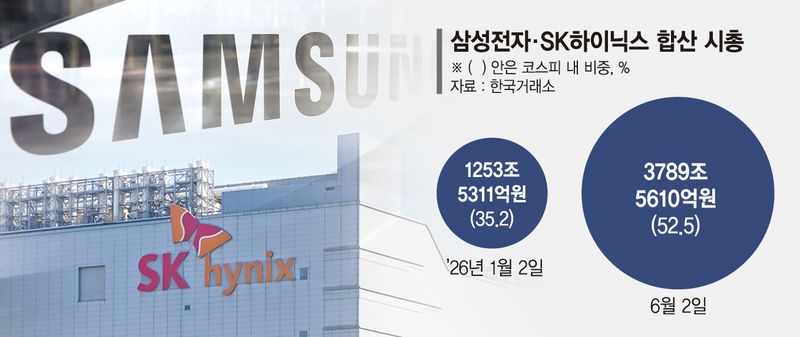
The concentration in market capitalization has also intensified. The combined market cap of Samsung Electronics and SK hynix rose from 1,253.5311 trillion won at the start of the year to 3,789.561 trillion won on the 2nd. Over the same period, their share of the KOSPI's total market capitalization jumped from 35.2% to 52.5%. In other words, the two stocks now account for more than half of the index's market value.
Retail money that has supported the recent rally has also been concentrated in large semiconductor stocks. Over the past month, from April 30 to June 2, individual investors bought a net 42.8653 trillion won worth of stocks on the main bourse. Of that amount, the top two net purchases were SK hynix at 16.2497 trillion won and Samsung Electronics at 11.4831 trillion won. Samsung Electronics preferred shares ranked eighth with 1.0559 trillion won, while LG Innotek, an IT hardware stock, came in fifth with 1.2602 trillion won. The four semiconductor and IT hardware names in the top 10 alone accounted for 30.0489 trillion won in net buying, or 70.1% of total retail net purchases.
Brokerages largely agree that semiconductors remain the market's core pillar. The reason is that rising investment in artificial intelligence is driving demand across hardware, including data centers, servers, memory, and substrates, making it difficult for the semiconductor-led trend to reverse in the near term.
Lee Sang-yeon, a researcher at Shinyoung Securities Co., Ltd., said, "Although the leadership of a small number of AI value chain sectors in the domestic market has persisted for a long time, I do not think the current strength in the stock market should be viewed simply as the result of concentrated liquidity." He added, "As long as the industrial structure in which bottlenecks in AI hardware move from advanced packaging to HBM, CPU, and substrates remains in place, it will not be easy for the hardware-led market to change quickly."
Since the semiconductor-driven trend is unlikely to fade easily, the search for the next leading stocks is seen less as a rotation of market leaders and more as a selection of late-stage beneficiaries. Brokerages are focusing on sectors such as Information Technology (IT) hardware, IT appliances, machinery, and construction, where recent share price gains have already reflected expectations. Still, these sectors face high valuation pressure, and the key issue is whether actual earnings improvements can justify current prices.
Lee Jeong-bin, a researcher at Shinhan Securities, said, "Given the large share that Samsung Electronics and SK hynix account for in KOSPI earnings, semiconductors still need to be treated as a core sector." He added, "For IT hardware, IT appliances, machinery, and construction, which are being mentioned as candidates for the next leading stocks, growth expectations have already been priced in, so we need to check whether actual earnings can justify current valuations."
[email protected] Bae Hangeul Reporter